AWS Announces Major Upgrade to Amazon EventBridge with Enhanced Custom Event Buses for Multi-Account Serverless Architectures

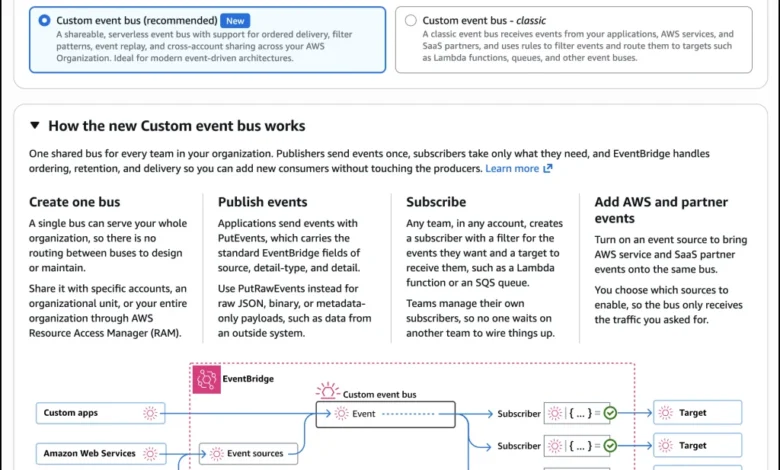
Amazon Web Services (AWS), a subsidiary of Amazon.com, has officially introduced a major enhancement to Amazon EventBridge, unveiling a purpose-built custom event bus designed to simplify and scale event-driven architectures across complex enterprise organizations. The newly launched feature addresses longstanding architectural friction points for development and platform engineering teams operating within multi-account AWS environments, offering a centralized shared bus, native event ordering, unified subscriber management, and a revamped economic pricing model.
The introduction of the enhanced custom event bus marks a significant evolutionary step for serverless computing on the cloud platform. Historically, as organizations scaled their adoption of event-driven paradigms, architectures frequently outgrew the simplicity of a single custom event bus residing within one account. AWS best practices heavily advocate for a multi-account structure to enforce security boundaries, resource governance, and team autonomy. However, routing events across these isolated accounts previously required the deployment of multiple event buses tied together via intricate cross-account rules and bus-to-bus configurations. This reliance on workarounds inadvertently reintroduced the operational overhead and maintenance complexities that serverless infrastructure was originally engineered to eliminate. Furthermore, platform administrators experienced a dilution of visibility regarding who was subscribing to specific events, while cumulative routing charges compounded rapidly, complicating cost accountability.
Evolution of Serverless Event Routing and Chronology of Challenges
Event-driven architectures gained massive enterprise traction due to their decoupled nature, allowing microservices to communicate asynchronously by producing and consuming events without direct point-to-point dependencies. Amazon EventBridge established itself as a foundational serverless event bus service, routing data from custom applications, software-as-a-service (SaaS) applications, and native AWS services.
Despite its widespread adoption, the classic EventBridge configuration presented structural scaling bottlenecks. Teams requiring strict event ordering—such as logistics platforms tracking real-time vehicle telemetry or financial systems processing sequential ledger updates—were forced to build elaborate workarounds or integrate intermediary queueing services like Amazon Simple Queue Service (SQS) alongside Lambda functions. Additionally, managing permissions via AWS Identity and Access Management (IAM) policies across numerous accounts required meticulous coordination, often slowing down application deployment velocities as development teams waited for platform engineers to provision routing pathways.

Recognizing these systemic challenges, AWS engineering teams developed the enhanced custom event bus to consolidate event flows without sacrificing the security and isolation inherent to multi-account frameworks. The rollout represents months of iterative design focused on enterprise platform management, developer productivity, and economic optimization at scale.
Core Architectural Enhancements and Technical Capabilities
The newly available enhanced custom event bus introduces several foundational capabilities that radically alter how distributed teams interact with event streams.
Organization-Wide Resource Sharing via AWS RAM
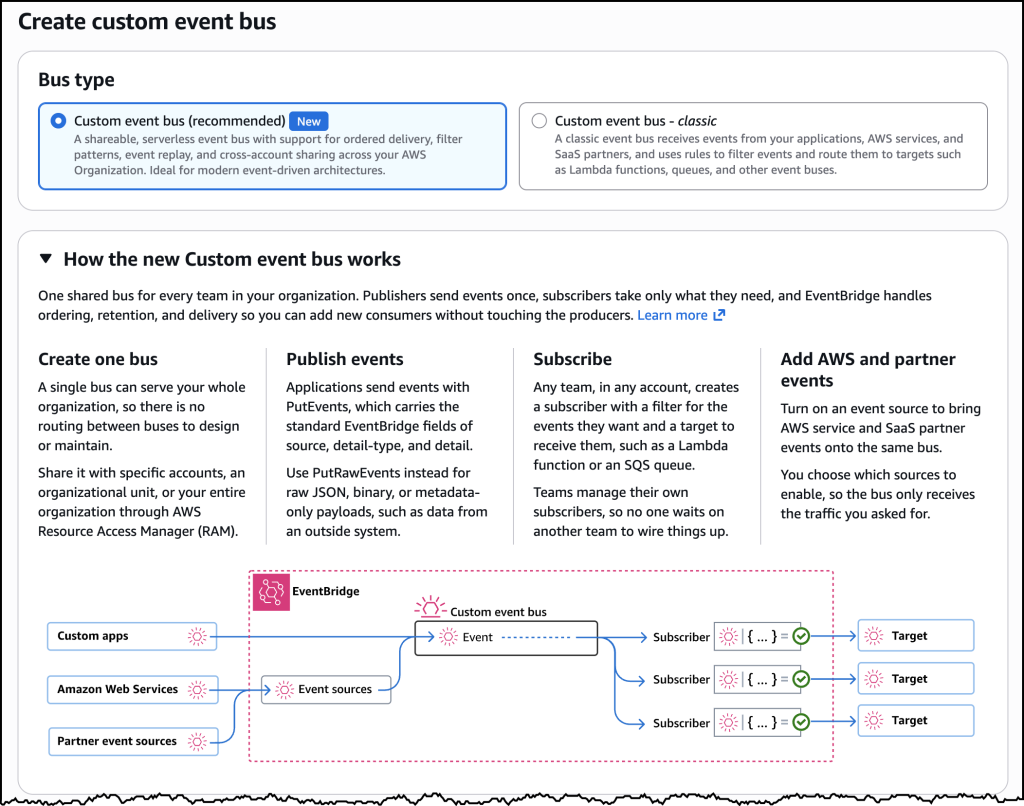
At the heart of the release is a centralized event bus model that can be deployed once by a platform team and shared seamlessly across all AWS accounts within an entire AWS Organization. Leveraging integration with AWS Resource Access Manager (AWS RAM), administrators can share the bus across specific accounts, organizational units, or IAM principals without manually configuring complex cross-account resource policies or brittle bus-to-bus routing rules. Publishers push events onto the central fabric without needing to know the downstream consumers, while application teams independently establish their own subscriptions. The architecture supports a default quota of up to 10,000 subscribers per bus, mitigating the historical necessity of fragmenting workloads across multiple discrete event buses.
Native Event Ordering and Synchronous Target Processing
While asynchronous execution remains the optimal design pattern for most event-driven workloads, certain business domains demand strict sequential processing. The enhanced custom event bus bridges this gap by supporting hybrid routing models on a single bus. Publishers can attach an EventGroupId parameter to payloads. EventBridge ensures that events sharing the same identifier are delivered sequentially to subscribers opting for ordered delivery, while other consumers on the same bus continue to receive payloads asynchronously.
To support this determinism, AWS has integrated synchronous invocation modes for compute targets such as AWS Lambda. This synchronous pathway confirms successful downstream processing before acknowledging event receipt, effectively eliminating the need for intermediary buffering mechanisms in scenarios where execution sequence is paramount.

Streamlined Subscriber Management and Advanced Data Transformation
The service introduces a unified Subscriber resource that consolidates event filtering patterns, target routing definitions, retry configurations, and dead-letter queue (DLQ) destinations into a single manageable entity. This contrasts sharply with legacy configurations, which required disparate rules and target settings spread across multiple cloud resources.
Moreover, the architecture addresses data compatibility challenges through built-in payload transformation and deserialization. Subscribers can deploy JSONata expressions to reshape event payloads dynamically before they reach downstream APIs. For organizations utilizing standardized serialization formats such as Apache Avro or Protocol Buffers, EventBridge can automatically deserialize payloads into JSON, empowering consumers to filter and route events based on deep payload inspection without executing custom parsing code.
Enhanced Reliability via Content-Based Deduplication
To combat duplicate event delivery resulting from network timeouts or transient retry mechanisms, the enhanced bus introduces native content-based deduplication. EventBridge hashes critical segments of the event payload, automatically collapsing identical messages arriving within a five-minute window. This capability grants publishers reliable, exactly-once delivery semantics for upstream sources incapable of generating their own idempotency tokens.
A Scalable Economic Model for Publishers and Subscribers
Financial governance and cost allocation have historically been pain points in multi-bus topologies, where cross-account routing fees accumulated rapidly. The enhanced custom event bus debuts a decoupled ingress and egress throughput pricing model designed to align costs with actual data utilization. Under this new structure, publishers incur charges based on ingested event volume, while subscribers pay for events successfully delivered to their designated endpoints. This transparent cost attribution model provides finance and cloud operations teams with granular visibility into resource consumption across different organizational units.
Industry Implications and Expert Analysis
Cloud infrastructure analysts and enterprise architects view the release of the enhanced custom event bus as a mature maturation of serverless event governance. By addressing the operational friction of multi-account topologies, AWS has effectively bridged the gap between developer autonomy and centralized platform oversight.
Industry observers note that the ability to enforce event ordering natively within a serverless event bus removes a significant architectural barrier for financial technology, supply chain, and telecommunications sectors, where out-of-sequence data processing can trigger costly operational errors. Furthermore, the integration of JSONata and automated schema deserialization reduces the custom integration code traditionally required to maintain microservice interoperability.
Availability and Deployment
The enhanced custom event bus is generally available today across a broad footprint of global AWS Regions, including US East (N. Virginia, Ohio), US West (Oregon), multiple European locations (Ireland, Frankfurt, Stockholm, Spain), and key Asia Pacific hubs (Hong Kong, Malaysia, Mumbai, Singapore, Sydney, Thailand, Tokyo).
Organizations can provision the new resource immediately through the AWS Management Console, the AWS Command Line Interface (AWS APIs), or infrastructure-as-code frameworks. Existing classic custom event buses remain fully supported and operational, allowing enterprises to migrate workloads to the enhanced architecture at an internal pace without disruption to legacy pipelines. Detailed technical documentation and pricing breakdowns are accessible via the official Amazon EventBridge portal.