Amazon ECS Gateway Streamlines Ingress Networking and Eliminates Infrastructure Bottlenecks for Containerized Workloads at Scale

Managing containerized applications at scale on modern cloud infrastructures has long presented platform engineering teams with significant operational hurdles, particularly regarding ingress networking. For years, operating workloads on Amazon Elastic Container Service (Amazon ECS) meant that every time a new microservice or containerized application was deployed, platform engineers had to meticulously provision, wire, and manage a complex array of underlying networking resources. This manual or semi-automated pipeline typically involved configuring Application Load Balancers (ALBs), generating and binding AWS Certificate Manager (ACM) SSL/TLS certificates, establishing AWS WAF web access control lists, and fine-tuning security groups.
As organizations scaled from a handful of services to hundreds or even thousands of distributed microservices, this per-service configuration overhead inevitably created a severe deployment bottleneck. Furthermore, maintaining synchronization across these discrete components as services scaled, updated, or decommissioned increased the risk of configuration drift, security vulnerabilities, and prolonged release cycles. To address these systemic pain points, Amazon Web Services (AWS) has officially announced the launch of Amazon ECS Gateway, a powerful new account-level resource designed to completely abstract and automate ingress networking for containerized workloads directly within the user’s AWS account.

Main Facts and Core Architecture of Amazon ECS Gateway
Amazon ECS Gateway introduces a clean, definitive separation of responsibilities between centralized platform teams and distributed application development teams. Platform teams can now establish centralized ingress controls, define security guardrails, and provision gateway resources once, while application teams simply attach their services to the gateway via simple connectors during deployment.
At its technical core, the ECS Gateway leverages host-based routing via Application Load Balancers, allowing up to 25 distinct containerized services to securely share a single ALB. This high-density consolidation significantly optimizes infrastructure costs by reducing the sheer number of idle or underutilized load balancers typically required in multi-tenant environments. Amazon ECS takes full operational ownership of the underlying infrastructure’s lifecycle. The system automatically provisions the initial ALB the moment a service connects, dynamically scales out by adding additional load balancers as capacity thresholds are reached, and safely tears them down when workloads scale in or are deleted. Upon successful provisioning, each connected service immediately receives a unique, ready-to-use DNS hostname and endpoint, eliminating traditional DNS propagation and manual mapping delays.
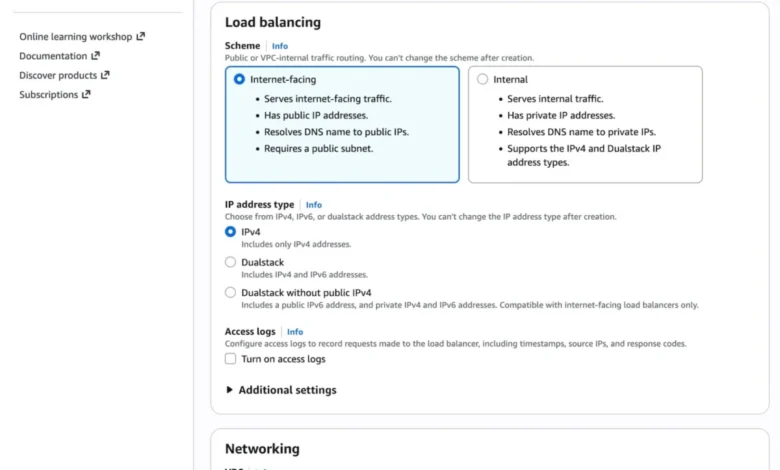
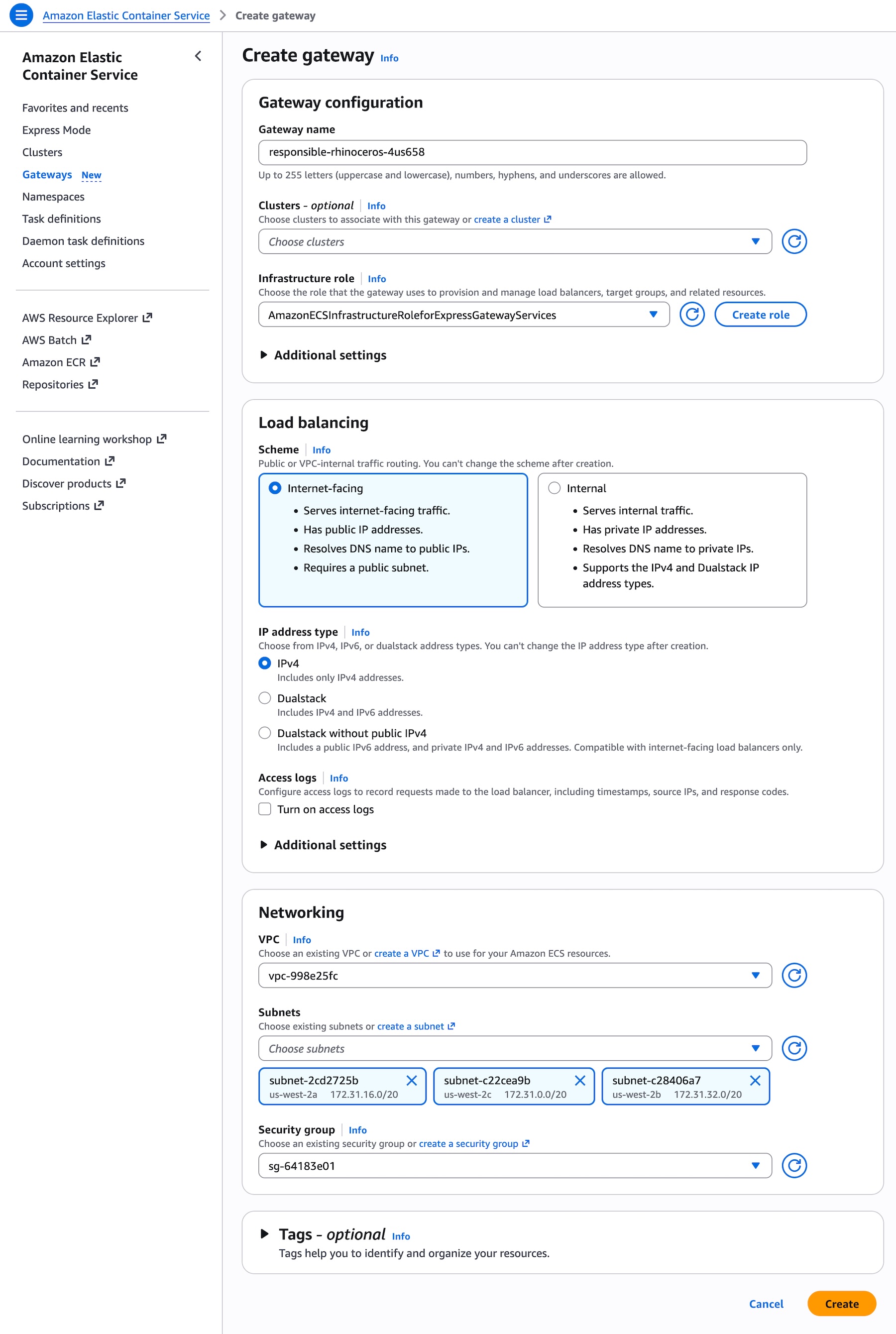
The architecture supports both public, internet-facing traffic routing and private, VPC-internal traffic routing, catering to diverse enterprise security postures. During the initial gateway creation phase—either via the AWS Management Console or the AWS Command Line Interface (AWS CLI)—administrators define an IAM infrastructure role that permits ECS to manage networking components securely inside their account. Parameters such as subnets, IP address types (supporting IPv4), listener protocols, and ports are securely bound to the gateway configuration. Once established, gateways can be mapped to as many as 10,000 distinct ECS clusters, while an individual cluster can associate with up to five different gateways. This many-to-many relationship gives enterprise architects exceptional flexibility to segment environments, designating distinct public and private gateways across complex organizational topologies.

Chronology and Implementation Workflow
The journey toward the release of Amazon ECS Gateway reflects years of iterative feedback from enterprise platform engineers who sought native alternatives to custom-built controllers or complex service mesh configurations. The development of the feature emphasizes seamless incremental adoption, allowing organizations with legacy or established architectures to transition without downtime.
To deploy an ECS Gateway programmatically, an administrator utilizes the AWS CLI CreateGateway API call, supplying a unique gateway name, the designated IAM infrastructure role ARN, and a comprehensive configuration block specifying subnet IDs and traffic schemes. Crucially, the system does not provision actual underlying infrastructure components like ALBs until an active service explicitly connects to the gateway via a gateway connector.
Once the gateway is active, administrators link it to target ECS clusters using the AssociateGatewayWithCluster command. Application teams can then modify their service definitions—either through CreateService or UpdateService API operations—to include a gateway connector configuration specifying port names, access type filters, and health check parameters. For existing services already bound to standalone load balancers, ECS Gateway supports a zero-downtime, incremental adoption path. Both ingress paths can run concurrently, enabling development teams to validate the new gateway routing and DNS resolution before safely deprecating and removing legacy load balancer configurations.
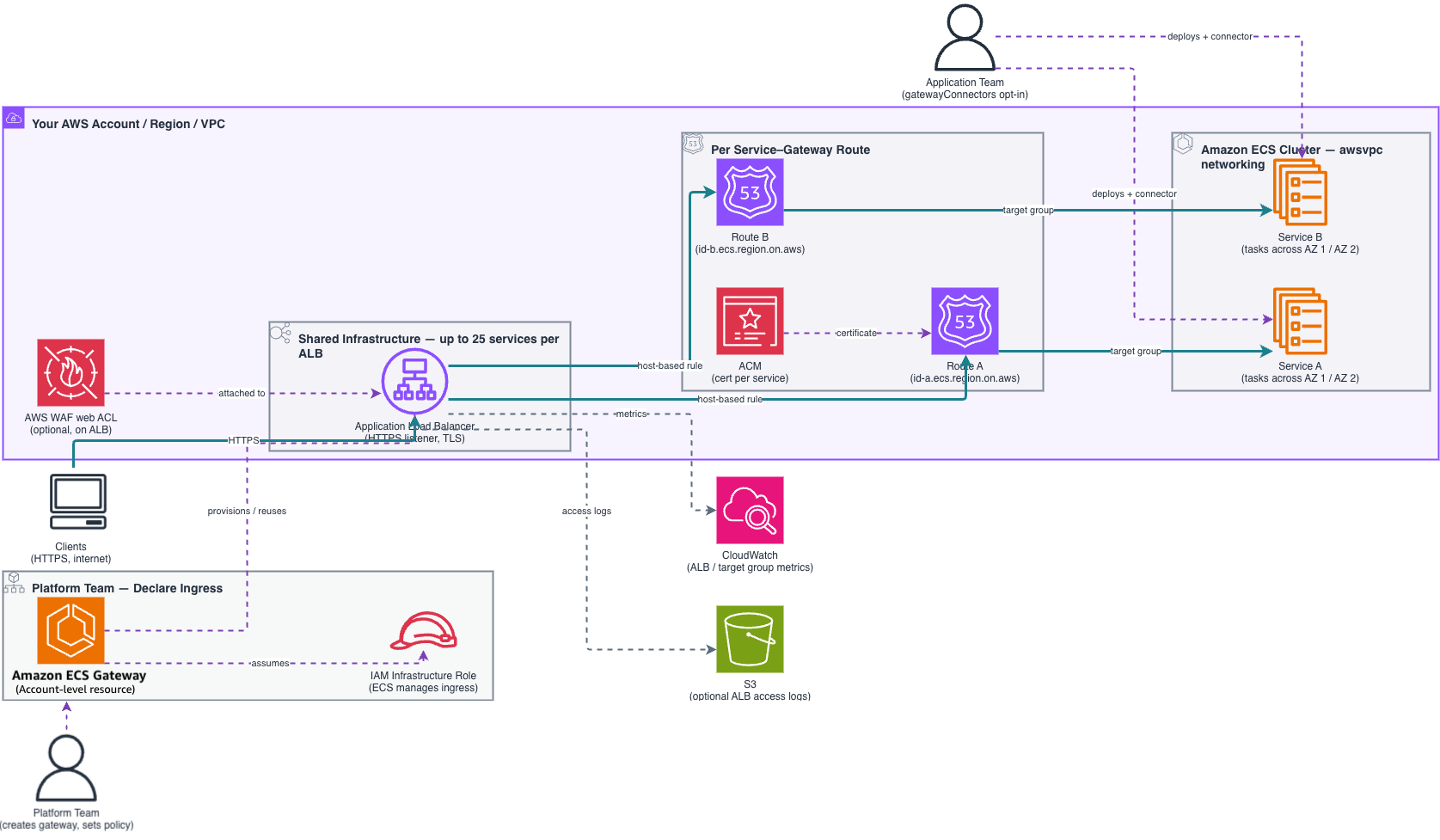
During deployment, Amazon ECS evaluates cluster-associated gateways, matching them against service connector filters, VPC boundaries, and Availability Zone coverage. Once matched, ECS automatically provisions the per-service resources, including ACM certificates, unique DNS hostnames, target group listener rules, and dedicated service security groups that restrict inbound traffic exclusively to the associated ALB security groups. When these components reach an active state, the service URL is immediately primed to process live production traffic. Furthermore, modern development workflows can leverage tools like the AWS MCP Server and integrated AI coding plugins to create, manage, and query ECS Gateway configurations programmatically.
Supporting Data, Economic Models, and Pricing
The economic implications of container scaling on public cloud infrastructure have always dictated that high resource density equals lower operational expenditure. By enabling up to 25 services to share a single Application Load Balancer under host-based routing, Amazon ECS Gateway directly reduces the fixed hourly costs associated with running dedicated load balancers for microservices architectures.
Amazon ECS Gateway itself is made available at no additional software or management charge to all customers. Organizations incur costs exclusively for the underlying AWS infrastructure resources that are dynamically provisioned within their accounts as services connect to the gateway. This consumption-based model includes standard charges for active Application Load Balancers, CloudWatch logs and operational metrics, AWS Certificate Manager (ACM) certificates, and standard inter-region or internet data transfer fees. This transparent pricing structure ensures that cost scaling remains directly proportional to application utilization and workload volume.
Broader Impact and Industry Implications
The introduction of Amazon ECS Gateway marks a significant maturation point in container orchestration and platform engineering paradigms. In recent years, the industry has witnessed a proliferation of complex tooling designed to bridge the gap between container runtimes and edge networking—ranging from Kubernetes ingress controllers and service meshes to bespoke Lambda-backed orchestration scripts. While these tools offered advanced routing capabilities, they frequently introduced steep learning curves and significant administrative overhead.
By baking advanced ingress automation directly into Amazon ECS, AWS is addressing the core tenets of Platform Engineering as a Service (PEaaS). Enterprises are increasingly moving away from forcing application developers to become networking experts. Instead, platform teams can codify organizational security and networking standards into a centralized ECS Gateway, empowering developers to deploy secure, externally accessible services with a single line of configuration.
This reduction in cognitive load directly translates into accelerated deployment velocities, minimized configuration errors, and tighter security postures. By automating the lifecycle management of certificates, security groups, and DNS endpoints, AWS has eliminated one of the most persistent friction points in cloud-native application delivery. As organizations continue to migrate mission-critical monolithic systems into scalable containerized environments, native capabilities like ECS Gateway will serve as foundational building blocks for enterprise-grade agility, operational resilience, and cost optimization.