The landscape of software development has undergone a profound transformation with the mainstream accessibility of autonomous AI coding agents. Historically restricted to enterprise organizations or developers willing to absorb the high costs associated with proprietary API subscriptions, advanced AI development assistants are now accessible to a broader audience. Today, developers and hobbyists alike can leverage sophisticated systems capable of repository inspection, file editing, terminal execution, and automated debugging without incurring upfront financial costs. This democratization of technology stems from a convergence of open-source model proliferation and competitive strategies by major artificial intelligence laboratories, lowering the barrier to entry for agentic programming.
Background and Context of the Agentic AI Revolution
The evolution of software engineering assistants has shifted rapidly from simple code completion tools—such as basic syntax highliners and autocomplete utilities—to autonomous agents capable of multi-step reasoning and execution. Early developer tooling required continuous human intervention for every line of code written or error resolved. However, the maturation of large language models (LLMs) with advanced coding benchmarks has enabled the creation of agentic frameworks. These frameworks can run locally or in cloud environments, plan complex operations, execute shell commands, run comprehensive test suites, and autonomously correct errors until a feature or bug fix is fully realized.
Despite these advancements, economic friction has remained a primary obstacle for independent developers. Premium coding assistants often demand subscription fees ranging from twenty to forty dollars monthly, alongside separate metered API consumption charges for high-performance frontier models. This financial gatekeeping stifled experimentation among students, open-source contributors, and developers in developing economies. Recognizing this market gap, several platforms, open-source projects, and enterprise providers have introduced robust free tiers, promotional model hosting, and integrated zero-cost access points, allowing users to experience state-of-the-art software engineering agents entirely free of charge.
Comprehensive Overview of Free AI Coding Agents
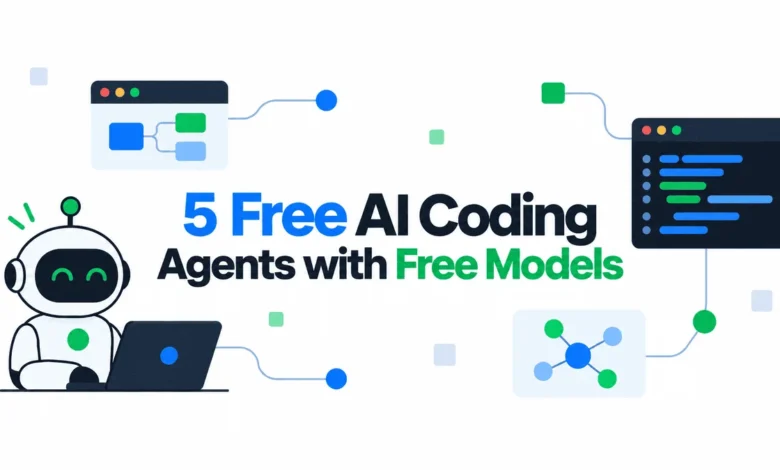
To navigate the expanding ecosystem of no-cost development agents, developers must evaluate tools based on their interface preferences, model flexibility, and rate-limit structures. The following platforms represent the leading options available for zero-cost agentic coding in 2026.
| Coding Agent | Free Model Access | Best For |
|---|---|---|
| OpenCode | OpenCode Zen free models | Best overall performance and model variety |
| Gemini CLI | Gemini free quota | Best free allowance via proprietary models |
| Kilo Code | Kilo Gateway free models | Best variety and automatic model routing |
| Cline | Cline Provider free models | Best for integrated development environment (IDE) users |
| Crush | Charm Hyper free tier | Best terminal-native experience |
1. OpenCode: Flexible Open-Source Repository Management
OpenCode has emerged as a premier terminal-based open-source coding environment designed for multi-step software development tasks. Operating directly within the command-line interface, the agent is equipped to explore directory structures, modify source files, execute system commands, and manage complex workflows independently.
The core advantage of OpenCode lies in its integration with OpenCode Zen. This feature provides direct access to a rotating catalog of free models without requiring users to configure external API providers or purchase usage credits. The platform frequently hosts capable open-source and experimental models, including variants from specialized labs such as Muse Spark, Ling, and NVIDIA Nemotron. While the specific model availability fluctuates based on promotional cycles and upstream updates, OpenCode Zen serves as a dynamic testing ground for developers seeking to experiment with emerging model architectures directly inside their native development workflows.
2. Gemini CLI: Direct Access to Google’s Proprietary Infrastructure
Google has positioned itself as a major provider of accessible AI infrastructure through the release of Gemini CLI, an open-source terminal coding agent engineered to interact directly with Google’s Gemini ecosystem. The utility allows developers to analyze repositories, edit files, and execute shell instructions without managing intermediate API keys or billing configurations.
By authenticating with an eligible Google account, developers gain access to Google’s robust model capabilities under the platform’s standard free tier allowances. While this offering eliminates financial barriers, users must account for operational constraints. The free tier is subject to strict rate limits and usage quotas, making it exceptionally well-suited for rapid prototyping, educational exploration, and targeted debugging tasks, though less reliable for continuous, heavy-load production environments.
3. Kilo Code: Multi-Platform Ecosystem and Automated Routing
Kilo Code began as an extension-based assistant for Visual Studio Code before expanding into a comprehensive multi-platform ecosystem. Currently supporting VS Code, JetBrains IDEs, command-line interfaces, and cloud environments, Kilo Code offers extensive architectural flexibility. Crucially, the platform supports hundreds of distinct models, preventing developer lock-in.
The standout feature for cost-conscious developers is Kilo Gateway’s inclusion of frequently hosted free models. Users can filter the model selection menu by searching for designated free options. Furthermore, Kilo Code introduces an automated routing system designated as Auto Free (kilo-auto/free). Instead of forcing users to manually track which models are currently operating under zero-cost promotions, the system dynamically routes requests to the most optimal available free model. This automated load balancing minimizes friction, allowing developers to focus entirely on code architecture rather than infrastructure management.
4. Cline: Advanced IDE Integration and Granular Control
For developers who prefer traditional graphical user interfaces over command-line tools, Cline provides a robust agentic workflow embedded directly within modern Integrated Development Environments. The agent systematically inspects codebases, authors and modifies files, executes terminal diagnostics, runs automated test suites, and iteratively refines solutions until designated criteria are met.
A key differentiator for Cline is its transparency. The agent explicitly outlines its proposed actions, requiring developer approval before executing critical file alterations or running terminal commands. Through the Cline Provider infrastructure, users can access rotating selections of free models marked explicitly within the IDE’s model picker. Although these options carry standard usage constraints, they provide a secure, low-risk environment for engineers to evaluate agentic software engineering capabilities without financial commitment.
5. Crush: Polished Terminal-First Engineering
Developed by Charm—the engineering team recognized for terminal utilities such as Bubble Tea and Gum—Crush delivers a highly refined terminal-native coding experience. Designed with careful attention to user interface design, Crush functions as a fully realized coding agent supporting file manipulation, shell command execution, Language Server Protocol (LSP) integration, and Model Context Protocol (MCP) servers.
Through its proprietary model provider, Charm Hyper, Crush features a built-in free tier that supplies users with a monthly allotment of Hypercredits. This allocation enables developers to install the terminal utility, authenticate via Charm Hyper, and immediately engage in agentic coding tasks without procuring external API credentials. The predictable monthly credit replenishment makes Crush an appealing option for terminal-centric workflows.
Industry Implications and Future Outlook
The democratization of agentic coding tools carries significant implications for the broader software development industry. By removing financial barriers to entry, platforms offering free model access lower the threshold for digital literacy and technical capability. Junior developers, students in emerging markets, and independent open-source maintainers gain access to productivity enhancements previously restricted to well-funded corporate entities.
However, relying on zero-cost tiers introduces specific operational challenges. Free models are inherently susceptible to sudden deprecation, fluctuating rate limits, and capacity bottlenecks during peak demand periods. Furthermore, data privacy policies associated with free-tier model hosting require careful evaluation by enterprises handling proprietary or sensitive codebases. Despite these limitations, the widespread availability of free agentic tools signals a permanent shift in software engineering education and tooling, establishing AI-assisted development as a standard utility rather than a luxury commodity.