The modern search engine optimization (SEO) landscape has evolved far beyond traditional keyword rankings and conventional blue-link search engine result pages (SERPs). As generative artificial intelligence (AI) platforms, large language models (LLMs), and answer engine optimization (AEO) tools fundamentally alter how internet users discover information, digital marketers face unprecedented visibility challenges. For decades, SEO professionals relied on straightforward diagnostic mainstays—such as the "site:" search operator in Google or Bing—to verify whether a specific web page had successfully entered a search engine’s index. These lightweight, reliable mechanisms were invaluable, particularly when direct administrative access to Google Search Console (GSC) or Bing Webmaster Tools (BWT) was unavailable. Similarly, checking for content indexing or syndication issues typically involved isolating a distinct, meaningful snippet of text, enclosing it in quotation marks, and executing a verbatim web query.
However, the rapid proliferation of conversational search agents and AI-driven retrieval systems has introduced a layer of opacity into web visibility diagnostics. Many modern AI search features do not offer granular, dedicated webmaster dashboards or real-time index-checking utilities for individual creators, making it significantly harder to diagnose why specific content is being ignored or omitted by algorithmic crawlers. Without direct access to comprehensive server log files, webmaster suites, or proprietary retrieval logs, digital marketers are often left guessing whether their pages are even being considered during a conversational AI’s retrieval-augmented generation (RAG) process.
To bridge this diagnostic gap, industry practitioners have begun developing creative, prompt-based workarounds. By leveraging the web-browsing capabilities of AI chat interfaces, site owners can perform functional audits to determine whether an AI model’s underlying retrieval system can locate, ingest, and cite their specific web URLs. While these methods cannot entirely replace robust technical infrastructure analysis, they provide an essential first-line triage technique for modern webmasters navigating the complexities of AI-first search visibility.
The Evolution of Search Indexing Diagnostics and Traditional SEO Constraints
Historically, verifying the presence of a web page within a search engine index was a routine, highly predictable technical task. The introduction of search operators allowed developers and site auditors to query domains directly, returning a snapshot of indexed URLs. When combined with verbatim quote-matching for unique textual blocks, these tools allowed content creators to immediately identify duplicate content, syndication issues, or stubborn crawl blocks caused by incorrect robots.txt directives or meta noindex tags.
As search ecosystems matured, Google Search Console and Bing Webmaster Tools became the definitive standards for site diagnostics, providing explicit performance metrics, index coverage reports, and security alerts. Yet, the paradigm has shifted dramatically with the mainstream adoption of generative AI systems. Platforms like ChatGPT, Perplexity, Claude, and Gemini increasingly act as direct intermediaries between users and web publishers. Instead of simply presenting a list of links, these systems retrieve information dynamically, synthesizing answers on the fly and citing sources based on complex vector embeddings and real-time web-search integration.
This shift presents a distinct hurdle for search marketers. When traffic from traditional search engines fluctuates or declines, and conversational AI tools fail to cite a brand’s newly published content, diagnosing the root cause becomes exceptionally difficult. Is the page missing because the AI’s web-retrieval crawler has not yet discovered it? Has the content been parsed but deemed insufficiently unique or authoritative? Or is a technical rendering error preventing the retrieval system from reading the underlying DOM elements? Without built-in diagnostic widgets in AI chat interfaces, publishers require a standardized methodology to test whether their digital assets clear the initial retrieval hurdle.
Developing a Prompt-Based Workaround for AI Retrieval Verification
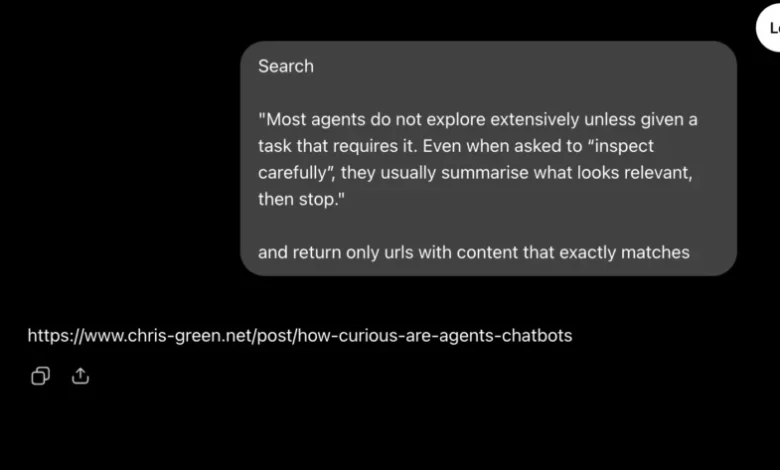
To address the lack of native diagnostic panels in conversational AI platforms, SEO specialists have adapted the traditional quote-matching technique for use within LLM chat interfaces. By providing a distinct, unambiguous string of text extracted directly from a target web page, auditors can instruct an AI model with active web-search capabilities to verify its presence in the live retrieval index.
The diagnostic process relies on precise prompting. Rather than asking an open-ended question about a brand or a general topic, the auditor inputs a specific snippet of text paired with a strict constraint. A standard diagnostic prompt typically follows this formulation:
Search for "paste your exact snippet here" and return any results which contain that exact text only.
When executed in an AI environment with active search capabilities—such as a signed-out instance of ChatGPT equipped with browsing tools—the model queries its underlying retrieval sources, evaluates the live web results, and attempts to locate the verbatim string. If the retrieval system successfully accesses the page, the AI’s output will generally surface the corresponding URL or reference the exact passage, confirming that the content has been successfully indexed and retrieved by the AI’s data-gathering architecture.
Industry case studies and practical testing demonstrate that this method yields remarkably consistent binary outcomes. If the AI model successfully returns the URL associated with the unique text snippet, site owners can draw several vital preliminary conclusions:
The web page has successfully navigated the discovery phase and been crawled by the AI system’s web-retrieval agents.
The content has been successfully processed, rendered, and stored within an accessible index or vector database utilized during live search queries.
The underlying server infrastructure is successfully serving the content to automated user-agents without triggering severe HTTP blocking or aggressive Cloudflare challenges that completely block retrieval.
Conversely, if the AI model fails to return the URL or claims it cannot find any matching text across the live web, the auditor is immediately alerted to potential technical barriers. These negative outcomes point toward several common troubleshooting priorities:
Discovery and Crawling Delays: The page may be too new, or internal linking structures may be too weak for the AI’s web crawler to have encountered the URL.
Rendering and Execution Failures: The content might rely heavily on client-side JavaScript that the retrieval crawler failed to execute properly.
Access Restrictions: Overly aggressive web application firewalls (WAFs), bot-mitigation tools, or strict robots.txt configurations may be actively blocking the AI’s fetching agents.
Insufficiency of Content: The textual block may lack the uniqueness required to stand out within the retrieval index, or the page may be structurally deemed low-value by the parsing algorithm.
Methodological Best Practices and Testing Margins of Error
While prompt-based retrieval testing offers a valuable operational workaround, technical SEO experts emphasize that it must be approached with a measured, analytical mindset. AI chatbot responses should never be interpreted as absolute, error-free technical truths. Modern conversational AI architectures frequently rely on diverse, rotating data sources and distributed API endpoints, meaning that a single query may not reflect the global state of an index.
To ensure data integrity, webmasters are advised to run diagnostic checks multiple times—typically four to five distinct iterations—particularly when initial results appear ambiguous or contradictory. Furthermore, changing the specific text snippet used in the prompt can help verify whether a localized caching issue or text length limitation skewed the initial output.
It is also critical to distinguish between retrieval and ranking. A web page successfully passing the prompt-based retrieval test confirms only that the content exists within the AI’s searchable database and can be fetched upon request. It does not guarantee that the content will be prominently featured or cited in response to broad, competitive user queries. If a page successfully clears the retrieval hurdle but fails to drive organic referral traffic or secure citations in AI-generated answers, the bottleneck is no longer technical indexing. Instead, it reflects deeper strategic challenges relating to content authority, topical depth, competitive differentiation, and the overall utility of the information relative to competing sources in the same vertical.
Automating the Audit Workflow: The Rise of Browser Extensions
Recognizing that manually copying text snippets, opening chat interfaces, and formatting verification prompts can quickly become tedious during large-scale site audits, developers have begun creating specialized productivity utilities. A notable example is "Exactly Matchy," an open-source developer extension hosted on GitHub designed to streamline the retrieval-checking workflow for technical SEOs.
Open-source utilities of this nature typically operate by integrating directly into the browser’s Document Object Model (DOM), allowing an auditor to highlight a specific section of text on any active web page and instantly dispatch it to an AI chat environment with predefined verification parameters. While such tools significantly accelerate the auditing process, cybersecurity and technical governance standards dictate caution. Industry leaders routinely remind digital marketers that installing third-party browser extensions—particularly those operating in developer mode outside official web store repositories—carries inherent security risks. Auditors must carefully review the underlying source code to ensure data privacy and prevent unintended data leakage before deploying such tools within enterprise environments.
Broader Implications for the Future of Technical SEO
The emergence of AI-driven search engines and conversational retrieval models marks a permanent structural shift in how digital information is indexed, evaluated, and presented. As traditional search engine result pages give way to synthesized answers and direct conversational responses, the traditional toolsets of search engine optimization must adapt to meet new realities.
While enterprise-grade analytics platforms, server log file analyzers, and official webmaster dashboards remain the gold standard for comprehensive technical audits, prompt-based retrieval testing provides an agile, accessible workaround for modern digital marketers. By combining traditional technical SEO principles with creative AI prompting techniques, site owners can maintain proactive oversight of their digital assets, ensuring they remain visible in an increasingly automated and conversational digital ecosystem.