How AI Skills Are Transforming Coding Agents from Functional Code Generators into Aesthetic Creators


The rapid proliferation of generative artificial intelligence in software development has fundamentally shifted how applications are built. Modern coding agents, powered by sophisticated large language models operating within environments like Claude Code, Cursor, and Codex, have proven exceedingly capable of producing functional, syntax-correct code. Yet, a persistent friction point has accompanied this technical capability: an acute deficiency in aesthetic judgment. By default, autonomous development agents routinely default to predictable, uninspired design choices—overusing generic UI tropes like gratuitous purple gradients, uniform rounded corners, and ubiquitous sans-serif fonts such as Inter, resulting in sterile interfaces that satisfy functional requirements devoid of creative conviction.
This design deficit is not a systemic failure of the underlying models, but rather a reflection of their training data and primary optimization targets. Without explicit design frameworks, an AI agent operates in a stylistic vacuum. However, the software engineering landscape is currently experiencing a paradigm shift with the introduction of "AI skills"—modular, markdown-based instruction sets and design system directories that can be seamlessly integrated into development agents. These configuration files inject rigorous aesthetic disciplines, ranging from classical typographical hierarchies and Swiss grid layouts to advanced color science, directly into an agent’s working vocabulary.
The Genesis of Algorithmic Taste
To understand the sudden emergence of design-focused AI skills, one must examine the evolution of developer-agent workflows over the past several years. Initially, artificial intelligence coding assistants were treated merely as auto-complete mechanisms or localized snippet generators. As context windows expanded and autonomous agents gained the ability to execute terminal commands, edit multiple files, and manage entire repositories, the bottleneck shifted from code writing to product presentation.
Industry data indicates that frontend development cycles consume a significant portion of engineering overhead, largely due to iterative visual corrections required to bring raw code up to production-grade design standards. Developers found themselves repeatedly correcting spacing anomalies, fixing poor contrast ratios, and smoothing out abrupt UI transitions that agents generated by default.
The introduction of markdown-based skill architecture—pioneered across various agentic platforms in late 2024 and accelerated throughout 2025—resolved this friction. Instead of manually prompting an AI with lengthy stylistic instructions for every new component, engineers could install persistent skill files that govern the agent’s behavioral guidelines, token definitions, and UI component libraries permanently. This transition mirrors the broader macro-trend in software architecture: moving configuration and styling rules from static, human-read design documents into executable, machine-readable specifications.
Comprehensive Overview of Essential Design Skills for AI Agents
As the ecosystem of available design skills expands, developers now have access to a robust toolkit of specialized packages. Each addresses a distinct pillar of digital product design, transforming how coding agents approach visual architecture.
-
OKLCH Color Skill: Eliminating Hue Drift in Algorithmic Palettes
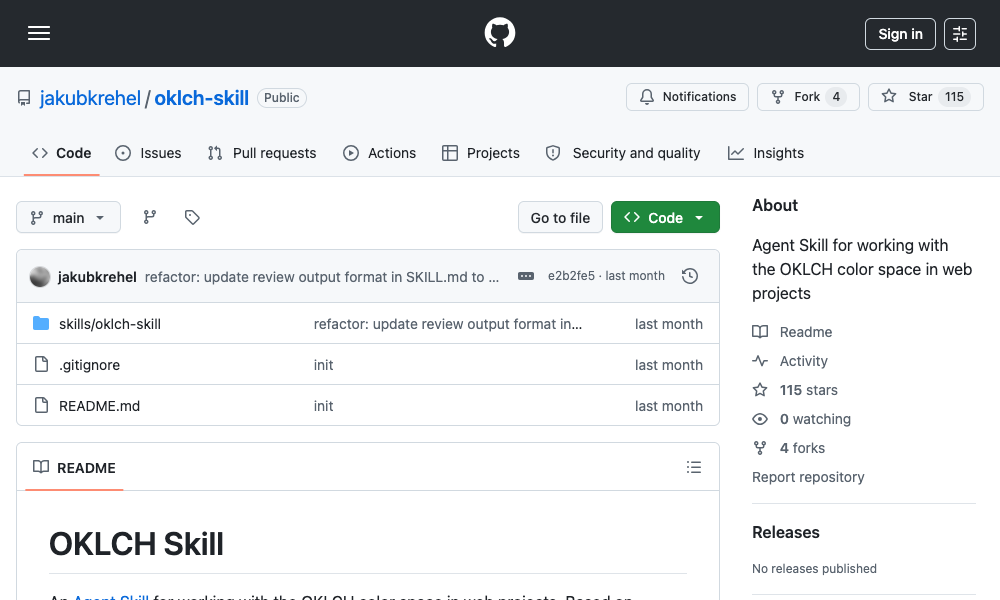
Managing color consistency across light and dark modes has historically been a trial-and-error process for both human developers and AI agents. Traditional color spaces like HSL often suffer from unpredictable hue shifts when lightness is manipulated. The OKLCH Color Skill addresses this by training agents to operate within the perceptually uniform OKLCH color space.
Installed via a straightforward command (npx skills add jakubkrehel/oklch-skill), the skill equips the agent to automatically calculate uniform palette scales from shade 50 to 950, perform mathematically sound dark mode adaptations, and verify accessibility compliance against rigorous WCAG 2 and SAPC-APCA standards. Furthermore, it natively formats these outputs into modern Tailwind CSS v4 tokens, ensuring that the visual output remains coherent regardless of system theme toggles. -
Swiss Design System Skill: Embracing Mathematical Grid Discipline
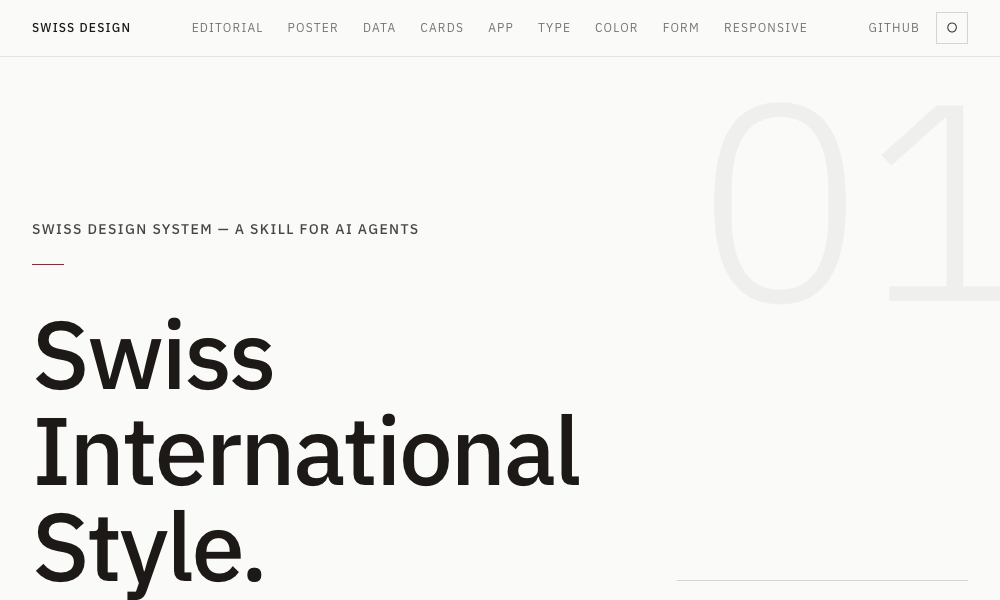
For projects requiring absolute structural clarity, editorial precision, and functional minimalism, the Swiss Design System skill brings the tenets of the Swiss International Style (International Typographic Style) to algorithmic generation. Utilizing grotesque typography such as Helvetica, Univers, and Neue Haas Grotesk, the skill enforces strict grid systems derived from design theorists like Josef Müller-Brockmann. Integrated vianpx skills add zeke/swiss-design-skill, the configuration forces agents to prioritize mathematical spatial relationships, generous whitespace, and restrained color palettes, proving exceptionally valuable for high-end landing pages and content-heavy editorial interfaces. -
Transitions.dev: Banishing Abrupt UI States
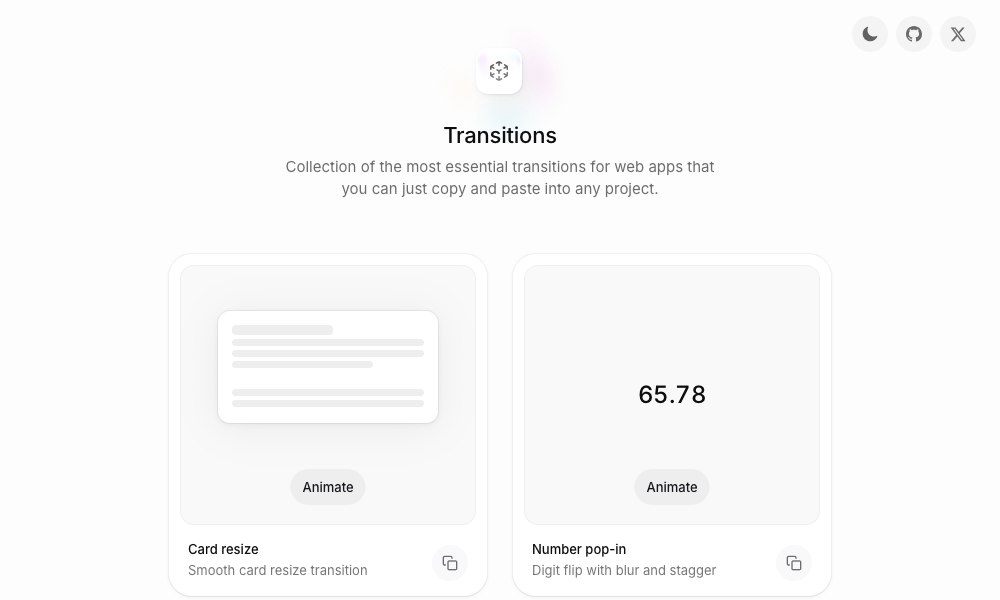
One of the most immediate indicators of AI-generated code is the jarring appearance of modal dialogs, dropdowns, and layout shifts that occur instantaneously without spatial context. Transitions.dev bridges this gap by bundling nine essential UI transition patterns—ranging from card resizing and number-flip counter animations to diagonal badge slides. Derived directly from production-ready CSS demonstrations, this skill allows developers to prompt their agents for specific motion curves, injecting fluid, performant micro-interactions into standard component codebases.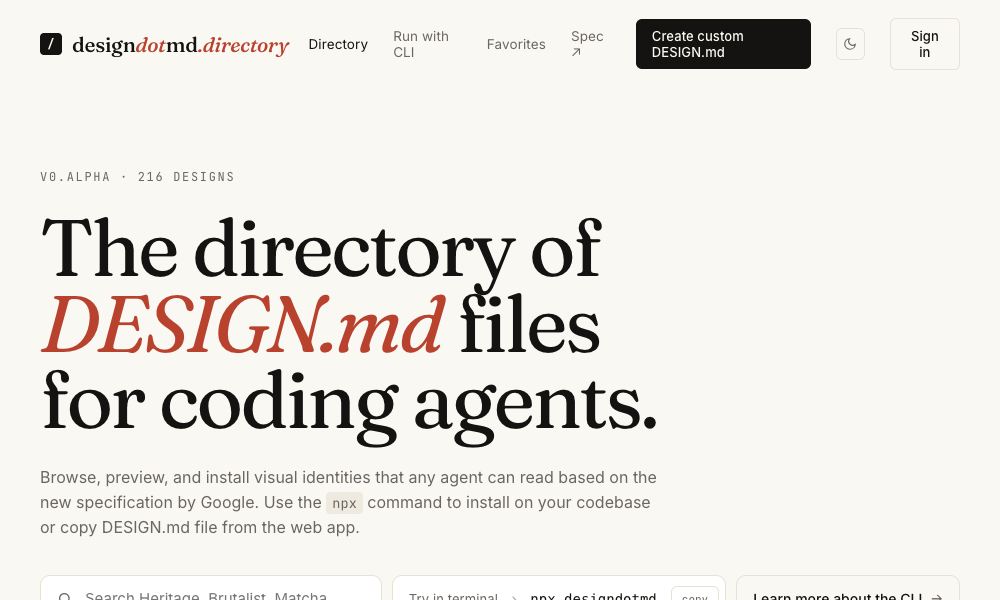
-
DESIGN.md Directory: Zero-Friction Aesthetic Integration
For teams seeking minimal configuration overhead, the DESIGN.md ecosystem offers a decentralized approach to agent styling. Rather than relying on command-line interfaces or package managers, developers simply drop a standardizedDESIGN.mdfile containing comprehensive typography rules, spacing scales, color tokens, and layout guidelines directly into their project’s root directory. Autonomous agents natively parse these markdown documents, adhering strictly to the embedded design language without requiring explicit per-prompt reminders. -
Agents with Taste: Codifying Micro-Interaction Philosophy
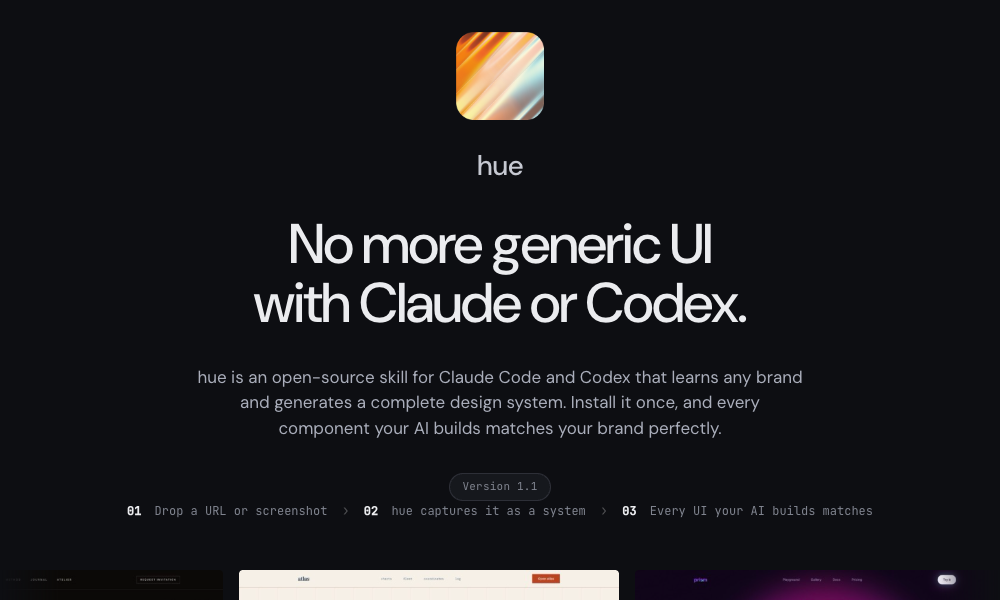
Authored by prominent design engineer Emil Kowalski, the Agents with Taste skill translates real-world design engineering principles into executable agent instructions. Available vianpx skills add emilkowalski/skill, this package provides precise easing curve decision trees, strict duration guidelines (distinguishing between 100-150ms micro-interactions and 200-300ms modal transitions), and typographical constraints such as strict character-per-line limitations for body copy. It encodes a distinct philosophy of modern, tactile web design directly into the agent’s execution loop. -
Hue: Reverse-Engineering Brand Identities from URLs
Maintaining brand fidelity when prototyping new features often forces engineers to manually extract design tokens from existing style guides. The open-source Hue application, developed by Dominik Martin, automates this reconnaissance. By pointing the skill at a target URL, brand name, or reference screenshot, the agent analyzes the visual identity and generates a complete, localized design system complete with custom YAML design models and preview HTML pages. This capability enables rapid prototyping that seamlessly mirrors established corporate identities.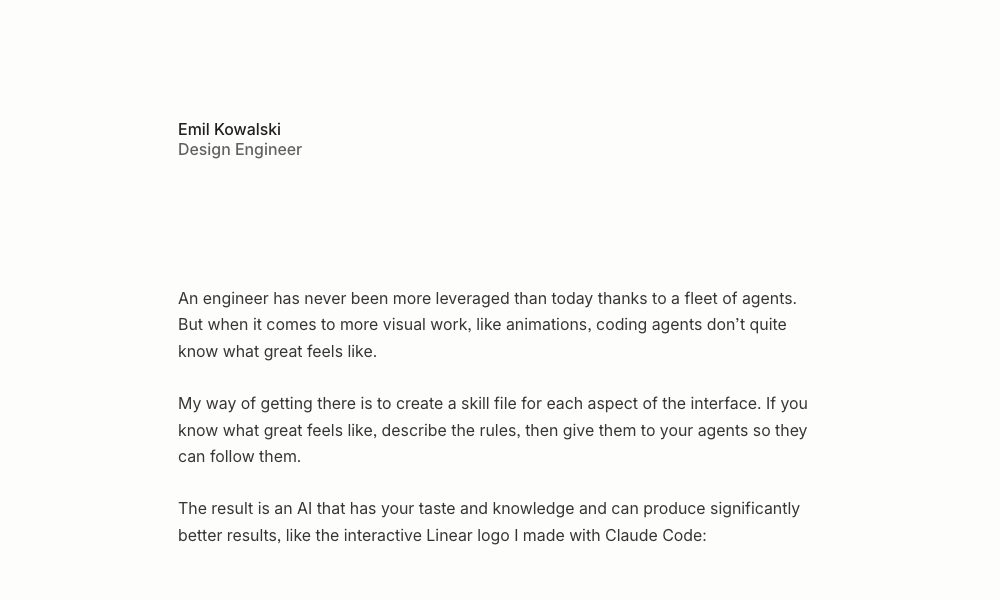
-
Refero Styles: Accessing a Library of Real-World UI Patterns
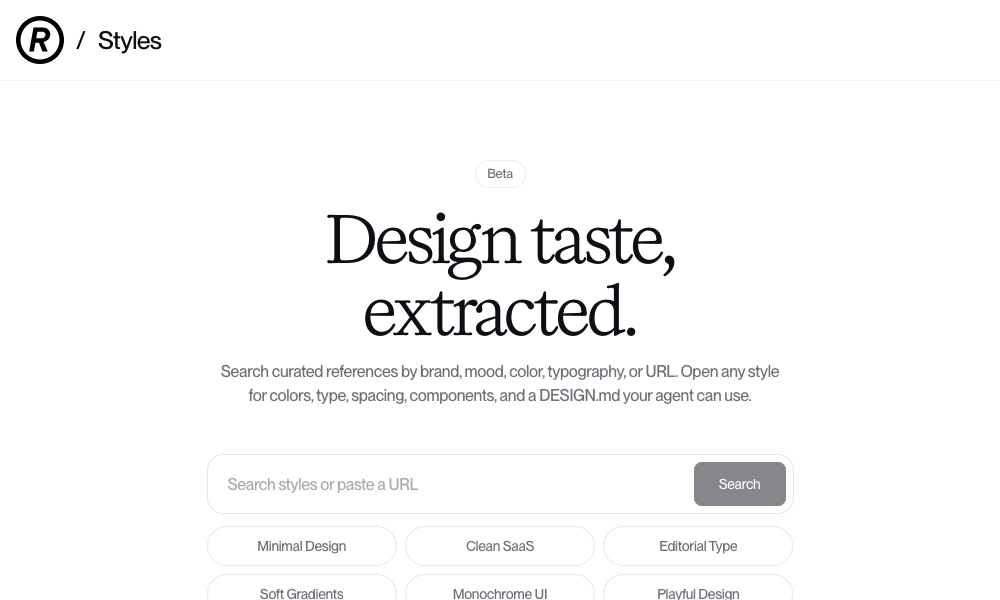
Bridging the gap between design inspiration and code implementation, Refero Styles connects AI agents to a vast repository of over 150,000 real application screens and user flows from industry-leading products like Stripe, Linear, and Notion. By utilizing the associated Model Context Protocol (MCP) server or importing pre-packagedDESIGN.mdconfigurations, developers can instruct their coding agents to emulate proven interface patterns drawn from production software rather than relying on abstract template guesses. -
TypeUI Design Skills and UI/UX Pro Max: Comprehensive Multi-Framework Generation
At the more complex end of the spectrum, packages like TypeUI Design Skills and the UI/UX Pro Max skill provide comprehensive engineering scaffolding. UI/UX Pro Max, featuring over 160 distinct reasoning rules and dozens of predefined UI aesthetics, operates as an end-to-end design system generator. Supporting React, Next.js, and Tailwind stacks, it evaluates project requirements—such as building a complex multi-step booking engine—and automatically establishes comprehensive layout hierarchies, component specifications, and accessibility safeguards.
Implications for the Future of Software Development and Design
The widespread adoption of executable design skills marks a structural evolution in the division of labor between human creatives and machine intelligence. Historically, design has functioned as a downstream asset—a set of static specifications handed off to developers who manually translated pixels into code, frequently encountering compromises along the way.
By shifting design knowledge into machine-executable rules, the industry is witnessing the emergence of design engineering as a primary interface for software creation. Designers are no longer limited to producing static mockups in vector-based tools; instead, they are increasingly tasked with authoring and refining the underlying rule sets, markdown definitions, and constraint matrices that govern how autonomous systems construct digital environments.
Industry analysts note that this evolution addresses one of the primary hurdles of enterprise AI adoption: brand dilution. As companies increasingly rely on automated coding agents to accelerate feature delivery, maintaining a cohesive, high-quality visual identity across distributed codebases has become a paramount concern. Executable design skills establish an algorithmic guardrail, ensuring that speed does not actively compromise brand integrity or user experience standards.
While the ecosystem remains in a rapid state of iteration—characterized by frequent specification updates and occasional interoperability challenges between competing agent frameworks—the overarching trajectory is definitive. The future of software generation belongs not to agents that simply write functional code, but to those equipped with the algorithmic taste to render it exceptionally. Developers and designers who master the authoring and deployment of these skills will effectively define the aesthetic standards of the next generation of digital products.