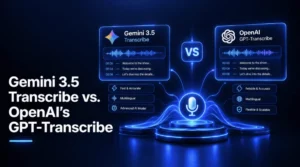
A Comprehensive Technical Comparison of Gemini 3.5 Transcribe and OpenAI GPT-Transcribe: Evaluating Speed, Accuracy, and Developer Ecosystems

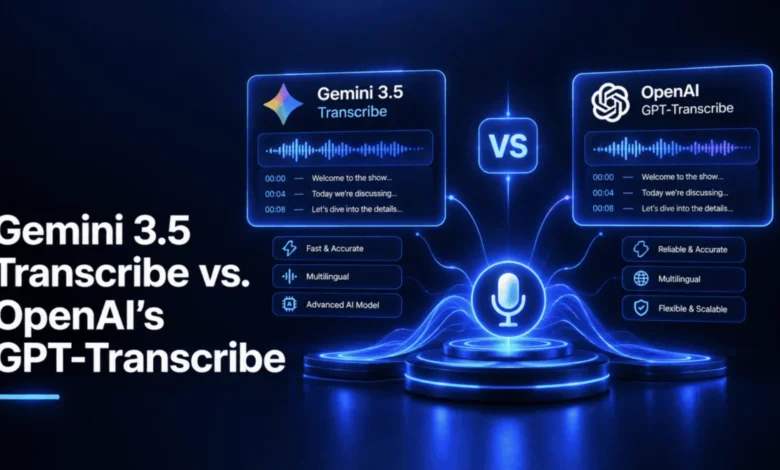
The artificial intelligence landscape witnessed a significant escalation in audio-to-text processing capabilities with the introduction of Google’s Gemini 3.5 Transcribe on August 26, 2026. This release arrived precisely four weeks after OpenAI deployed its own flagship audio processing model, GPT-Transcribe, on July 28, 2026. Because these two industry leaders launched competing transcription architectures within the exact same monthly window, developers and enterprise organizations are presented with a rare, synchronous evaluation opportunity. Rather than comparing disparate generations of technology, the industry can now directly assess how Google and OpenAI approach low-latency streaming and high-fidelity pre-recorded audio processing under near-identical market conditions.
Both artificial intelligence pioneers have structured their deployment portfolios identically. Each lab offers a dual-model architecture: one specialized variant engineered explicitly for real-time streaming applications and another optimized for deep, comprehensive processing of pre-recorded files. This structural parity allows for a rigorous, apples-to-apples performance analysis spanning word error rates, cost metrics, implementation complexity, and native feature sets. As voice-first interfaces, automated meeting assistants, and live-captioning services become ubiquitous across consumer and enterprise software, the underlying transcription layer has transformed from a commodity utility into a critical competitive differentiator.
Background Context and Architectural Evolution
The path to the 2026 transcription models reflects years of iterative engineering in speech recognition. Google’s Gemini 3.5 Transcribe serves as the official successor to Chirp 3, the company’s previous enterprise-grade speech-to-text offering. According to engineering disclosures accompanying the launch, Google focused its primary optimization efforts on reducing latency. The resulting model boasts a 70 percent improvement in time-to-final-transcription metrics compared to Chirp 3, alongside demonstrable gains in phonetic accuracy across diverse acoustic environments.
Rather than routing all requests through a monolithic, general-purpose endpoint, Google partitioned Gemini 3.5 Transcribe into two discrete model identifiers. The gemini-3.5-transcribe-live endpoint is architected for continuous, sub-second-latency streaming via the Live API, making it suitable for interactive voice agents and live translation. Meanwhile, gemini-3.5-transcribe is tailored for asynchronous workloads—such as processing multi-hour meeting recordings, customer service call logs, and archived audio files—via the Interactions API.
OpenAI’s trajectory mirrors this emphasis on modern deep-learning architectures over legacy systems. The organization’s foundational open speech model, Whisper, dominated the open-source community for years but has steadily been replaced by native GPT-integrated infrastructure. In March 2025, OpenAI introduced gpt-4o-transcribe, its first speech model built directly upon the multimodal GPT-4o architecture rather than traditional cascading acoustic-to-text pipelines. GPT-Transcribe, deployed on July 28, 2026, represents the next evolutionary step in this paradigm. OpenAI now formally recommends GPT-Transcribe over older iterations—including whisper-1, gpt-4o-transcribe, and gpt-4o-mini-transcribe—for all standard recorded speech applications operating in its original language. Similar to Google’s ecosystem, OpenAI provides a streaming sibling designated as gpt-live-transcribe to handle continuous, low-latency sessions.
Chronology of Releases
The summer of 2026 marked a concentrated period of commercial audio model rollouts, highlighting the rapid pace of advancement in multimodal artificial intelligence:
- July 28, 2026: OpenAI releases GPT-Transcribe and its real-time counterpart,
gpt-live-transcribe, positioning the model as the new default standard for developers seeking high-accuracy speech recognition paired with cost reductions over previous generations. - August 26, 2026: Google counters with the release of Gemini 3.5 Transcribe (
gemini-3.5-transcribeandgemini-3.5-transcribe-live), emphasizing a 70 percent speed increase over Chirp 3 and introducing native multi-speaker attribution and word-level timestamps without auxiliary model dependencies. - Late August to September 2026: Independent testing benchmarks, notably conducted by Artificial Analysis, begin publishing granular error rates and latency comparisons, fueling industry-wide discussions regarding architectural efficiencies.
Quantitative Performance and Accuracy Benchmarks
Evaluating audio transcription models requires examining standardized metrics, primarily Word Error Rate (WER), alongside speed, multilingual capabilities, and cost structures. Independent benchmarks provide an objective foundation for these comparisons.
According to data compiled by Artificial Analysis and highlighted in Google’s technical disclosures, Gemini 3.5 Transcribe achieves a 4.0 percent WER for streaming applications and an exceptionally low 2.6 percent WER for non-streaming, pre-recorded audio files. On the FLEURS multilingual benchmark—a rigorous evaluation dataset designed to test speech recognition across a vast array of languages—Google reports a 5.04 percent WER for non-streaming tasks and 5.50 percent for streaming tasks. The model natively supports over 85 languages, incorporates custom vocabulary weighting for domain-specific jargon, and possesses the unique capability to delegate secondary analytical tasks (such as image generation or deep file analysis) to other Gemini models via function calling, a feature already integrated into the macOS Gemini application.
OpenAI evaluates its models through expansive internal and standardized benchmarks. On its launch benchmark utilizing the Common Voice dataset across 22 distinct languages, GPT-Transcribe approximately halved the word error rate of the legacy whisper-1 model, reducing errors from 40.37 percent down to 19.27 percent. From a pricing perspective, OpenAI achieved a 25 percent cost reduction per minute compared to its direct predecessor. File transcription is priced at $0.0045 per minute, while the streaming variant (gpt-live-transcribe) is billed at $0.017 per minute of session audio. GPT-Transcribe accepts keyword hints and multiple language identifiers to assist with code-switching and domain-specific terminology, returning metadata regarding the detected languages.
However, a notable architectural divergence exists regarding secondary output features. Plain GPT-Transcribe does not natively execute speaker diarization or output word-level timestamps. To achieve speaker separation, developers must route audio through a separate model (gpt-4o-transcribe-diarize), while precise word-level timestamps still necessitate falling back on the older whisper-1 infrastructure. Conversely, Gemini 3.5 Transcribe includes robust, out-of-the-box multi-speaker attribution—reliably identifying up to three distinct speakers, with broader capabilities listed as experimental—alongside native word-level timestamps within a single API call.
Comparative Feature Matrix
| Feature | Gemini 3.5 Transcribe | OpenAI GPT-Transcribe |
|---|---|---|
| Release Date | August 26, 2026 | July 28, 2026 |
| Direct Predecessor | Chirp 3 | gpt-4o-transcribe |
| Streaming Endpoint ID | gemini-3.5-transcribe-live |
gpt-live-transcribe |
| File/Pre-recorded Endpoint ID | gemini-3.5-transcribe |
gpt-transcribe |
| Word Error Rate (WER) | 4.0% (Streaming) / 2.6% (Non-streaming) | ~19.27% on Common Voice (down from 40.37% on whisper-1) |
| Language Support | 85+ languages | 22+ benchmarked languages with keyword/language hints |
| Built-in Speaker Diarization | Yes (reliably up to 3 speakers) | No (requires separate gpt-4o-transcribe-diarize model) |
| Word-Level Timestamps | Yes (native) | No (requires legacy whisper-1) |
| File Pricing | Not published per-minute at launch | $0.0045 per minute |
| Streaming Pricing | Not published per-minute at launch | $0.017 per minute of session audio |
Practical Implementation Scenarios
To understand how these architectural differences manifest in real-world development, consider two distinct use cases: processing a multi-party business meeting and operating a low-latency live captioning feed.
Implementing Gemini 3.5 Transcribe for Multi-Speaker Meetings
In enterprise environments, transcribing a recorded conversation requires identifying individual speakers rather than generating an undifferentiated wall of text. Gemini 3.5 Transcribe accomplishes this natively without requiring auxiliary models or post-processing pipelines.
from google import genai

client = genai.Client(api_key="YOUR_GOOGLE_API_KEY")

with open("meeting_recording.mp3", "rb") as f:
    audio_bytes = f.read()

response = client.models.generate_content(
    model="gemini-3.5-transcribe",
    contents=[
        "text": "Transcribe this meeting with speaker labels and timestamps.",
        "inline_data": "mime_type": "audio/mp3", "data": audio_bytes,
    ],
)
print(response.text)
By supplying raw audio bytes alongside a natural language instruction, the gemini-3.5-transcribe endpoint returns structured output designating Speaker 1, Speaker 2, and Speaker 3, complete with temporal markers. This output can be consumed directly by downstream analytics pipelines, executive summarization tools, or Customer Relationship Management (CRM) synchronization scripts.
Implementing OpenAI GPT-Transcribe for Live Captioning
For real-time broadcasting, live events, or interactive voice assistants, low latency and incremental text generation take precedence over speaker diarization. OpenAI’s streaming architecture utilizes persistent WebSocket connections to deliver partial transcription updates as speech occurs.
import asyncio
import websockets
import json

async def stream_captions(audio_chunks):
    uri = "wss://api.openai.com/v1/realtime?intent=transcription"
    headers = "Authorization": "Bearer YOUR_OPENAI_API_KEY"

    async with websockets.connect(uri, extra_headers=headers) as ws:
        await ws.send(json.dumps(
            "type": "transcription_session.update",
            "session": "input_audio_transcription": "model": "gpt-live-transcribe",
        ))

        for chunk in audio_chunks:
            await ws.send(json.dumps(
                "type": "input_audio_buffer.append",
                "audio": chunk,
            ))
            message = await ws.recv()
            event = json.loads(message)
            if event.get("type") == "conversation.item.input_audio_transcription.delta":
                print(event["delta"], end="", flush=True)
This asynchronous routine streams audio buffers continuously. As the model processes incoming acoustic data, gpt-live-transcribe emits delta events containing incremental text strings. This design allows user interfaces to update caption displays dynamically in sync with the speaker, minimizing perceived system latency.
Industry Implications and Strategic Outlook
The rapid succession of releases from Google and OpenAI underscores a broader industry shift toward unified, multimodal foundation models that treat audio as a native modality rather than an afterthought translated via secondary pipelines.
For enterprise architects and software engineers, selecting between Gemini 3.5 Transcribe and OpenAI GPT-Transcribe depends heavily on the specific requirements of the application workflow. Google’s Gemini 3.5 Transcribe establishes a strong value proposition for complex, multi-speaker audio workloads—such as board meetings, medical dictations, and legal depositions—where native diarization and word-level timestamps eliminate the friction and additional latency of chaining multiple API calls together.
Conversely, OpenAI’s GPT-Transcribe provides a highly optimized, cost-effective solution for single-speaker transcription, translation, and real-time streaming applications where raw speed, aggressive per-minute pricing, and straightforward integration are paramount. As both companies continue to refine their inference efficiencies and expand language coverage, the competition between Google and OpenAI ensures that developers will benefit from compounding performance gains, lower error rates, and richer native feature sets throughout the remainder of the decade.