Why Chasing ChatGPT Traffic Is a Trap and How the Shift to Agentic Commerce Changes Search Marketing


The landscape of search engine optimization is undergoing a profound structural evolution, yet digital marketers continue to misallocate resources in pursuit of generative artificial intelligence visibility. Recent data analysis indicates that obsessing over referral traffic from standalone large language models like ChatGPT represents a strategic miscalculation. While these platforms generate higher conversion rates on a per-visitor basis, their overall volume remains negligible when compared to the traffic driven by traditional search engines. Industry experts argue that the modern optimization playbook must pivot away from standard generative engine optimization and toward the emerging paradigm of the agentic web, where search engines function as automated task coordinators and transaction processors.
Empirical Findings on LLM Traffic Versus Traditional Organic Search
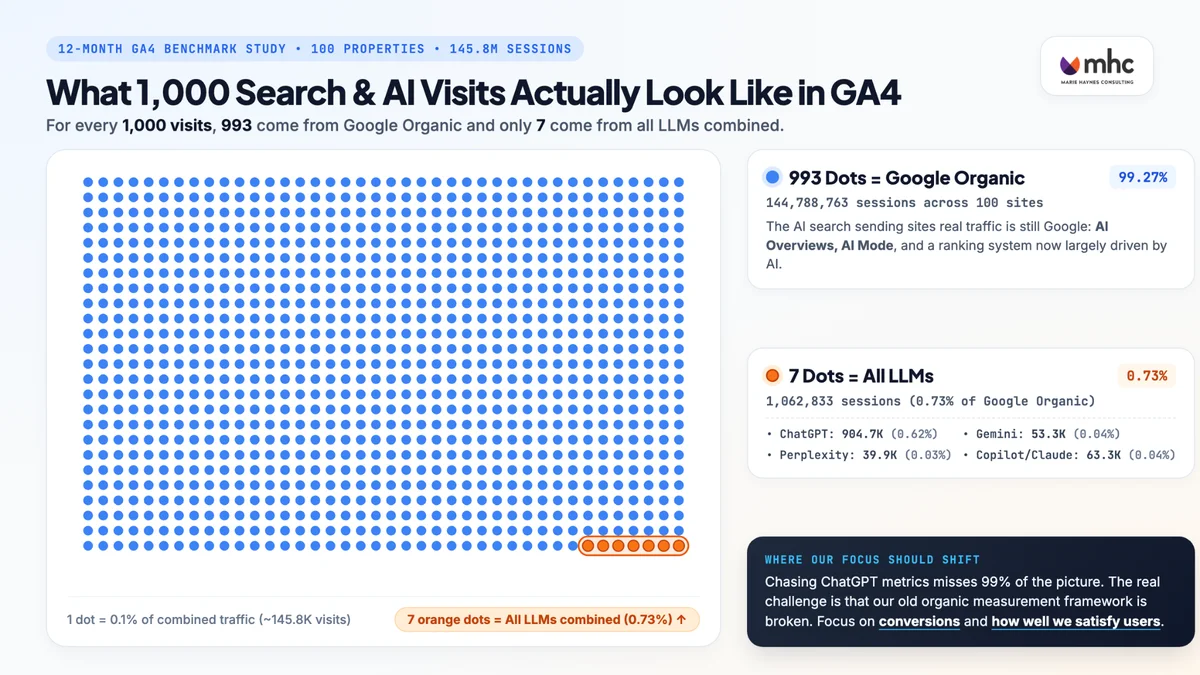
To quantify the actual impact of generative tools on web traffic, a comprehensive analysis of 12-month Google Analytics 4 data was recently conducted across 100 websites of varying scales, encompassing a combined total of over 145 million sessions. The findings challenge prevailing assumptions regarding the traffic-driving capabilities of conversational AI platforms. Sessions originating directly from ChatGPT accounted for a mere 0.62 percent of the volume generated by Google Organic search. When broadened to include all alternative large language models, the cumulative referral share rose only marginally to 0.73 percent.

Despite these low volume figures, qualitative behavioral metrics initially suggest a different dynamic. Among the subset of 55 properties actively tracking conversions within GA4, visitors arriving via ChatGPT demonstrated a conversion rate exceeding that of standard Google organic visitors by a factor of 4.5. Nevertheless, because the sheer volume differential remains vast—with Google organic traffic dwarfing AI referrals—Google ultimately accounted for 96.5 percent of total conversions across the evaluated channels. In absolute terms, Google organic search drove approximately 27 times more conversions than all monitored LLMs combined.
The Plateau of Conversational AI Referral Growth
The data also dispels early predictions of a sustained exponential trajectory for AI referral traffic. In the months immediately following the public rollout of conversational search tools, rapid growth in referral clicks led many analysts to project that LLMs would eventually eclipse traditional search engines. However, longitudinal tracking of the 100 sample properties indicates that this upward curve flattened significantly. Following the deployment of advanced model iterations in mid-2025, the exponential expansion of ChatGPT referral sessions reached a plateau, transitioning into a steady decline in referral visits sent directly to external publisher websites.
This deceleration aligns with broader shifts in user behavior. Modern search platforms increasingly provide synthesized answers directly within the interface, retaining users within the ecosystem rather than dispatching them to external links. Consequently, digital publishers relying purely on informational content capture have experienced noticeable contractions in organic click-through rates.
Google Retains Market Dominance Through Embedded AI Integration
Rather than visiting dedicated chat interfaces for informational discovery, everyday internet users are increasingly turning to AI-powered features natively embedded within traditional search environments. Features such as Google’s AI Overviews, advanced conversational modes, and deeply integrated core ranking algorithms powered by deep learning systems mean that millions of consumers perform AI-driven searches daily without ever navigating away from the primary search engine results page.
Industry analysts emphasize that while the mechanics of search engine results pages have shifted, Google remains the dominant gateway for commercial intent. The primary obstacle for modern digital marketers is not the absence of search demand, but rather the complexity of measurement. Standard rank-tracking metrics offer minimal predictive value, and Search Console data frequently lacks immediate operational utility. Analysts recommend that businesses shift their focus from superficial keyword positioning toward rigorous tracking of key conversion events and user satisfaction metrics. Because contemporary ranking algorithms heavily weigh deep learning signals that predict helpfulness, optimizing for genuine user utility aligns more closely with algorithmic objectives than mechanical optimization tricks.
The Emergence of the Agentic Web and Universal Commerce
As search platforms evolve from passive link directories into active task managers, the technological infrastructure supporting digital commerce is undergoing a radical redesign. Chief Executive Officers across major technology firms have noted that search is transitioning into an agent-first ecosystem where autonomous software agents execute complex workflows on behalf of human users. Several foundational protocols and technologies are accelerating this transition:

- Google Universal Cart: This infrastructure aggregates product catalogs from multiple retailers into a unified checkout interface housed within digital wallets. The system continuously monitors pricing adjustments, inventory levels, and promotional campaigns, allowing consumers to compile multi-vendor shopping carts and complete transactions natively without visiting individual merchant domains.
- Universal Commerce Protocol (UCP): Governed through collaborative frameworks involving major technology and commerce platforms, UCP establishes an open discovery layer that permits autonomous AI agents to compare disparate inventories and complete secure purchases while ensuring the merchant retains official record status.
- Web Model Context Protocol (WebMCP): This protocol enables websites to expose native interactive functionalities—such as dynamic pricing calculators, appointment schedulers, and multi-step forms—directly to AI agents through standardized declarative markup and imperative application programming interfaces.
- Intelligent Eyewear: The integration of multimodal AI systems into wearable hardware powered by advanced extended reality operating systems introduces ambient search capabilities. Consumers can interact contextually with their physical surroundings, allowing software agents to identify products, troubleshoot mechanical issues, or initiate purchases via voice and visual commands.
Strategic Implications for Digital Marketers
The transition toward an agentic web requires a fundamental reassessment of technical and marketing strategies. Traditional reliance on manual search engine optimization and basic generative engine positioning is increasingly viewed as a tactical distraction from core commercial drivers. To remain competitive, organizations must invest in structured data mastery, particularly within merchant data feeds and automated inventory protocols.
Marketers are encouraged to audit their digital infrastructure to ensure readiness for machine-readable discovery endpoints. By preparing product feeds for automated bundling, structuring interactive site features for agent accessibility, and aligning content strategies with deep learning satisfaction signals, businesses can position themselves to capture high-intent traffic in an environment where search engines coordinate commerce autonomously.