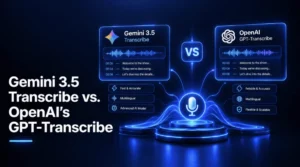
Google Gemini 3.5 Transcribe Versus OpenAI GPT-Transcribe: A Comprehensive Technical and Market Comparison

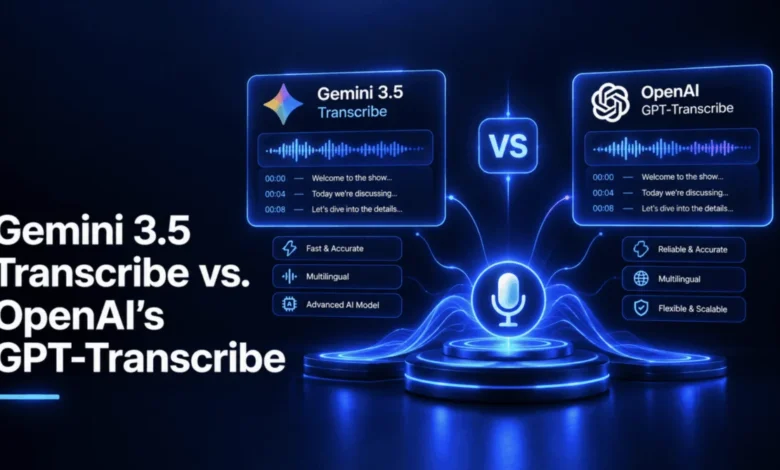
The landscape of automated speech recognition (ASR) experienced a significant shift in the summer of 2026, driven by back-to-back enterprise model releases from two of the artificial intelligence industry’s primary competitors. On July 28, 2026, OpenAI deployed its flagship transcription architecture, GPT-Transcribe, targeting improved efficiency and lower error rates for production audio workflows. Just four weeks later, on August 26, 2026, Google countered with the release of Gemini 3.5 Transcribe, a model designed to improve upon its predecessor, Chirp 3, by focusing heavily on end-to-end processing speeds, native multi-speaker attribution, and sub-second latency streaming.
Because these two systems arrived within a single month of each other, they represent a rare, synchronous generation gap in conversational AI. Rather than comparing legacy models to cutting-edge architectures, developers and enterprise procurement teams are currently evaluating two state-of-the-art ecosystems launched under nearly identical market pressures. Both companies have structured their commercial offerings into a dual-model framework—separating pre-recorded batch processing from real-time streaming infrastructure—thereby allowing for a direct, parallel analysis of their technical capabilities, cost structures, and practical application boundaries.
Evolution and Background Context: From Legacy Architectures to Modern Endpoints
The path toward current transcription models has been defined by a gradual departure from older, standalone neural network topologies toward unified, multimodal foundation models. For years, OpenAI’s Whisper served as the open-source benchmark for speech-to-text tasks. However, its heavy compute requirements and lack of native real-time streaming integrations prompted the introduction of gpt-4o-transcribe in March 2025, which shifted speech recognition onto a multimodal GPT-4o backbone. GPT-Transcribe, launched in late July 2026, represents the maturation of this paradigm, leading OpenAI to formally deprecate or recommend against its older iterations—including whisper-1 and gpt-4o-mini-transcribe—for standard native-language speech tasks.
Similarly, Google’s release of Gemini 3.5 Transcribe supersedes Chirp 3, moving away from conventional isolated ASR pipelines toward an integrated model framework. Google’s strategy relies on segmenting the product into two dedicated model identifiers: gemini-3.5-transcribe for asynchronous batch processing via the Interactions API, and gemini-3.5-transcribe-live for low-latency streaming applications through the Live API. OpenAI utilizes an equivalent functional split, dividing its architecture into gpt-transcribe for file inputs and gpt-live-transcribe for continuous WebSocket-based sessions.
This architectural alignment by both companies highlights an industry consensus: modern enterprise audio processing requires a bifurcated approach. Batch jobs, such as legal depositions, corporate earnings calls, and podcast archiving, demand high accuracy, rich metadata (such as timestamps and speaker labels), and fault-tolerant ingestion. Conversely, live captions, voice assistants, and real-time translation demand minimal time-to-first-token and predictable, continuous streaming streams.
Chronology of Releases
- March 2025: OpenAI introduces gpt-4o-transcribe, moving speech recognition to the GPT-4o multimodal architecture.
- July 28, 2026: OpenAI officially launches GPT-Transcribe (
gpt-transcribeandgpt-live-transcribe), significantly lowering word error rates and cutting per-minute costs relative to previous generations. - August 26, 2026: Google responds by releasing Gemini 3.5 Transcribe, touting a 70% speed improvement over Chirp 3 and introducing native multi-speaker diarization and word-level timestamps out of the box.
Quantitative Benchmarking and Performance Metrics
Evaluating speech-to-text models requires analyzing multiple metrics, most notably the Word Error Rate (WER), throughput latency, and multilingual robustness.
According to independent evaluations conducted by Artificial Analysis and cited in Google’s official documentation, Gemini 3.5 Transcribe achieves a word error rate of 4.0% for streaming use cases and 2.6% for non-streaming pre-recorded tasks. On the FLEURS multilingual benchmark—a more challenging evaluation dataset covering dozens of languages—Google reports a 5.50% WER for streaming and 5.04% for non-streaming pipelines. Furthermore, Google emphasizes a 70% reduction in time-to-final-transcription when compared directly to its predecessor, Chirp 3.
OpenAI’s performance metrics present a different optimization profile. In internal benchmarks measuring performance against the Common Voice dataset across 22 languages, OpenAI reported that GPT-Transcribe roughly halved the word error rate of the legacy whisper-1 model, dropping from 40.37% down to 19.27%.
| Feature / Metric | Gemini 3.5 Transcribe | OpenAI GPT-Transcribe |
|---|---|---|
| Release Date | August 26, 2026 | July 28, 2026 |
| Predecessor Model | Chirp 3 | gpt-4o-transcribe / whisper-1 |
| Streaming Endpoint | gemini-3.5-transcribe-live |
gpt-live-transcribe |
| Pre-recorded Endpoint | gemini-3.5-transcribe |
gpt-transcribe |
| Word Error Rate (WER) | 4.0% (Streaming) / 2.6% (Batch) | ~19.27% (Common Voice benchmark) |
| Language Support | 85+ languages natively | 22+ benchmarked languages with keyword/language hints |
| Speaker Diarization | Native (up to 3 speakers reliably) | Requires separate model (gpt-4o-transcribe-diarize) |
| Word-Level Timestamps | Native, included out-of-the-box | Requires legacy fallback (whisper-1) |
| File Processing Cost | Not published per-minute at launch | $0.0045 per minute |
| Streaming Session Cost | Not published per-minute at launch | $0.017 per minute |
Feature Parity: Diarization, Timestamps, and Multilingual Support
A critical differentiator between the two ecosystems lies in how auxiliary features—such as speaker diarization and word-level timestamps—are packaged.
Gemini 3.5 Transcribe integrates these capabilities directly into its primary pre-recorded endpoint. Users submitting audio files containing multi-speaker interactions can obtain speaker-attributed transcripts (reliably handling up to three speakers, with expanded experimental support) alongside precise word-level timestamps in a single API call, without needing secondary processing models. Additionally, the model natively supports over 85 languages, accepts custom vocabulary hints, and integrates with Google’s function-calling architecture to delegate downstream tasks, such as file analysis or image generation, directly to other Gemini models.
In contrast, OpenAI’s GPT-Transcribe prioritizes raw linguistic processing speed and cost efficiency. While it supports keyword hints, multiple language hints for code-switching environments, and automatic language detection, the base gpt-transcribe model does not natively perform speaker diarization or output word-level timestamps. To achieve speaker separation, enterprise pipelines must route audio through a separate model endpoint (gpt-4o-transcribe-diarize), and for exact word-level timing, developers must still rely on legacy components such as whisper-1.
Economic and Cost Analysis
Pricing models reflect differing commercial strategies. OpenAI has established a transparent, consumption-based pricing schedule for GPT-Transcribe: file-based transcription is billed at $0.0045 per minute, while the streaming variant (gpt-live-transcribe) costs $0.017 per minute of session audio. OpenAI notes that this structure represents a 25% cost reduction compared to its previous generation of transcription models.
Google’s pricing for Gemini 3.5 Transcribe relies on standard Gemini API billing tiers, with explicit per-minute rates remaining unbundled or tied to broader multimodal token consumption metrics at the time of publication. However, enterprise architects must factor in the hidden costs of auxiliary calls. Because Gemini includes native diarization and timestamping within a single inference request, it eliminates the computational overhead and API latency of chaining multiple models together—an expense that must be accounted for when utilizing OpenAI’s multi-step transcription workflows.
Practical Implementation: Code Examples
To illustrate how these architectural differences manifest in software engineering workflows, consider the implementation paradigms for both services.
Implementing Gemini 3.5 Transcribe for Multi-Speaker Meetings
The following Python snippet demonstrates how to process a pre-recorded multi-speaker audio file using Google’s genai SDK, leveraging native speaker labeling and timestamp extraction without intermediate utility models:
from google import genai

# Initialize the Gemini client with enterprise credentials
client = genai.Client(api_key="YOUR_GOOGLE_API_KEY")

# Read the target multi-speaker audio recording
with open("meeting_recording.mp3", "rb") as f:
    audio_bytes = f.read()

# Execute transcription with direct instructions for speaker attribution
response = client.models.generate_content(
    model="gemini-3.5-transcribe",
    contents=[
        "text": "Transcribe this meeting with explicit speaker labels and timestamps.",
        "inline_data": "mime_type": "audio/mp3", "data": audio_bytes,
    ],
)

print(response.text)
Implementing OpenAI GPT-Transcribe for Real-Time Live Captioning
For low-latency applications such as live event broadcasting or real-time voice interfaces, OpenAI utilizes a persistent WebSocket connection through its Realtime API. The code below demonstrates streaming audio chunks to gpt-live-transcribe:
import asyncio
import websockets
import json

async def stream_captions(audio_chunks):
    uri = "wss://api.openai.com/v1/realtime?intent=transcription"
    headers = "Authorization": "Bearer YOUR_OPENAI_API_KEY"

    async call websockets.connect(uri, extra_headers=headers) as ws:
        # Initialize the transcription session with the target model
        await ws.send(json.dumps(
            "type": "transcription_session.update",
            "session": "input_audio_transcription": "model": "gpt-live-transcribe",
        ))

        # Stream continuous audio buffers
        for chunk in audio_chunks:
            await ws.send(json.dumps(
                "type": "input_audio_buffer.append",
                "audio": chunk,
            ))

            # Receive incremental delta responses asynchronously
            message = await ws.recv()
            event = json.loads(message)

            if event.get("type") == "conversation.item.input_audio_transcription.delta":
                print(event["delta"], end="", flush=True)

# Example placeholder for running the async loop
# asyncio.run(stream_captions(sample_audio_generator()))
Strategic Implications for Enterprise Architecture
The introduction of Gemini 3.5 Transcribe and GPT-Transcribe forces a strategic evaluation for organizations building voice-enabled applications, customer service analytics platforms, and automated transcription services.
For workflows dominated by multi-speaker interactions—such as corporate board meetings, legal proceedings, multi-participant customer support calls, and qualitative research interviews—Google’s Gemini 3.5 Transcribe presents a more streamlined engineering path. By consolidating speech-to-text, speaker diarization, and timestamp generation into a single API request, it minimizes pipeline complexity and reduces the risk of alignment errors between disparate models.
Conversely, OpenAI’s GPT-Transcribe remains a strong option for high-throughput, single-speaker environments, live captioning infrastructure, and cost-sensitive batch ingestion tasks. Its aggressive per-minute pricing structure ($0.0045 for files and $0.017 for streaming sessions) combined with deep language-hinting capabilities makes it well-suited for applications where multi-speaker attribution is handled downstream or is fundamentally unnecessary.
Ultimately, the choice between Google and OpenAI in the current ASR market depends less on raw accuracy differentials and more on pipeline topology: whether an organization prefers an all-in-one, feature-rich multimodal endpoint or a modular, cost-optimized streaming architecture.