Microsoft Azure Databricks Delivers 331 Percent Return on Investment According to Independent Economic Impact Study

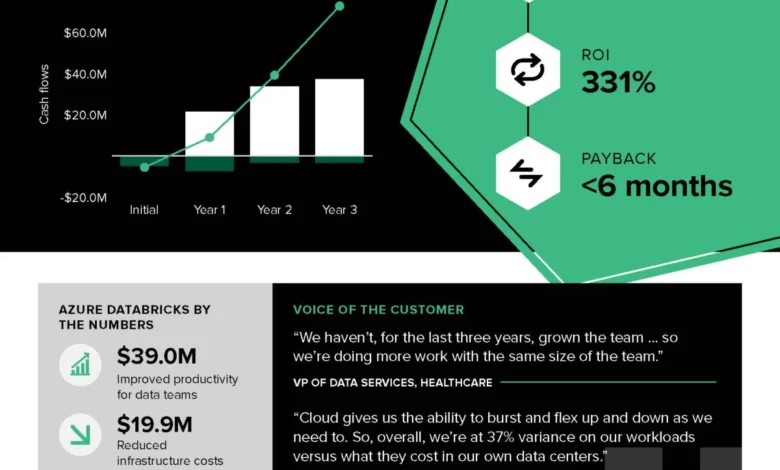
The integration of advanced data analytics and artificial intelligence into enterprise operations has moved from a competitive advantage to a fundamental necessity for large-scale organizations. As companies grapple with the complexities of managing vast data estates, a newly released study by Forrester Consulting, commissioned by Microsoft, reveals that Azure Databricks provides a measurable financial and operational advantage. According to the Total Economic Impact™ (TEI) study, a composite organization utilizing the platform achieved a 331 percent return on investment (ROI) over a three-year period. This figure underscores the efficacy of the co-engineered partnership between Microsoft and Databricks, which seeks to provide a native, first-party experience within the Azure ecosystem.
The findings indicate that the value of Azure Databricks is not merely theoretical but is reflected in a net present value (NPV) of $58.1 million. Perhaps most significantly for decision-makers concerned with budget cycles and liquidity, the study found that the initial investment in the platform was recovered in less than six months. These results come at a time when global enterprises are seeking to consolidate their technology stacks to reduce the "fragmentation tax"—the hidden costs associated with managing disparate tools, inconsistent data governance, and complex integration requirements.
The Economic Framework: Analyzing the Forrester TEI Findings
To reach these conclusions, Forrester interviewed a range of existing Azure Databricks customers to design a composite organization. This model represents a typical large-scale enterprise: a $6 billion company operating within a regulated industry, managing approximately 10 petabytes of data. Before the implementation of Azure Databricks, these organizations typically reported a fragmented data estate that was both expensive to maintain and difficult to govern. Scaling operations often led to reliability issues, creating bottlenecks for data scientists and business analysts alike.
The study’s financial model compared a three-year cost of $17.5 million against total benefits of $75.6 million. These benefits were categorized into four primary areas of impact:
- Infrastructure and Management Savings: By moving to a unified, managed service, organizations reduced the overhead associated with maintaining legacy on-premises or siloed cloud environments.
- Accelerated Data Science and Engineering Productivity: The native integration with Azure tools allowed technical teams to spend less time on "plumbing"—the manual movement and cleaning of data—and more time on developing high-value models.
- Enhanced Business Value through Data-Driven Insights: Faster processing times and better data accessibility enabled business units to identify market opportunities and operational efficiencies more rapidly.
- Risk Mitigation and Governance: The implementation of unified governance frameworks reduced the likelihood of data breaches and non-compliance penalties in regulated sectors.
Beyond the quantified financial metrics, the study highlighted several qualitative advantages that serve as the foundation for long-term growth. These include seamless integration with native Azure services, wider internal access to data through democratized analytics, and the implementation of the Unity Catalog for centralized governance across the entire data lakehouse.
Technical Architecture: The First-Party Advantage
The primary driver behind these economic gains is the unique "first-party" status of Azure Databricks. Unlike third-party software-as-a-service (SaaS) offerings that are simply hosted on a cloud provider, Azure Databricks is co-engineered by Microsoft and Databricks. This means the service is built into the core Azure architecture rather than being "bolted on."
For technical teams, this integration manifests as a unified integration roadmap. Developments in the Microsoft data and AI stack—such as Azure Machine Learning, Power BI, and Microsoft Fabric—are synchronized with Databricks updates. This alignment ensures that performance optimizations are applied at the kernel level, reducing latency and improving compute efficiency. From a business perspective, the first-party status simplifies the procurement and support process; organizations receive a single bill from Microsoft and have a single point of contact for technical support, effectively eliminating the "vendor finger-pointing" that often occurs during complex troubleshooting.
Innovations in Generative AI and Copilot Integration
A critical component of the platform’s current value proposition is its role in the generative AI revolution. The integration of Azure Databricks Genie with Microsoft Copilot Cowork serves as a prime example of how the partnership is evolving to meet modern demands. Genie allows users to interact with their data lakehouse using natural language queries, effectively lowering the barrier to entry for non-technical staff.
This functionality is now integrated directly into the tools that employees use daily, such as Microsoft Teams and Microsoft 365 Copilot. Through the use of "Genie Ontology," the system grounds AI-generated tasks in the organization’s own trusted data. Crucially, every query and answer is scoped by the Unity Catalog. This ensures that the intelligence reaching the flow of work adheres to strict governance rules, meaning a user can only access information they are explicitly permitted to see. This balance of accessibility and security is a key factor in the productivity gains identified in the Forrester study.
Performance Benchmarking: Azure vs. AWS
The economic value of a data platform is intrinsically linked to its performance speed. To validate the efficiency of the Azure-native approach, Principled Technologies, an independent research firm, conducted a series of industry-standard benchmarks. Using a 10-terabyte dataset and a TPC-DS-like decision-support workload, the firm compared Azure Databricks against Databricks on Amazon Web Services (AWS).
The results showed that Azure Databricks completed a single query stream in up to 21.1% less time than its AWS counterpart when autoscaling was disabled. Furthermore, in tests involving four concurrent query streams, Azure Databricks maintained its lead, finishing more than nine minutes faster than the competition. These speed advantages translate directly into lower compute costs and faster time-to-insight, reinforcing the "performance-to-value" ratio that Forrester quantified in its ROI analysis.
Chronology of the Microsoft-Databricks Partnership
The success highlighted in the 2026 Forrester study is the result of nearly a decade of strategic collaboration.
- 2017: Microsoft and Databricks announced the launch of Azure Databricks at the Connect(); conference. It was the first time a major cloud provider offered a third-party analytics platform as a first-party service.
- 2019-2021: The partnership focused on the "Lakehouse" architecture, combining the best elements of data lakes and data warehouses. This period saw the introduction of Delta Lake as a standard for reliability.
- 2022-2023: Governance became the focal point with the rollout of Unity Catalog, providing a unified layer for data and AI assets across clouds.
- 2024-2025: The focus shifted toward "Data Intelligence," integrating Large Language Models (LLMs) and generative AI capabilities directly into the data estate.
- 2026: The release of the Forrester TEI study serves as a comprehensive validation of this long-term engineering and business strategy.
Strategic Analysis: Implications for the Modern Enterprise
The shift toward platforms like Azure Databricks represents a broader trend in the enterprise software market: the move away from best-of-breed fragmentation toward integrated ecosystems. For years, the prevailing wisdom suggested that organizations should pick the single best tool for every niche task. However, the Forrester data suggests that the "integration tax"—the cost of making those tools work together—has become prohibitively high.
By choosing a platform that is co-engineered with the underlying cloud provider, enterprises are essentially outsourcing the burden of integration to Microsoft and Databricks. This allows internal IT departments to pivot from being "systems integrators" to "value creators." The high ROI and short payback period indicated in the study suggest that the market is placing a premium on simplicity, speed, and governance.
Furthermore, the study’s focus on a "regulated industry" composite organization highlights the growing importance of compliance. In an era of GDPR, CCPA, and emerging AI regulations, having a single governance layer (Unity Catalog) that spans across data and AI models is no longer optional. It is a prerequisite for any company looking to deploy AI at scale without incurring massive legal and operational risks.
Conclusion
The Forrester Total Economic Impact™ study provides a data-driven confirmation of the strategic value inherent in the Azure Databricks partnership. With a 331 percent ROI and a payback period of less than six months, the platform has demonstrated its ability to transform fragmented, expensive data estates into streamlined engines of business intelligence.
As organizations look toward the future of AI-driven operations, the ability to ground those models in secure, governed, and high-performance data will be the deciding factor in their success. The first-party advantage of Azure Databricks—characterized by native integration, co-engineering, and a unified roadmap—offers a clear path for enterprises to realize measurable value in an increasingly complex digital landscape. For the $6 billion companies modeled in this study, and for the thousands of smaller organizations following suit, the choice of a data platform is no longer just a technical decision; it is a fundamental pillar of fiscal and strategic health.