In the modern enterprise landscape, business-to-business (B2B) marketing departments rarely struggle to generate impact, but they consistently struggle to prove it. While budgets are routinely allocated and closed deals flow into the CRM, the digital paper trail connecting marketing activities to tangible revenue frequently fractures somewhere in the middle. This chronic lack of visibility carries steep organizational consequences. Rather than focusing their energy on driving market expansion and customer acquisition, marketing teams are routinely forced into a defensive posture, expending valuable resources justifying their existence rather than scaling their growth programs.

This dynamic gives rise to a familiar, debilitating corporate cycle. Lacking clear, unassailable evidence of return on investment (ROI), marketing leaders find themselves unable to secure adequate funding from the C-suite. Underfunded programs predictably underperform, which in turn provides ammunition to executives skeptical of marketing’s value, making future proof and evidence even harder to attain. At the heart of this operational deadlock are fundamental, persistent questions regarding how value is tracked, measured, and presented to the board. Most legacy reporting frameworks attempt to resolve these queries through overly simplistic mechanisms, treating buyer influence as an isolated, singular event rather than acknowledging it as a complex, interconnected set of digital and human interactions unfolding over extended sales cycles.
Overcoming this pervasive industry hurdle does not require the pursuit of an unattainable statistical perfection. Instead, it demands organizational discipline, a modern architectural framework, and the executive confidence to make high-stakes strategic decisions based on directional data rather than waiting for an absolute certainty that will never materialize in complex enterprise sales environments.
The Anatomy of Connecting Campaigns to Revenue
The primary function of any sophisticated go-to-market (GTM) measurement capability layer is to accurately track performance, attribute revenue influence, and generate actionable insights across the entire buyer journey. When properly optimized, this infrastructure connects top-of-funnel campaigns directly to active pipelines and closed-won revenue, highlights critical bottlenecks within the conversion funnel, and ultimately transforms marketing from a perpetual budget defender into a strategic revenue optimizer.
Many B2B organizations have successfully implemented the foundational basics of this architecture. Standard practices often include campaign-level ROI reporting, first-touch or last-touch attribution models, pipeline velocity tracking, and periodic assessments of marketing’s influence on closed deals. While these baseline approaches serve a purpose, they quickly reach their limits when navigating enterprise-grade buying groups involving multiple stakeholders, long consideration periods, and non-linear touchpoints. Building a robust, future-proof foundation requires organizations to interrogate their data architecture deeply, asking critical questions about data cleanliness, attribution weightings, and how multi-channel interactions are credited across long sales cycles.

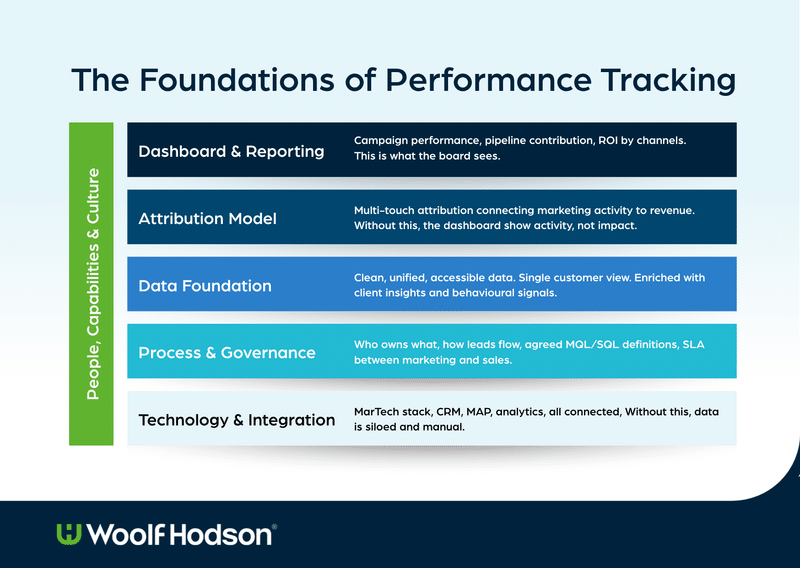
As industry veterans frequently emphasize, an organization cannot report on what it cannot measure, and it cannot measure what it fails to properly connect. While executive dashboards and visually polished reports represent the visible outputs of performance-tracking capabilities, the foundational layers underneath must function seamlessly for those numbers to carry any real business meaning or serve as legally and financially sound evidence of performance.
The executive dashboard presented to the board room only tells the unvarnished truth when the technical and operational layers beneath it are sound. Every metric displayed on a screen ultimately depends upon an underlying influence model that reliably connects marketing activity to financial return, a clean and unified data foundation, rigorous processes that clearly define ownership and lead flow, and an integrated technology stack that stitches disparate tools together. In far too many enterprises, performance reporting has officially reached the breaking point of its current technological infrastructure. To advance further, organizations must rebuild from the bottom up, investing heavily in foundational data integrity so that when leadership asks what marketing actually contributed to the quarterly ledger, the answer is trusted, comprehensive, and entirely evidence-based.

Evolution from Budget Defender to Revenue Optimizer
The analytics and reporting layer serves as the primary engine driving the outputs by which the rest of the enterprise evaluates marketing success. It functions as the diagnostic dashboard where the marketing engine demonstrates its calibration and seamless integration with adjacent GTM functions, particularly sales and customer success.
In a modernized enterprise ecosystem, signal capture continuously feeds business intelligence. That intelligence and those localized insights subsequently drive intelligent campaign orchestration. Well-orchestrated engagement programs, in turn, generate fresh behavioral signals from prospective buyers. This self-sustaining engine—fueled by clean, unified data, powered by automated processes, and increasingly accelerated by artificial intelligence and machine learning workflows—enables marketing teams to execute strategies with profound confidence and maintain absolute operational alignment with revenue-generating peers across the business.

Achieving this level of maturity requires more than just purchasing off-the-shelf software; it demands a comprehensive framework and a meticulously tuned marketing engine. Industry practitioners frequently spend their engagements working alongside enterprise clients to construct these foundational layers and fine-tune the overarching operational architecture.
For modern business leaders, the critical evaluation begins with an internal audit: Where does the organization stand today, and how confident is leadership in its current operational framework? Identifying the enterprise’s exact position within the maturity curve is the first step toward determining the highest-leverage strategic move to transition from a defensive cost center into an indispensable engine of predictable revenue growth.

Industry Context and Broader Implications
The persistent challenge of B2B attribution and evidence-based marketing has taken on renewed urgency amid broader macroeconomic pressures and the explosive rise of AI-generated content. As enterprises scrutinize every line item in their operational budgets, marketing departments face unprecedented pressure to justify expenditure. Simultaneously, the proliferation of digital channels, anonymous buyer behavior, and autonomous AI research tools has rendered traditional, simplistic tracking models obsolete.
Industry analysts note that the shift from simple lead generation to comprehensive revenue attribution represents one of the most significant operational transformations in modern enterprise management. Organizations that successfully modernize their data architecture and embrace holistic influence models are better positioned to weather economic downturns, secure sustained executive buy-in, and outmaneuver competitors mired in legacy reporting methodologies. Conversely, companies that fail to address their underlying "evidence problem" risk chronic underfunding, misaligned go-to-market strategies, and a diminishing organizational footprint as boards increasingly demand quantifiable proof of marketing’s contribution to the enterprise bottom line.