From RAG to Agentic AI: Building the Next Generation of Intelligent Enterprise Systems

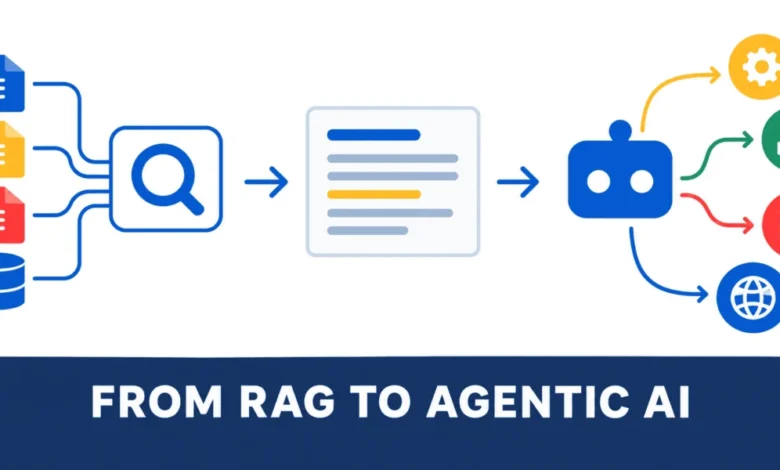
The enterprise technology landscape is undergoing a profound structural shift as organizations move beyond standard Retrieval-Augmented Generation (RAG) models toward advanced Agentic Artificial Intelligence architectures. For years, vanilla RAG served as the cornerstone of enterprise generative AI deployments. By embedding user queries and extracting relevant document chunks from vector databases, companies could ground large language models in internal data rather than relying entirely on pre-training memory. However, practical implementation at a massive enterprise scale has exposed significant operational bottlenecks, driving software architects and data scientists to engineer sophisticated, multi-tiered retrieval systems.
The evolution from basic vector matching to autonomous, reasoning-driven workflows addresses fundamental limitations in enterprise semantic search. Industry specialists, including AI researchers at major technology firms like Dell Technologies, note that standard RAG frequently falters when dealing with domain-specific jargon, polysemous acronyms, complex cross-referencing, and the lack of reliable confidence scoring. These limitations have catalyzed a multi-generational transformation in enterprise search and knowledge retrieval.
Chronology of Enterprise AI Architecture
The maturation of enterprise knowledge systems over the past several years can be categorized into three distinct generations, each addressing the failures of its predecessor.
The first generation established hybrid retrieval methodologies. Early enterprise implementations relied solely on vector search, which captures conceptual semantics but often fails to surface exact keyword matches, product codes, or niche acronyms. To bridge this gap, engineers adopted hybrid search frameworks running dense vector models and sparse lexical algorithms (such as BM25) simultaneously. This phase introduced multi-tier deduplication strategies and Reciprocal Rank Fusion (RRF) algorithms, initially proposed by computer scientists Cormack, Clarke, and Buettcher in 2009, to merge heterogeneous scoring systems efficiently without manual score normalization.
The second generation integrated structured domain knowledge through GraphRAG. Recognizing that flat document chunks treat information as isolated islands of text, developers began layering knowledge graphs onto retrieval pipelines. This approach injected ontologies, entity extraction, and relationship mapping into the search architecture. While early iterations relied heavily on resource-intensive and non-deterministic large language model calls for Named Entity Recognition (NER), production environments quickly shifted toward rule-based, multi-pass deterministic entity extraction to ensure low latency and regulatory compliance.
The third and current generation introduces Agentic AI. Moving past rigid retrieve-then-generate pipelines, agentic systems employ dynamic reasoning models. These architectures decompose multi-part user queries, consult disparate data sources concurrently, incorporate strict safety boundaries, and leverage multiplicative confidence scoring to determine whether an answer is robust or if the system should explicitly state its lack of knowledge.
Technical Innovations and Data Mechanics
Transitioning from experimental setups to enterprise-grade production environments requires rigorous engineering decisions, particularly regarding latency, determinism, and data security.
Data metrics from production deployments demonstrate that asynchronous execution of hybrid search pipelines can reduce retrieval latency by up to 40 percent compared to sequential querying. Furthermore, optimizing computational pathways through deterministic logic—such as rule-based entity matching and word-frequency heuristic disambiguation—eliminates the unpredictable latency overhead associated with exhaustive generative model calls.
In the realm of confidence scoring, enterprise systems are increasingly abandoning arithmetic averaging in favor of multiplicative scoring models. Traditional averaging can mask critical component-level failures, where a high planning confidence score might obscure a severely flawed retrieval output, resulting in an artificially inflated aggregate score of 0.5. Multiplicative scoring, rooted in classical decision theory, ensures that a failure in any single pipeline phase—such as a drop in retrieval confidence from 0.9 to 0.1—drastically reduces the overall product score to 0.09. This conservative approach provides an unambiguous signal, allowing the system to trigger self-correction loops or safely decline to answer when data integrity is compromised.
Moreover, architectural paradigms are increasingly incorporating strict privacy boundaries at the initial ingestion and query interception phases. Industry standards, such as the Model Context Protocol (MCP), emphasize rigorous human-in-the-loop checkpoints and explicit safety guardrails that function as hard architectural boundaries rather than downstream filters. Queries flagged for containing sensitive customer data or proprietary intellectual property are systematically halted before engaging downstream retrieval or generation components.
Implications and Broader Industry Impact
The shift toward agentic enterprise systems carries substantial implications for corporate productivity, regulatory compliance, and software engineering methodologies. As businesses scale their artificial intelligence operations, the demand for auditable, reproducible, and deterministic behavior takes precedence over raw generative flexibility.
Analysts project that organizations implementing advanced agentic orchestration—wherein specialized AI agents dynamically discover capabilities and collaborate across organizational silos—will achieve significantly higher operational efficiency in managing complex, multi-source enterprise workflows. This transition minimizes hallucinations, enhances data governance, and aligns automated decision-making processes with stringent corporate compliance standards.
Looking forward, the integration of multi-agent systems and standardized context protocols marks the next frontier in enterprise software development. By prioritizing deterministic logic, rigorous latency budgeting, and non-negotiable confidence metrics, enterprise architects are successfully laying the groundwork for the next generation of intelligent, reliable, and secure corporate knowledge systems.