The Paradox of Abundance: Why the One-Person AI Company Struggles with the New Bottleneck of Discovery

In the annals of corporate history, the scale of a company was long tethered to its headcount. The ability to ship a product was a direct function of human capital—engineers, designers, marketers, and support staff. However, the advent of agentic artificial intelligence has fundamentally dismantled this barrier. Today, the tech landscape is dominated by a new, intoxicating vision: the one-person enterprise, armed with a single laptop and a suite of autonomous agents capable of researching markets, writing production-grade code, designing interfaces, and automating complex operational workflows. While this shift has democratized production, it has simultaneously introduced a profound, structural crisis in distribution. In an era where building is nearly instantaneous, the struggle to be seen has become the defining challenge of the modern entrepreneur.
The core of this phenomenon lies in the decoupling of creation from visibility. Historically, the difficulty of building a product acted as a filter; if a team could successfully launch, they had already overcome significant operational hurdles. Today, those hurdles have collapsed. AI has turned production into an abundant commodity, leading to a crowded digital marketplace where millions of products are launched daily. Consequently, the bottleneck of the software economy has shifted from the supply side to the demand side. The entrepreneur is no longer fighting for the ability to build, but for the scarcity of attention, trust, and reputation.

The Erosion of the Traditional Discovery Model
For the past two decades, the digital economy operated on a predictable, symbiotic bargain: creators published information, search engines indexed it, social networks distributed it, and users clicked through to the source. This model allowed niche blogs to evolve into media empires and small software firms to scale into global players. It was a reliable funnel where content discovery led directly to brand awareness and customer acquisition.
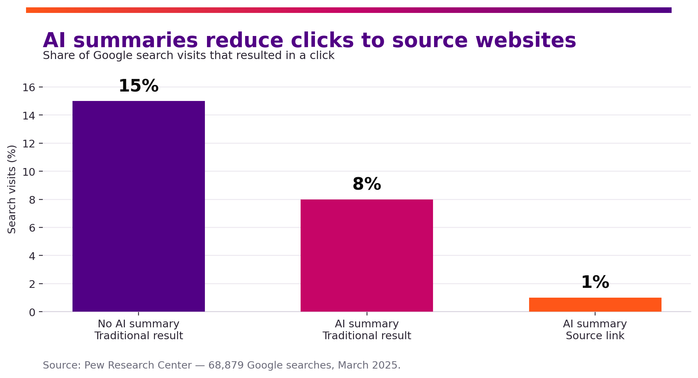
Data from the Pew Research Center highlights the fragility of this legacy system. An analysis of nearly 69,000 search queries revealed a stark decline in referral traffic. When AI-generated summaries were absent, approximately 15% of searches resulted in a click to a third-party site. When an AI summary was present, that figure plummeted to 8%, with only a negligible 1% of users clicking through to a source link provided within the AI response. This creates a "black hole" effect: the user receives the value they were seeking—the answer to their question—without ever engaging with the entity that created the knowledge.
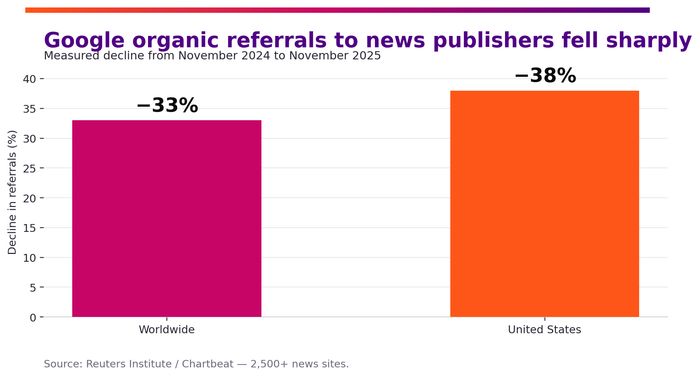
This shift is corroborated by the Reuters Institute’s 2026 Digital News Report, which observed a 33% decline in organic search referrals to over 2,500 global news sites between November 2024 and November 2025. While algorithm updates and evolving user behaviors are contributory factors, the rise of AI-integrated search interfaces is undeniably altering the mechanics of the open web.
The Structural Imbalance: Crawling vs. Converting
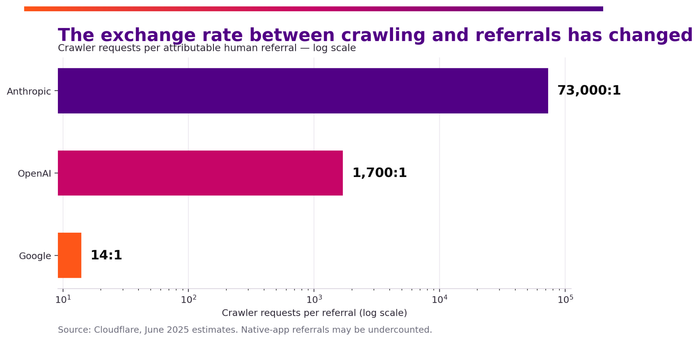
The relationship between AI developers and content creators has become increasingly asymmetrical. Research from Cloudflare, conducted in June 2025, underscores the disparity between the effort expended by content creators to be indexed and the actual traffic returned to their domains. The study estimated that for every human referral, there were roughly 14 crawler requests for Google, 1,700 for OpenAI, and an staggering 73,000 for Anthropic.
While these metrics do not equate to a moral failing—as indexing for training and retrieval is fundamentally different from traditional referral—they indicate a significant structural shift. The old bargain of "crawl my content and send me humans" is effectively being phased out. For the individual founder, this means the strategy of "publishing more" is no longer a viable path to growth. When an AI can synthesize, summarize, and extract the utility from a product or an article, the brand behind the work risks becoming an invisible utility provider.
Shifting Value: From Information to Trust and Experience
As information becomes increasingly commoditized and cheap, the value proposition for the one-person AI company must migrate toward what cannot be compressed into a summary. If a business offers only information, it is operating on unstable ground. The traits that are becoming increasingly scarce—and therefore valuable—include original evidence, lived experience, expert judgment, and human-to-human relationships.
This evolution is forcing a transition from passive publishing to active network building. The most successful founders are those who realize they do not own the algorithms that control their visibility. Relying on search engine optimization or viral social media trends is a strategy of renting distribution from landlords who can alter the terms of the lease at any moment.
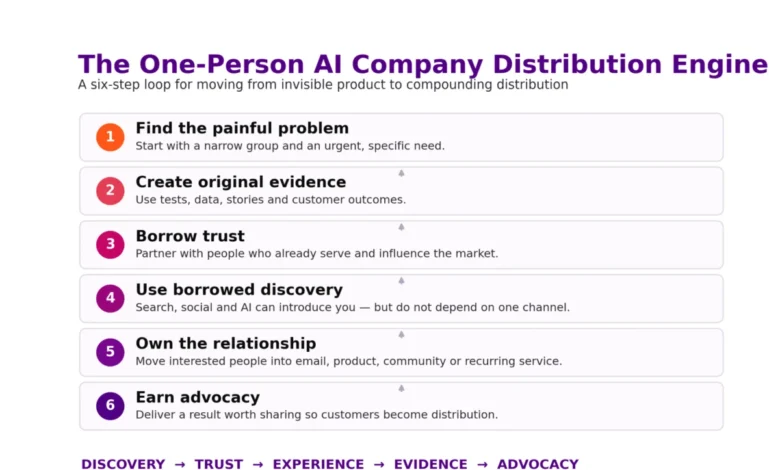
A more durable approach involves a three-tiered distribution strategy: borrowing attention from established sources, owning the direct relationship with the user (e.g., through email lists or private communities), and earning advocacy from satisfied clients. By leveraging the existing trust of third-party experts, consultants, or industry newsletters, a solo founder can bypass the noise of the general algorithm. A trusted recommendation from an industry peer to 500 potential customers is statistically and economically more potent than 500,000 cold impressions.
The Counter-Intuitive Rise of AI-Referenced Intent
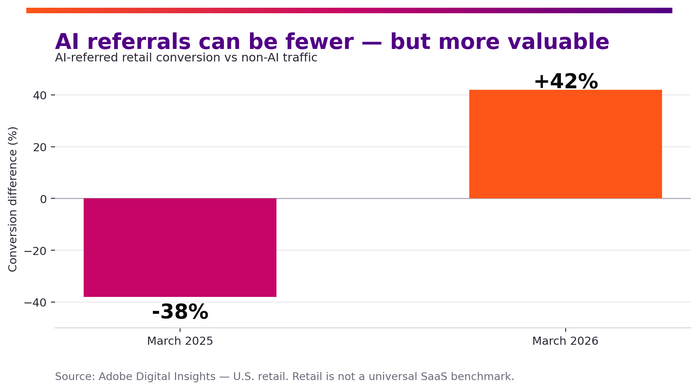
Despite the prevailing narrative of "AI-induced doom," there are emerging signals that suggest a more nuanced future. Adobe Digital Insights, in a 2026 analysis, found that while AI-referred traffic to retail sites initially saw lower conversion rates, that trend has reversed. By March 2026, traffic originating from AI-integrated platforms converted at a rate 42% higher than non-AI traffic.
This suggests that AI may be evolving from a barrier into a discovery layer. If an AI assistant is trained to recognize high-quality solutions, it can serve as a sophisticated broker of intent. When a user asks an assistant to find the best tool for a specific, complex professional problem, an AI that identifies a niche, high-performance product provides immense value. The challenge for the solo founder is no longer just to rank, but to become "recommendable"—to ensure their product provides verifiable outcomes that satisfy both the machine’s criteria and the human user’s needs.
The Second Revolution: Building a Distribution Engine
The first revolution of the one-person company was technological: the ability to build without a team. The second revolution, which is only just beginning, will be organizational: the ability to build a distribution engine that mimics the reach of a traditional sales and marketing department without the associated overhead.
Agentic AI will play a central role here as well, enabling a single person to monitor market signals, identify prospects, personalize outreach, and analyze conversion funnels with a level of precision previously reserved for large enterprises. However, this automation has a hard limit. Technology can facilitate the mechanics of distribution, but it cannot manufacture trust or fabricate a reputation.
The ultimate advantage in the AI economy will belong to the founder who understands the distinction between what should be automated and what must remain human. Creation is becoming abundant; discovery is becoming the new bottleneck. The successful entrepreneurs of the coming decade will be those who treat distribution not as an afterthought to the product launch, but as a core pillar of their product architecture.
In the final analysis, the one-person AI company is a viable model, but it is not a shortcut. It requires a fundamental move away from the "publish and pray" mentality toward a model that prioritizes deep, human-verified outcomes. To be heard in the AI economy, one must stop shouting into the void and start building a network where every interaction creates a signal, every customer produces evidence, and every partnership acts as a doorway. The tools are available to build anything; the challenge is to be remembered for it.