AI-Assisted Security Breach Reveals Vulnerability Chain Targeting OpenAI Internal Systems

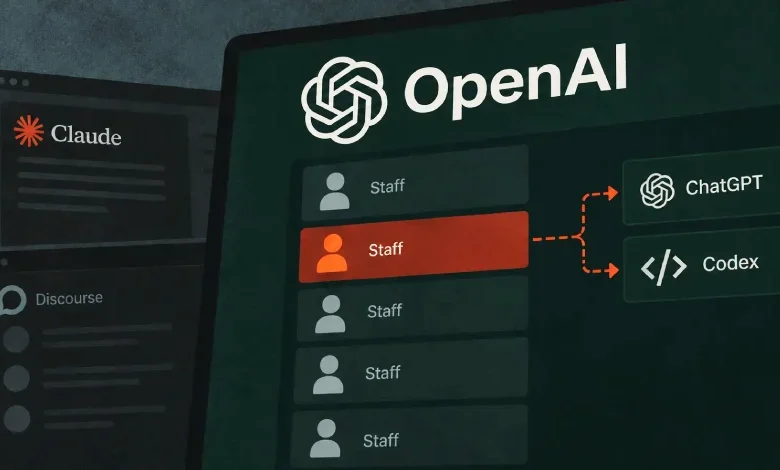
In a striking demonstration of how artificial intelligence is transforming the landscape of offensive cybersecurity, researchers at the security firm Hacktron have successfully utilized Anthropic’s Claude Opus 5 model to chain two distinct vulnerabilities, ultimately gaining unauthorized access to internal OpenAI systems. The exploit, which targeted OpenAI’s public-facing forum before pivoting to internal employee accounts, highlights the critical risks posed by integrated identity management systems and the accelerating efficiency of AI-driven vulnerability research.
The security researchers, acting under the banner of a project dubbed "HEIF Heist," managed to compromise ChatGPT and Codex accounts belonging to several OpenAI staff members. By leveraging these accounts, the team successfully reached an internal code repository, proving that a breach of a secondary, public-facing service can have catastrophic downstream effects on an organization’s most sensitive infrastructure. While the researchers confirmed that their actions were strictly limited to a "proof-of-concept" pull request—designed to verify access without reading proprietary source code or accessing customer data—the incident serves as a stark warning to the tech industry regarding the interconnectedness of modern enterprise software.

The Anatomy of the Attack: From Forum to Repository
The breach began with a sophisticated exploitation of the software powering OpenAI’s public help forum, which utilizes the open-source Discourse platform. At the heart of the initial compromise was a memory corruption vulnerability within libheif, a popular library used for decoding HEIF and HEIC image formats. The vulnerability, tracked as CVE-2026-32882, allowed the researchers to craft a malicious image file that, when processed by the server, triggered an out-of-bounds read. By combining this memory leak with advanced exploitation techniques, the researchers were able to bypass Address Space Layout Randomization (ASLR), a security feature designed to prevent the execution of arbitrary code.
Once the researchers achieved remote code execution (RCE) on the forum server, they pivoted to the secondary stage of their attack: exploiting OpenAI’s single sign-on (SSO) infrastructure. Because the forum shared a common authentication gateway with internal company tools, the researchers were able to intercept the sessions of forum members who were also OpenAI employees. This privilege escalation allowed them to assume the digital identities of staff members, granting them access to tools like ChatGPT and Codex, which in turn were connected to internal repositories, Slack, and email services.
A Chronology of the HEIF Heist
The timeline of this incident reflects both the rapid evolution of AI-powered hacking and the typical response time of a high-profile technology firm.

- Mid-July 2026: The Hacktron team initiates their investigation into image-decoding libraries, utilizing earlier AI models like Claude Opus 4.8. These initial attempts at exploit development proved difficult due to existing memory defenses.
- July 24, 2026: Anthropic releases Claude Opus 5. The researchers shift their strategy, using the more capable model to automate the creation of a working exploit, which is completed within hours.
- Late July 2026: The researchers successfully execute the exploit against the OpenAI forum, moving from initial server access to account takeover in under 72 hours.
- August 2026: The team documents the breach and reports the findings to OpenAI. During this period, the researchers also investigate similar vulnerabilities across other platforms, including Next.js and various enterprise frameworks.
- September 1, 2026: OpenAI confirms the fix and issues a $6,500 bug bounty to the Hacktron team. The company emphasizes that the reward pertains specifically to the internal security findings, distancing itself from the activities conducted against the third-party Discourse software.
The Role of Artificial Intelligence in Offensive Security
One of the most significant aspects of this report is the explicit role of generative AI in shortening the development lifecycle for exploits. The Hacktron researchers noted that while they provided the strategic direction and set up the controlled environment, the AI model significantly reduced the cognitive load required to navigate complex memory protection schemes.
This development aligns with recent warnings from industry experts and AI safety organizations, which have suggested that large language models (LLMs) are lowering the barrier to entry for cyberattacks. Previously, discovering and weaponizing a vulnerability of this nature would require a team of highly skilled security engineers working over several weeks. By offloading the "heavy lifting" of code generation and bug-chaining to models like Claude Opus 5 and GPT-5.6 Sol, researchers—and potentially malicious actors—can iterate through target environments at an unprecedented speed.
Despite the inclusion of safety guardrails in these models, the researchers demonstrated that they could circumvent restrictions by creating a simulated "capture-the-flag" environment. This suggests that the current safety protocols implemented by AI developers may be insufficient against determined researchers who know how to frame their queries within a testing context.

Official Responses and Industry Implications
OpenAI’s response was swift, confirming the fix roughly 14 hours after the report was filed. However, the company has remained notably quiet regarding the specific mechanics of the login flaw that allowed the lateral movement from the forum to internal accounts. This silence is typical of large tech firms that prefer to minimize public discourse on vulnerabilities, though it leaves the broader community with questions regarding the security of SSO implementations across the industry.
Discourse, the platform underlying the forum, had actually addressed the libheif vulnerability in subsequent software updates. However, the breach underscores a common "dependency hell" scenario: while the platform itself was patched, the underlying server image provided by the Linux distribution (Debian 12) had not yet incorporated the upstream security fix into its packages. This serves as a critical reminder to system administrators that patching a web application is insufficient if the underlying operating system libraries remain outdated.
Broader Security Consequences
The implications of the "HEIF Heist" extend far beyond OpenAI. The project highlighted that common image-processing libraries are a massive, often overlooked attack vector. The fact that an investment of less than $3,000 in AI compute resources could uncover a chain of vulnerabilities impacting major platforms like Meta, GitHub, and Shopify suggests that the industry is facing a new era of "automated vulnerability discovery."

For organizations, the primary lesson is the danger of "unified identity." When a public-facing help desk or community forum shares the same SSO credentials as internal development environments, the security perimeter becomes only as strong as the most vulnerable public-facing component. The industry standard moving forward must be the strict isolation of SSO domains and the implementation of robust multi-factor authentication (MFA) that is not easily bypassed by session token theft.
Furthermore, the incident demonstrates that even when firms participate in comprehensive bug bounty programs, they remain exposed to the risks of supply chain vulnerabilities. As AI models continue to advance in their ability to analyze source code and identify logic errors, the window of time between the disclosure of a vulnerability and its mass exploitation by bad actors is expected to shrink dramatically.
In conclusion, the Hacktron report is not just a story about a bug in a forum; it is a case study in the new reality of digital security. As AI tools become more adept at identifying and chaining vulnerabilities, the security of the future will rely less on the obscurity of code and more on the defense-in-depth architecture of organizational systems. The "HEIF Heist" may have been a controlled demonstration, but it has undoubtedly provided a blueprint that others—with less honorable intentions—will be eager to follow. Organizations must now prioritize the hardening of their SSO gateways and ensure that their automated patching processes are as efficient as the AI-driven tools that are currently being used to test them.