The Evolution of Authorship in the Age of Artificial Intelligence: Redefining Creativity Through Delegation and Mastery

Ten years ago, a visitor walking through the Musée Rodin in Paris might have operated under the common, albeit naive, assumption that every chisel mark on a sculpture was made by Auguste Rodin himself. That assumption, however, collapses upon a closer examination of the studio system that defined his practice. Rodin, while the singular creative force behind his works, relied on a sophisticated network of assistants, marble carvers, and foundry specialists to realize his vision. This historical reality offers a vital framework for understanding the current disruption facing writers and knowledge workers in the age of generative artificial intelligence: the distinction between the physical act of creation and the intellectual act of authorship.
The contemporary debate surrounding AI and writing has polarized into two untenable extremes. On one side, proponents of "pure" writing argue that any involvement of a machine in the drafting process renders the work inherently suspect, prioritizing the mechanical keystroke over the creative intent. On the other side, a growing trend of "abdication" sees individuals delegating the entire research, drafting, and editing process to AI, effectively acting as mere conduits for algorithmic output. Both positions misunderstand the nature of creative labor. The former confuses authorship with the physical act of typing, while the latter confuses automated supervision with the rigorous responsibilities of a true author.
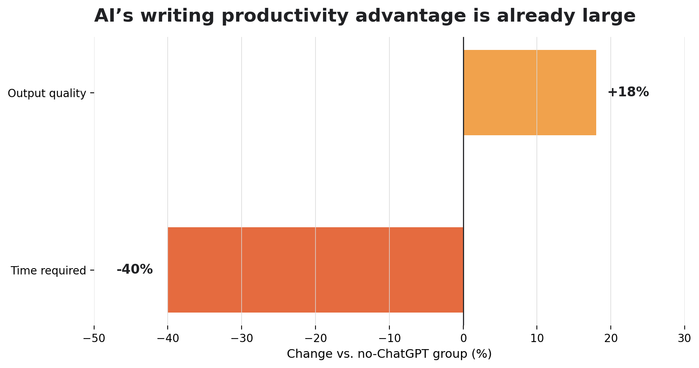
The scale of this shift is documented in recent empirical research. A 2023 study published in the journal Science by researchers Shakked Noy and Whitney Zhang involving 453 college-educated professionals found that access to generative AI tools reduced task completion time by 40 percent while simultaneously increasing the assessed quality of the output by 18 percent. This data suggests that we are witnessing a fundamental transition in the professional landscape, moving from the role of a "sentence maker" to that of a "director" or "architect of meaning."
The Historical Precedent: From Craftsperson to Director
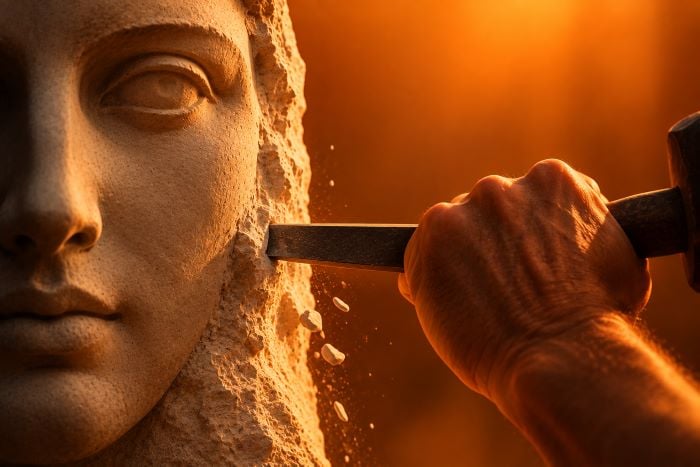
The history of fine art provides a roadmap for this transition. Just as Rodin utilized specialists to translate plaster models into stone, modern artists like Jeff Koons maintain highly systematic studio operations. In the Koons model, digital scans, standardized lighting, and paint-by-numbers precision are used to ensure that every gesture and color choice aligns with a central vision. Critics often ask, "Who made the art?" The answer, as it applies to both Rodin and Koons, is that the team executed the labor, but the artist authored the work.
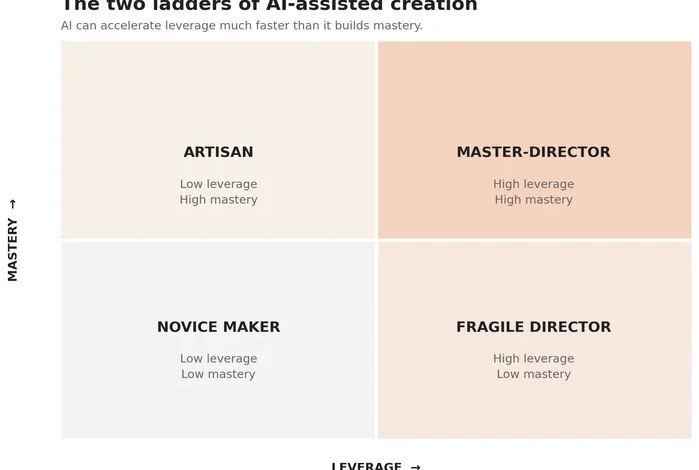
This model is increasingly relevant as writers adopt AI as a digital assistant. The transition from individual craftsperson to creative director offers immense leverage. A single writer can now conduct exhaustive research, test multiple counterarguments, and synthesize complex datasets in a fraction of the time previously required. However, this leverage introduces a significant risk: the rise of the "fragile director."
Mastery requires an internal model built through years of practice. Rodin could effectively delegate because he understood the physical properties of clay and the human form; he possessed the refined taste required to reject an assistant’s work if it failed to meet his standards. When writers leap to the role of "director" without first climbing the "mastery ladder," they lose the ability to judge the quality of the output they are commissioning from AI.
The Paradox of AI-Assisted Creativity
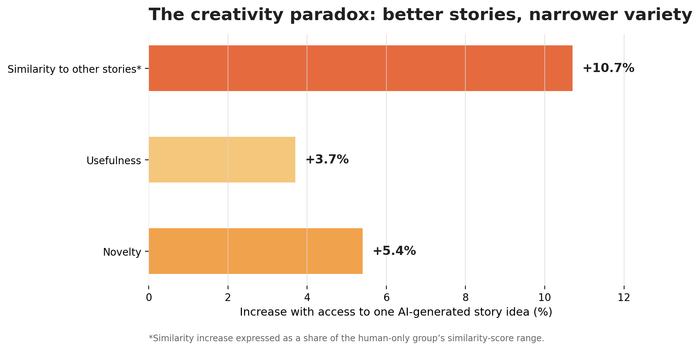
While AI offers clear productivity gains, it introduces a "creativity paradox." Experiments conducted by Anil Doshi and Oliver Hauser, published in Science Advances, revealed that while AI-assisted writers produced content that was 8.1 percent more novel and 9 percent more useful, the stories themselves became increasingly homogenized. As access to AI tools becomes universal, the output tends to gravitate toward a statistical average, diminishing the unique semantic diversity that defines human innovation.
This phenomenon is corroborated by a 2025 study of over 2,200 college admissions essays, which found that human-written submissions contributed new semantic ideas at a rate two to eight times faster than those generated by base models of GPT-4. Furthermore, a 2026 meta-analysis of 19 distinct studies confirmed a statistically significant homogenization effect in human-AI co-creation. In this context, the term "AI slop"—a phrase that gained cultural traction in 2025—describes content that is grammatically flawless but intellectually hollow, reflecting a total abdication of the author’s curiosity and judgment.
Defining the Responsibilities of Authorship
In light of these findings, the U.S. Copyright Office issued reports throughout 2025 emphasizing that while AI can serve as an assistive tool, simple prompting does not constitute authorship. Legal and philosophical consensus is coalescing around five core pillars of authorship that remain strictly human-centric:
- Origin: Determining the purpose and necessity of the work.
- Intent: Defining the core message and the audience.
- Direction: Curating the research and challenging the machine’s output.
- Judgment: Evaluating the work for truth, beauty, and utility.
- Responsibility: The willingness to stand behind and defend the final product.
These responsibilities require the author to remain "present" throughout the creative lifecycle. A writer who uses AI to brainstorm but retains the final say on structure and evidence is not abdicating their role; they are leveraging technology to focus on higher-level creative decisions.
Cognitive Offloading and Formative Friction
The risk of AI integration is not the technology itself, but the potential for "cognitive offloading"—the tendency to rely on machines for tasks that are essential to developing one’s own intellect. A 2026 review in Trends in Cognitive Sciences suggests that while automating rote tasks like transcribing or formatting can improve efficiency, offloading the "wrestling" with an argument—the actual synthesis of thought—can lead to skill decay.
For the modern writer, the goal should be to identify "formative friction." There is a distinct difference between the friction of manual transcription, which is often a waste of time, and the formative friction of refining a difficult sentence to capture a nuanced thought. The latter is where the author’s voice is forged. The ideal future is not one of total automation, but of a "master-builder" model: a professional who utilizes technology to multiply their output while remaining deeply engaged in the cognitive labor that produces quality work.
Implications for the Future of Knowledge Work
As the capabilities of AI expand, the most critical challenge for writers will not be how to generate content, but how to maintain a distinct direction. With the ability to produce infinite variations of text, the value of the human input shifts from the ability to "write" to the ability to "choose."
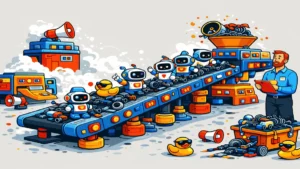
The industry is currently witnessing a movement toward intentionality. As platforms like Zyrro and other AI-integration tools emerge, they aim to assist creators in understanding their own patterns—what energizes them, what matters to them, and which paths are worth pursuing. This represents a shift in the role of the author: moving away from the assembly-line production of text and toward a model of curation, taste-making, and critical inquiry.
Ultimately, the distinction between delegation and abdication is clear. Delegation is a strategic choice to expand authorship by removing barriers to expression; abdication is the surrender of the creative process to a statistical model. The strongest creators in the coming decade will be those who use AI to amplify their reach while doubling down on the development of their own judgment, ensuring that their work remains a product of human intent rather than a byproduct of machine efficiency.
Related posts: