Security Researchers Uncover Critical Sandbox Escapes in OpenAI Codex Allowing Remote Code Execution

The landscape of artificial intelligence security faced a significant wake-up call following the disclosure of two severe vulnerabilities within OpenAI Codex, a premier AI-driven coding assistant widely adopted by developers globally. Security researchers at Accomplish AI identified sophisticated escape mechanisms capable of bypassing the application’s strict isolation boundaries. Most alarming among these discoveries was an exploit dubbed "Heapjack," which enables malicious actors to achieve remote code execution (RCE) on a developer’s local machine simply by enticing them to review a compromised repository. Operating entirely silently and without triggering any approval prompts, even when the software was configured to its strictest read-only security mode, the flaw highlighted critical vulnerabilities in how modern AI agents handle trust boundaries.
The findings underscore a mounting challenge for the software engineering industry. As autonomous and semi-autonomous coding agents become deeply integrated into everyday development workflows, attackers are increasingly targeting the underlying infrastructure of these tools. Rather than attacking traditional operating system vectors, adversaries are exploiting the architectural seams where AI models interact with host environments. The disclosure adds to a growing catalog of security incidents affecting generative AI tooling across the market, forcing developers and enterprise security teams to re-evaluate the inherent risks of deploying advanced coding assistants locally.
The Chronology of Discovery, Disclosure, and Remediation
The timeline surrounding the identification and patching of the OpenAI Codex vulnerabilities highlights a rapid response lifecycle by both the independent researchers and the vendor. The discovery phase culminated in mid-August, setting off a high-priority remediation window.
- August 12: Oren Yomtov and the research team at Accomplish AI officially disclosed both the Heapjack and Overpatch vulnerabilities to OpenAI through responsible disclosure channels, providing comprehensive technical documentation and proofs of concept.
- August 13–19: OpenAI’s security engineering teams initiated an immediate internal review, validating the mechanics of both sandbox escapes across the Codex Desktop application and the open-source Codex CLI tool.
- August 20: OpenAI successfully deployed security patches across the affected distribution channels, exactly eight days after the initial notification.
- Codex Desktop Build 26.818.21641: Released to remediate the memory-sharing architecture flaw exploited by the Heapjack attack vector.
- Codex CLI Version 0.149.0: Deployed to patch the path-traversal logic flaw utilized in the Overpatch exploit.
The swift eight-day turnaround prevented widespread exploitation in the wild, though the nature of the vulnerabilities left security professionals analyzing the broader implications of how AI agent architectures are constructed.
Deconstructing Heapjack: Memory Compartmentalization Failures
The more dangerous of the two discovered vulnerabilities, designated Heapjack, centers on the operational mechanics of node_repl, a component automatically installed by Codex Desktop into the user’s global configuration file (~/.codex/config.toml). Because this configuration file is established globally during installation without requiring explicit opt-in from the user, standard users of the Codex command-line interface inadvertently inherit the vulnerable component.
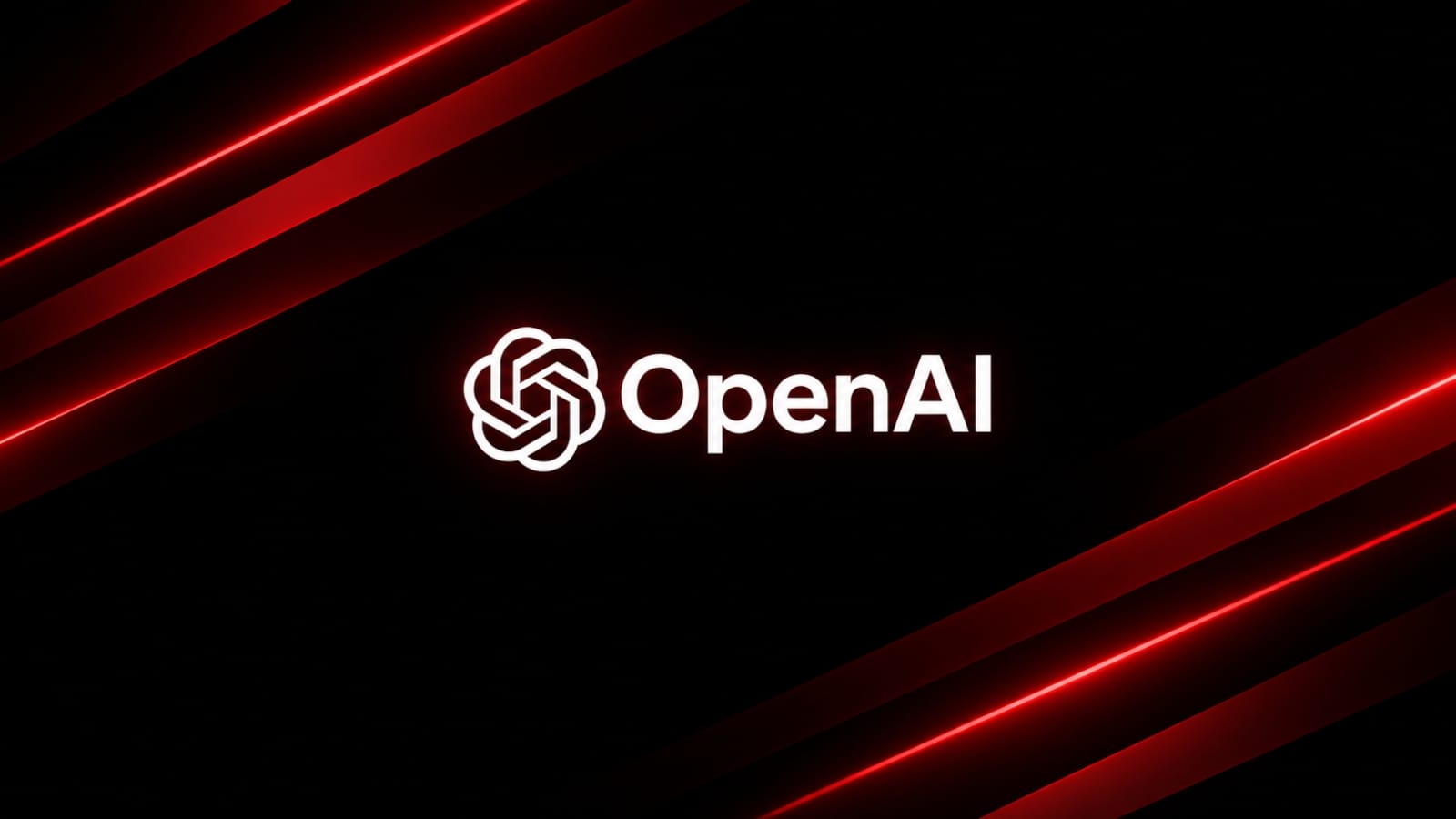
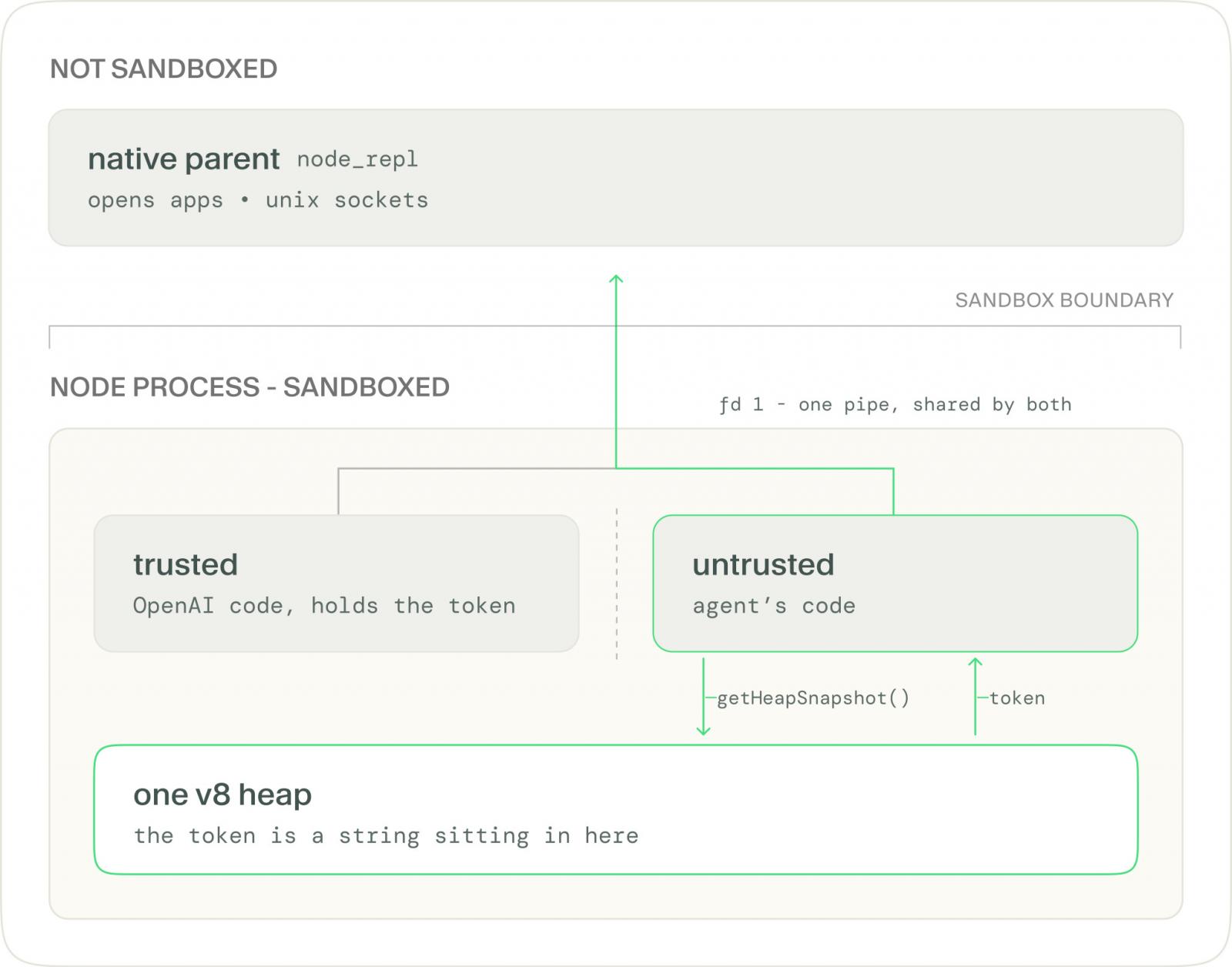
Architecturally, node_repl operates via a single Node.js process that simultaneously hosts two distinct JavaScript execution contexts: a trusted context containing core OpenAI proprietary code, and an untrusted context designed to execute agent-driven tasks. To maintain security, the trusted context generates a cryptographic token upon startup, which is theoretically required to authorize sensitive actions, such as interacting with native system processes or parent APIs.
However, because both the trusted and untrusted contexts reside within the same Node.js process, they share a single memory heap. This design choice effectively neutralized the cryptographic protection. The researchers demonstrated that untrusted code could capture a snapshot of the memory heap utilizing the standard Node.js API function v8.getHeapSnapshot(). By parsing the resulting data structure for strings matching UUID patterns, the untrusted code could easily locate the secret authorization token residing in plain text within the shared memory space.
Once the token was harvested, the untrusted code could craft and inject arbitrary requests into the communication pipe normally reserved exclusively for the trusted context. The parent process, receiving a valid token, dutifully executed the commands outside the sandbox environment. Through their proof of concept, the researchers utilized the operating system’s native open command to launch external applications entirely outside the Codex process tree, demonstrating that an attacker could theoretically interface with Unix sockets, Docker daemons, or system configuration utilities—all while the agent ostensibly operated in read-only mode.
Analyzing Overpatch: Path Manipulation in the CLI
While Heapjack targeted the desktop environment’s memory management, the second vulnerability, named Overpatch, targeted the open-source Codex CLI tool, specifically weaponizing its internal patch-application utility (apply_patch).
Under standard operating parameters, when Codex is configured in workspace-write mode, it is strictly restricted to modifying files within the designated project folder. Operations directed toward sensitive system directories, such as a user’s home directory, are designed to be blocked automatically. Accomplish AI discovered, however, that the apply_patch tool calculated its own path permissions dynamically based entirely on strings provided within the patch data itself.
Specifically, the utility evaluated path permissions by granting write access to the parent directory of any path named within a patch instruction. By structuring a malicious patch containing two distinct changes—one referencing a broad directory like /tmp solely to widen the permission scope, and another appending a malicious execution line to a shell configuration file (.zshrc) via a symlink pointing to the home directory—the researchers successfully bypassed the workspace restriction. Without the initial decoy path, the write operation was properly refused; with it, the path validation logic failed open, allowing unauthorized file modification. Consequently, the next time a developer opened a terminal session, the injected command executed automatically with the user’s full privileges.
Industry-Wide Vulnerability Patterns in AI Agents
The discovery of Heapjack and Overpatch is not an isolated incident, but rather part of a broader, emerging class of security challenges affecting generative AI assistants across the technology sector. In July, security researchers at Pillar Security disclosed a wave of similar sandbox escape vulnerabilities impacting prominent developer tools, including Cursor, Gemini CLI, and Google’s Antigravity platform.
These incidents share a common architectural vulnerability: the enforcement mechanisms designed to secure the sandbox are frequently hosted internally, relying on input supplied by the untrusted agent or executing within the same trust domain they are meant to govern. As industry observers noted following the Accomplish AI disclosure, technologies like the V8 engine isolate global variables rather than physical memory, meaning that logical separations can easily collapse if underlying runtime environments share resources.
Security analysts have increasingly criticized the default configurations of modern AI developer tools, which often install background daemons or global configuration hooks without requiring explicit user consent or providing granular privilege controls. The reliance on implicit trust boundaries—described by some researchers as acting merely like "room dividers" rather than fortified walls—creates significant exposure for enterprise environments where developers routinely clone and analyze untrusted external repositories.
Implications for Enterprise Security and Mitigation Strategies
The rapid adoption of AI coding assistants has outpaced the development of robust security frameworks, leaving organizations vulnerable to supply-chain attacks via malicious repositories. When a developer utilizes an AI agent to inspect code from an untrusted third-party GitHub repository, the agent processes code that may be specifically crafted to exploit vulnerabilities like Heapjack.
Security leaders emphasize that defending against these sophisticated attack vectors requires a fundamental shift in how AI developer tools are integrated into enterprise networks:
- Strict Version Management: Organizations must enforce mandatory update policies to ensure all development workstations run patched software builds, specifically Codex Desktop build 26.818.21641 and Codex CLI version 0.149.0 or higher.
- Isolation and Virtualization: Enterprises should consider running AI coding agents within isolated virtual machines or containerized environments rather than directly on native developer workstations, limiting the blast radius of potential remote code execution events.
- Principle of Least Privilege: Development teams should audit global configuration files (such as
~/.codex/config.toml) to ensure background daemons and REPL processes operate with minimal necessary system privileges. - Enhanced Threat Modeling: Security operations centers must update their threat models to account for AI-specific attack vectors, recognizing that compromised code repositories can now serve as vectors for host-level compromise through the tooling meant to analyze them.
As the cybersecurity community prepares for increasingly automated, AI-speed threat landscapes—a central theme of upcoming industry forums such as the Validation Summit 2026 featuring prominent security leaders—the remediation of the Codex vulnerabilities serves as a critical reminder that the security of AI infrastructure is only as strong as its deepest internal boundary.