How to Check If Your Web Pages Are in AI Search Indices Without Traditional Webmaster Tools

The digital marketing landscape has undergone a seismic shift over the past several years, driven by the rapid adoption of generative artificial intelligence and large language models (LLMs) for everyday information retrieval. For decades, search engine optimization (SEO) professionals relied on tried-and-true mechanisms to evaluate a website’s presence in traditional search indices. Commands such as the "site:" operator in Google and Bing, alongside exact-match quoted text strings, served as the primary diagnostics for checking whether a specific URL or piece of content had been successfully crawled, parsed, and indexed. These foundational tactics allowed digital marketers, webmasters, and site owners to troubleshoot visibility issues even in the absence of direct access to official webmaster portals like Google Search Console (GSC) or Bing Webmaster Tools.
However, as user behavior pivots toward conversational search interfaces, AI-driven chat engines, and Answer Engine Optimization (AEO) paradigms, the old rules of engagement face severe limitations. Modern AI search systems often operate as black boxes, pulling from vast, dynamic vector databases and retrieval-augmented generation (RAG) pipelines that do not always align with traditional crawler behaviors or index transparency reports. Consequently, SEO practitioners frequently find themselves navigating an opaque environment where standard diagnostic shortcuts fall short, necessitating novel methodologies to verify whether content is being successfully retrieved and ingested by emerging AI-driven platforms.
Evolution of Search Indexing and the Rise of AI Retrieval
To understand the current diagnostic dilemma, one must examine how search indexing has evolved. Traditional search engines construct inverted indices—massive databases mapping keywords to documents—allowing algorithms to return ranked lists of URLs in milliseconds. Webmasters monitor these indices using dedicated telemetry suites provided by search engine operators. Google Search Console and Bing Webmaster Tools provide granular insights into crawl stats, index coverage errors, sitemap statuses, and performance metrics.
Yet, the proliferation of AI search engines—such as ChatGPT with browsing capabilities, Perplexity, Google Gemini, and Microsoft Copilot—introduces a different layer of technology. These systems rely heavily on real-time web retrieval, scraping snippets, synthesizing data, and citing sources dynamically. While some AI platforms partner closely with major search engines, others utilize independent web-crawler networks and specialized vector databases to fetch and index fresh content.
When a website fails to appear in AI-generated answers or conversational queries, diagnosing the root cause becomes exceptionally challenging. Without direct dashboard access to proprietary AI retrieval indices, marketers are often left guessing whether their content was ignored due to technical blocks (such as restrictive robots.txt directives for AI user-agents), low domain authority, or simply a lack of discovery time. This visibility gap has sparked a demand for creative, prompt-based auditing techniques that allow technical SEOs to probe AI retrieval systems directly.
A Prompt-Based Workaround for AI Index Verification
Faced with the opacity of modern conversational search tools, SEO experts have developed empirical workarounds to test whether an AI model’s underlying search infrastructure has ingested specific pieces of content. Much like the legacy method of searching for a unique string of text inside quotation marks on Google, practitioners can query conversational AI models using precise verbatim prompts designed to force the system to retrieve and output exact source matches.
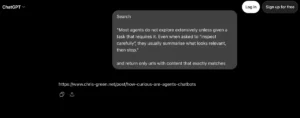
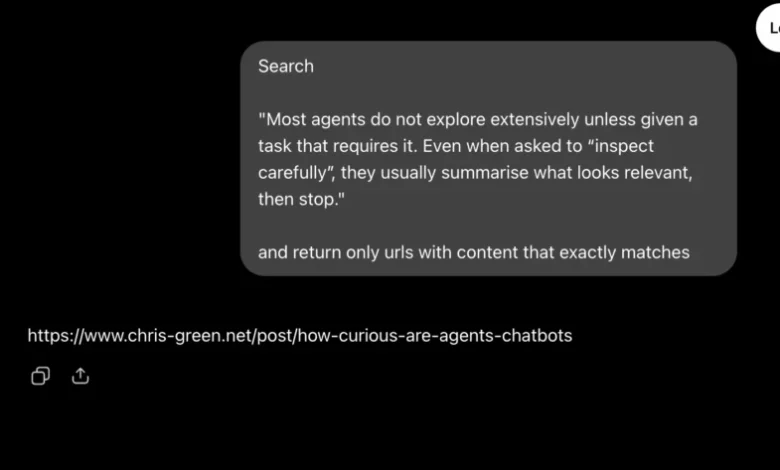
The methodology hinges on crafting a prompt that instructs the AI chatbot to search for a distinct, highly specific snippet of text drawn directly from the target webpage. A representative prompt structure takes the following form:
"Search for ‘[insert unique snippet of text here]’ and return any results which contain that exact text only."
When executed within a signed-out environment—to prevent personalization bias—advanced language models equipped with live search capabilities will attempt to query their active web index, locate the matching document, and cite or reproduce the text. If the model successfully returns the target URL and matches the verbatim phrase, it provides empirical proof of a successful retrieval event. Conversely, if the model fails to surface the page after multiple iterations, it signals a potential breakdown in discovery, crawling, or retrieval.

Industry Implications and Diagnostic Frameworks
The ability to verify AI retrieval through prompt engineering carries significant implications for digital strategists and content publishers. When a page is successfully retrieved via this method, several positive inferences can be made: the content is accessible to the AI’s web-fetching mechanism, the text has been successfully ingested into the active retrieval index, and the URL is deemed eligible for citation under certain query conditions.
However, if the test yields no results, site operators must systematically troubleshoot potential technical and architectural barriers. Common culprits include overly restrictive robots.txt files blocking specific AI user-agent crawlers, suboptimal server response times, client-side rendering issues that hinder JavaScript execution, or simply a lack of sufficient backlink authority and internal linking structure to prompt frequent recrawling.
Experts advise caution when interpreting these results. Because large language models often query diverse data sources and retrieval endpoints depending on user location, session state, and load balancing, a single test may yield false negatives. Analysts recommend executing the verification prompt four to five times across different sessions, occasionally varying the selected text snippet to ensure accuracy and account for stochastic variations in AI response generation.
Workflow Automation and Emerging Toolsets
While manual copy-pasting of text snippets into conversational interfaces is effective for ad-hoc audits, it introduces friction into enterprise-scale SEO workflows. Recognizing the need for efficiency, independent developers have begun crafting browser extensions designed to streamline the process.
One notable open-source utility, dubbed "Exactly Matchy," has emerged within the developer community to accelerate AI retrieval testing. Operating as a lightweight browser extension, the tool automates the extraction of unique paragraph snippets from a currently active browser tab and formats them into an optimized prompt designed to query AI search endpoints for exact-match verification.
Security and privacy advocates, however, urge caution when adopting community-built browser extensions. Because such utilities require permissions to read webpage content and interact with active browser sessions, security best practices dictate that users review the underlying source code—typically hosted on platforms like GitHub—before installation. Loading extensions via developer modes carries inherent risks, underscoring the importance of vigilance within technical marketing operations.
Distinguishing Retrieval from Ranking in the Age of AEO
A critical distinction must be drawn between content retrieval and actual search visibility or ranking performance. Confirming that an AI model can retrieve a specific URL via verbatim snippet matching merely proves that the page has cleared the foundational hurdle of being indexed. It does not guarantee that the page will appear prominently for broad, high-volume conversational queries.
If a piece of content successfully passes the retrieval test yet fails to drive traffic or secure citations in competitive AI-generated summaries, the challenge shifts from technical SEO to strategic authority and content differentiation. In the ecosystem of Answer Engine Optimization, mere indexing is no longer a golden ticket to visibility. AI search models heavily weigh semantic depth, brand authority, contextual relevance, and the unique value proposition of content relative to competing sources across the web.
As search engines continue to evolve into conversational answer engines, mastering these hybrid diagnostic workflows will remain essential for digital marketers striving to maintain transparency, measure visibility, and protect organic reach in an increasingly automated information economy.