The prevailing narrative surrounding artificial intelligence and the labor market has long focused on a single, binary outcome: the displacement of workers. This fear is frequently projected onto older generations, who are often portrayed as being unable to adapt to the rapid pace of technological innovation. However, a comprehensive analysis of 733 social media interactions conducted in October 2026 suggests that this conventional wisdom is significantly flawed. Instead of feeling left behind, a majority of experienced professionals over the age of 50 are discovering that AI serves as a catalyst for renewed professional capacity, allowing them to leverage decades of domain expertise in ways previously restricted by physical or technical limitations.

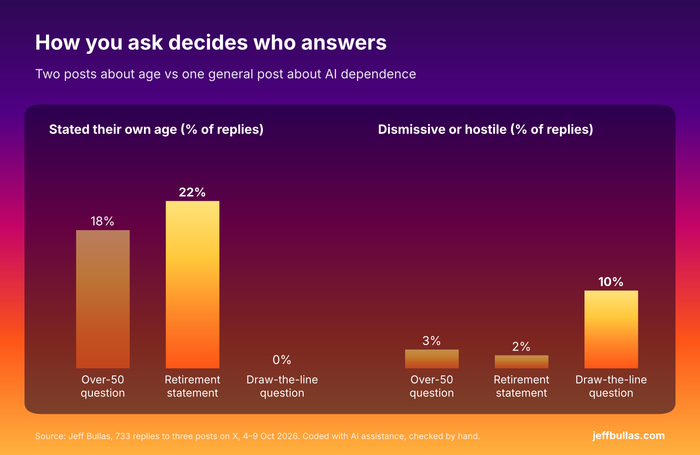
The research project, which spanned the first week of October 2026, utilized a series of direct inquiries on the social platform X to solicit unfiltered perspectives from individuals over 50. By coding 733 replies from approximately 675 unique participants based on stance, core themes, and stated age, the study provides a granular view of how veteran workers perceive their relevance in an era defined by generative AI. The findings challenge the assumption that older workers are passive victims of technological disruption.
Chronology of the Inquiry
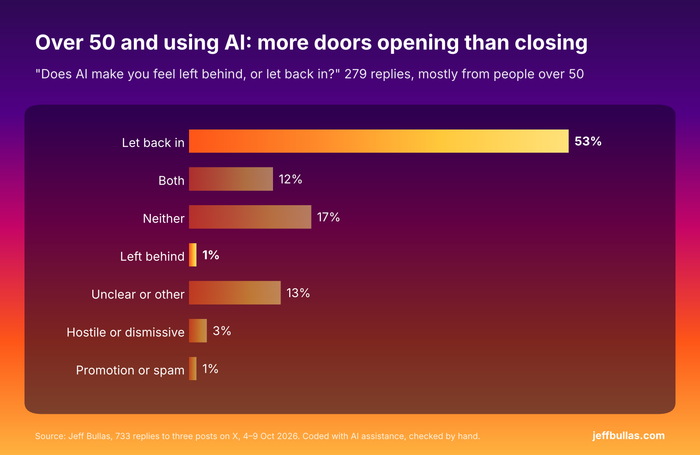
The investigation began on the night of Sunday, October 4, 2026, when an open-ended question was posed to the platform’s user base: "Honest question for anyone over 50. Does AI make you feel left behind, or let back in?" By Thursday, October 8, the query had garnered 279 replies and reached over 18,000 impressions.
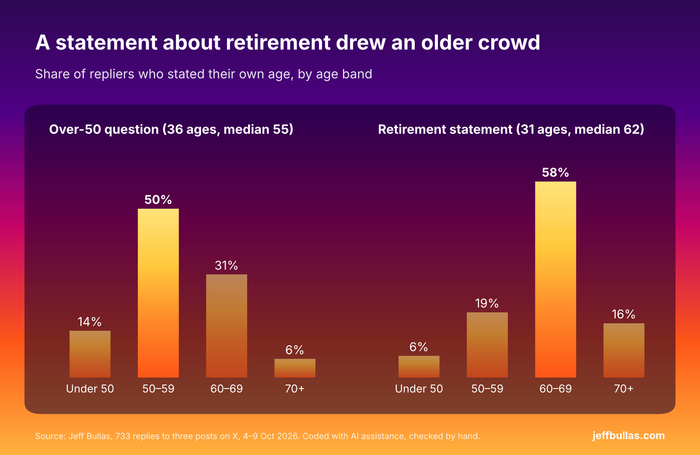
Following the initial response, two follow-up prompts were introduced to refine the data collection. The first, a reflective statement on the transition from retirement planning to active entrepreneurship, and the second, a philosophical inquiry into the boundary between professional assistance and cognitive dependence, were designed to probe deeper into the psychological implications of AI integration. The resulting data set offered a window into the lived experience of a demographic often overlooked in mainstream tech discourse.
Data Analysis and Key Findings
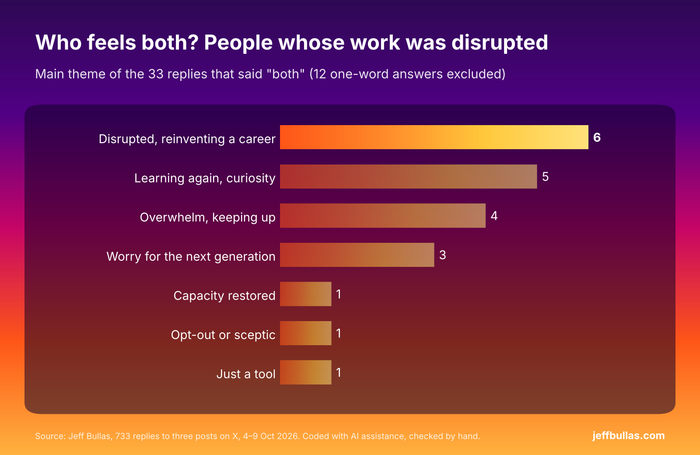
The data presents a clear departure from the "fear-based" narrative. Among the 279 respondents to the primary question, 53% explicitly stated that AI had "let them back in," providing them with renewed opportunities for professional engagement. A further 12% reported feeling both enabled and disrupted, while 17% expressed a neutral stance, viewing AI strictly as a tool. Remarkably, only 1% of respondents—totaling three individuals—identified with the feeling of being "left behind."
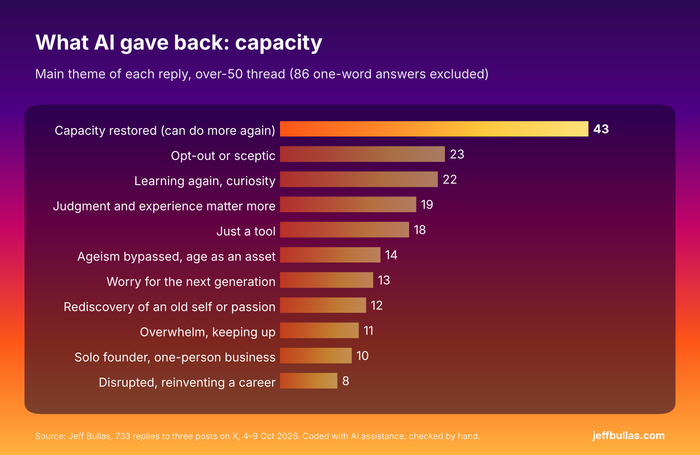
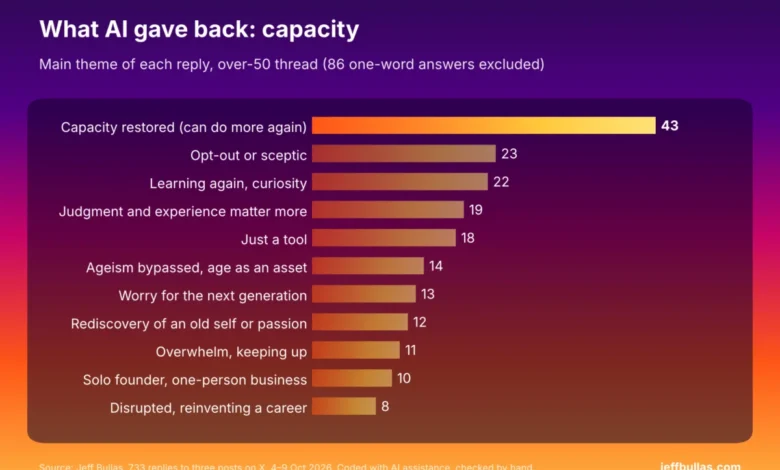
One of the most significant takeaways from the study is the concept of "capacity restoration." Many respondents noted that while their ability to perform manual or labor-intensive tasks had waned with age, AI allowed them to bridge that gap. One respondent, a woodworker, drew a compelling analogy: "I am a woodsman that had a hatchet and now have a chainsaw." This sentiment was echoed by others who found that AI enabled them to execute complex projects—such as software development or creative writing—that had previously been physically or temporally impossible due to professional burnout or age-related strain.
Categorizing the Experience: The Six Archetypes
The qualitative analysis of the 733 replies identified six distinct archetypes within the over-50 demographic:
- The Capacity Restorers: Individuals who utilize AI to overcome age-related physical or cognitive limitations, allowing them to remain productive at a high level.
- The Rediscoverers: Professionals who use AI to re-engage with past passions—such as coding, music, or literature—that they had abandoned earlier in their careers.
- The Solo Founders: Entrepreneurs who are leveraging AI to run businesses that previously would have required large teams and significant venture capital.
- The Disrupted Reinventors: A subset of professionals who have faced significant career setbacks due to AI-driven market shifts and are currently in the process of rebuilding their professional identities.
- The Overlooked Experts: Experienced individuals who possess deep, institutional knowledge but struggle to find a market or platform that values their "judgment-first" approach over the "energy-first" approach of younger cohorts.
- The Content Retirees: Individuals who have successfully transitioned away from the workforce and view AI with healthy skepticism or indifference.
The Conflict of Purpose vs. Productivity
While the data suggests that older workers are finding new ways to stay productive, it also reveals an underlying existential anxiety. A 63-year-old respondent captured this succinctly: "The script isn’t really the problem; it’s that it ends with nobody needing you."
This finding aligns with broader sociological research, including a September 2026 report from Elon University, which found that 64% of Americans believe AI will undermine human purpose and meaning. For the over-50 demographic, the struggle is not necessarily one of technical aptitude, but of maintaining a sense of relevance in a labor market that is increasingly skewed toward rapid, AI-driven output. The fear is not that they will be replaced by a machine, but that they will be excluded from the human connections that work provides.
The Dependence Dilemma
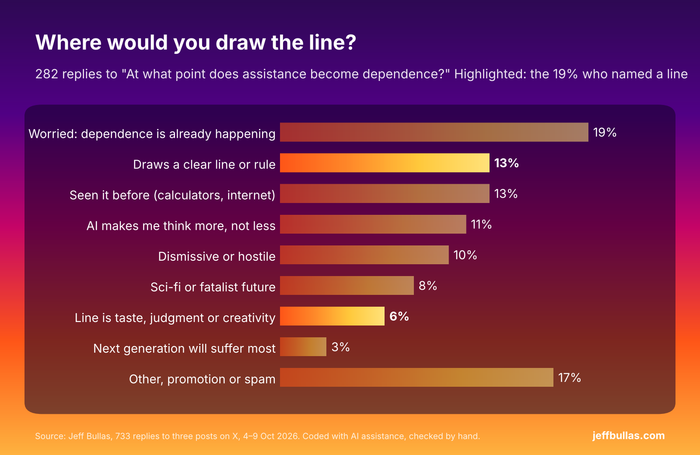
A significant portion of the discourse focused on the tension between "assistance" and "dependence." When asked where to draw the line between using AI as a tool and becoming reliant upon it, the responses were deeply divided.
Approximately 20% of respondents expressed concern that reliance on AI is already eroding critical thinking skills. Comparisons were frequently made to GPS technology or the decline of manual mathematical proficiency in education. However, a counter-perspective emerged: for many, AI is an intellectual multiplier. One retired respondent noted that they had "used more math in the last 12 months than in the preceding 30 years," because AI allowed them to tackle problems they previously lacked the confidence to approach.
The consensus among the most successful users of AI was a "human-in-the-loop" strategy. By formulating ideas independently first, then using AI to challenge, refine, or expand upon those concepts, users could maintain their critical thinking faculties while leveraging the tool’s efficiency.
Generational Nuance: The Youth Paradox
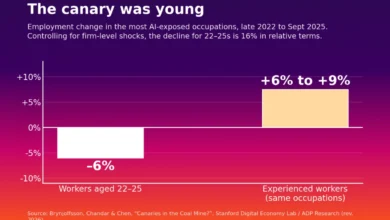
Perhaps the most surprising finding of the study was the contrast in perspectives between older and younger cohorts. While public discourse often frames the elderly as the most vulnerable to AI-related anxiety, the data suggests the opposite. According to 2025 data from the Pew Research Center, 61% of Americans under 30 expect AI to make people worse at creative thinking, compared to only 40% of those aged 65 and older.
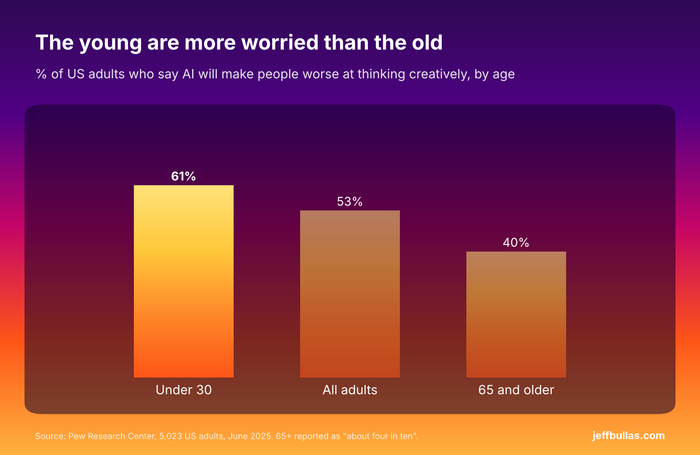
This suggests that older workers, having already established their professional identities and core skills, are better positioned to integrate AI as a tool rather than viewing it as a systemic threat to their career development. Younger workers, who are currently competing against AI for entry-level roles, feel the pressure of disruption more acutely.
Professional and Economic Implications
The findings carry significant implications for employers and the broader economy. The combination of seasoned, judgment-heavy experience and AI-driven efficiency appears to be an underpriced asset in the modern labor market. As the population ages, the potential for "un-retirement"—or the return of experienced workers to the workforce with the help of AI—could reshape labor supply dynamics.
However, institutional barriers remain. The cost of returning to work, including pension structures and tax complexities, often discourages older individuals from re-entering the professional arena. For those who are making the transition, the challenge is not just technical training, but the strategic identification of where their unique "judgment" is most valuable.
Ultimately, the research indicates that the "over-50 opportunity" is not about teaching older individuals how to use software. It is about helping them recognize that their decades of experience—honed through trial, error, and institutional memory—provide a layer of quality control and strategic oversight that AI cannot replicate. As the workforce continues to evolve, the most successful individuals will likely be those who refuse to hand over the "thinking" that made them valuable in the first place, using technology instead as a lever to amplify, rather than replace, their human contribution.