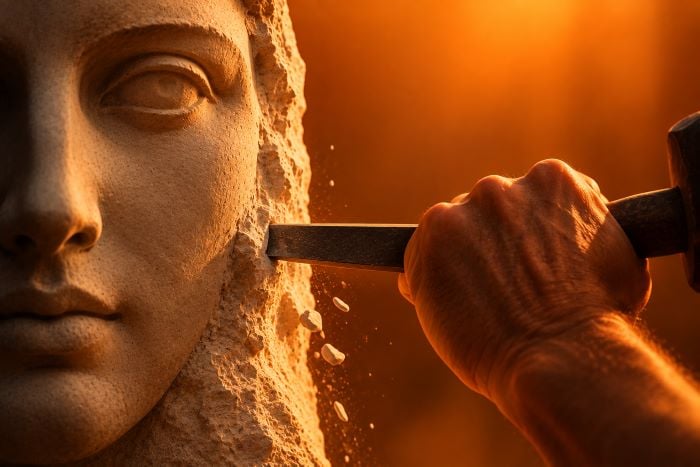
Ten years ago, a visitor walking through the halls of the Musée Rodin in Paris might have operated under the common misconception that every stroke of a chisel on the museum’s masterpieces was made by Auguste Rodin himself. This belief in the singular, solitary genius—the "maker" who touches every inch of a work—is a cornerstone of how society traditionally views creative output. However, historical records from the museum reveal a more nuanced reality: Rodin, while the conceptual heart of his work, operated a sophisticated studio. He relied on a network of skilled practitioners to enlarge and reduce models, marble carvers to translate plaster into stone, and foundries to handle the complexities of bronze casting. Even renowned sculptor Camille Claudel contributed to the intricate details of pieces attributed to him. Despite this collaborative reality, history continues to label these works simply as "a Rodin."
This dichotomy between the concept of a creator and the physical labor of production has taken on new urgency in 2026. As generative artificial intelligence becomes an integrated tool in professional writing, media, and design, the definition of authorship is undergoing a systemic transformation. The current debate mirrors the historical reality of the artist’s studio, forcing a transition from the era of the "maker" to the era of the "architect."
The Mechanics of Modern Production: From Rodin to Koons
The shift toward delegation is not unique to the digital age; it has been a gradual trend in high-stakes creative industries. A recent profile in the New York Times regarding Jeff Koons provides a contemporary lens for this transition. In his prime, Koons maintained a studio staff of over 100 people, including artists tasked with meticulously hand-copying old masters. While his operation has evolved, the reliance on advanced systems remains constant: digital modeling, laser scanning, standardized lighting protocols, and paint-by-numbers precision.
Koons characterizes his methodology as a rigorous system of control, ensuring that every hue, gesture, and dimension aligns with his specific intent. This process raises a fundamental question: if the artist does not physically touch the final product, who made the art? The traditionalist view suggests the team; the more analytical view suggests that Koons authored the work through the design of the system and the imposition of his creative vision. This distinction is the critical pivot point for modern knowledge workers, writers, and creative directors navigating the integration of AI tools.
The Productivity Paradigm: Data and Efficiency
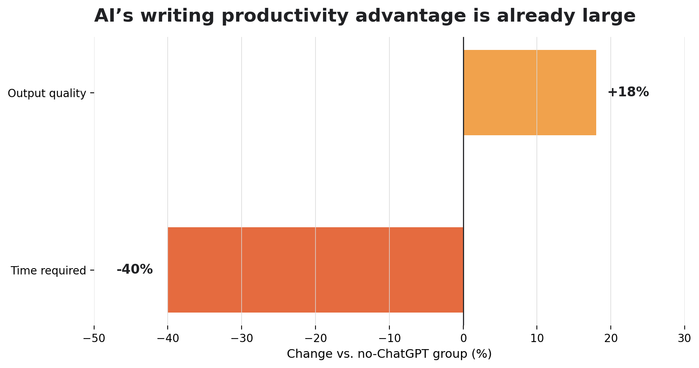
The adoption of AI in the workplace has transitioned from an experimental phase to a measurable productivity catalyst. A 2023 study published in the journal Science by researchers Shakked Noy and Whitney Zhang quantified this impact. In an experiment involving 453 college-educated professionals, participants were tasked with various writing assignments. The results indicated that access to tools like ChatGPT reduced task completion time by an average of 40 percent while simultaneously increasing the assessed quality of the output by 18 percent.
This is not a marginal shift in workflow; it is a fundamental disruption of the labor model. For writers, consultants, and marketers, this speed creates a seductive, albeit dangerous, temptation. It offers the ability to automate the "friction" of writing—researching, structuring, and drafting—which can lead to a significant increase in output. However, as the research indicates, speed is not synonymous with authorship.
The Danger of the Fragile Director
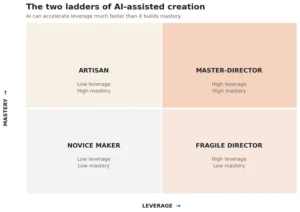
The transition from "sentence maker" to "architect of meaning" carries a significant risk: the decoupling of leverage from mastery. Historically, masters like Rodin were able to delegate because they had spent decades mastering the physical craft of sculpture. They possessed an internal model of what constituted excellence, allowing them to provide precise, expert direction to their assistants.
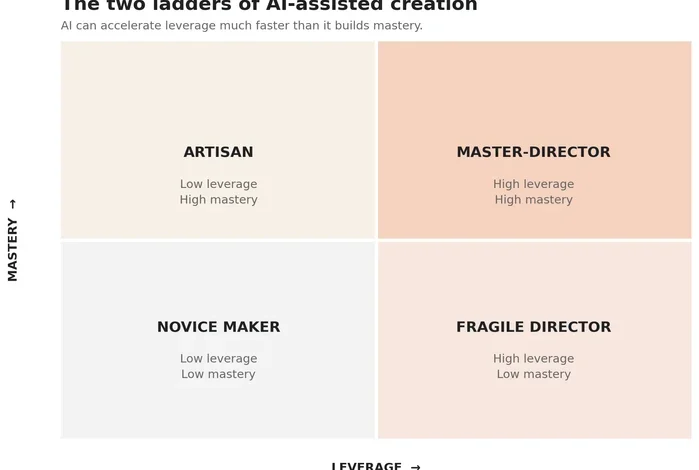
In the AI era, users are often encouraged to leap to the "director" role before they have climbed the "mastery" ladder. This creates a new archetype: the "fragile director." This individual can generate high volumes of polished content at extraordinary speed but lacks the foundational craft to evaluate whether the output is genuinely valuable or merely aesthetically pleasing. A 2026 review in Trends in Cognitive Sciences highlights the risk of "cognitive offloading," where delegating cognitive tasks to AI can lead to skill atrophy. If a writer stops the practice of wrestling with complex arguments or refining sentence rhythm, they lose the ability to judge the machine’s output, eventually becoming a mere conduit for algorithmic averages.
The Homogenization Paradox
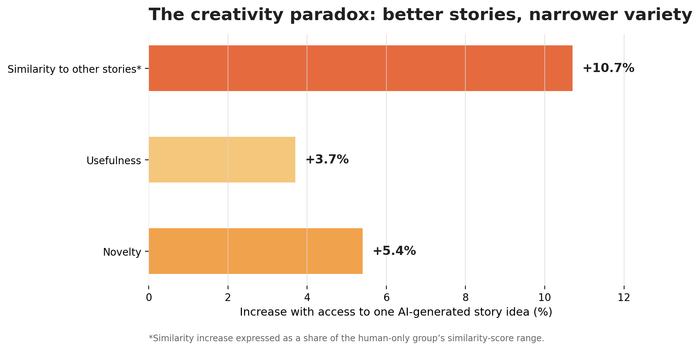
The integration of AI into creative processes introduces a paradoxical effect on quality and originality. Research from Science Advances involving researchers Anil Doshi and Oliver Hauser revealed that while AI-generated ideas can improve the perceived creativity and utility of a story, they also lead to a "homogenization effect." When writers use AI to brainstorm, their final products tend to cluster around a statistical mean, losing the idiosyncratic edges that define unique human expression.
Further evidence of this trend was found in a 2025 study of 2,200 college admissions essays, which noted that human-authored essays introduced semantic diversity at a rate two to eight times higher than those generated by base-level AI models. A 2026 meta-analysis covering 19 studies confirmed that human-AI co-creation consistently tends toward a reduction in stylistic variance. This phenomenon has fueled the rise of the term "AI slop"—a term popularized in 2025 by Merriam-Webster—referring to the glut of low-quality, derivative digital content. However, experts suggest that "slop" is merely a symptom of a larger problem: the abdication of creative responsibility. When humans outsource curiosity, point of view, and judgment to a machine, the resulting work may be grammatically perfect but intellectually vacant.
Redefining Authorship for the 21st Century
As the legal and professional standards of authorship evolve, the U.S. Copyright Office’s 2025 report on AI provides a framework for this transition. The report suggests that while AI can function as an assistive tool without invalidating copyright, authorship remains anchored in human selection, arrangement, and creative modification. Simple prompting is insufficient; the human must remain the "authoritative architect" of the work.
Authorship today can be distilled into five core responsibilities that transcend the act of typing:
- Origin: Determining the fundamental reason for the work’s existence.
- Intent: Establishing the clear purpose and message.
- Direction: Curating the research and defining the boundaries of the argument.
- Judgment: Exercising critical discernment to ensure the work is true, useful, and original.
- Responsibility: Assuming public accountability for the work’s content and claims.
These responsibilities require the creator to be "present" throughout the process, even if they are not the primary generator of the text.
Toward a Master-Director Framework
The future of creative work lies in a hybrid model: the "master-director." This individual combines the high leverage provided by AI with the high mastery gained through years of deliberate practice. This model requires a dual-track development process. The first track is the mastery of the craft itself—the ability to write, analyze, and synthesize thought without the crutch of automation. The second track is the development of systemic design—the ability to use technology to multiply that mastery.
The ultimate test of authorship in the AI age is not the percentage of machine-generated words. Rather, it is whether the work would exist in its current, specific form without the human behind it. Did the piece originate from a human observation? Did the human challenge the evidence? Did the human make the final call on what belongs and what does not?
If the goal of the modern creator is to avoid the trap of "abdication," they must distinguish between friction that wastes life and "formative friction." Transcribing an interview or formatting a bibliography is mechanical labor; wrestling with an argument or finding the precise word to express a complex thought is formative. To lose the latter is to lose the craft of thinking itself. As technology continues to expand the horizon of what can be produced, the most valuable skill for the future will not be the speed of production, but the intentionality of the direction. The challenge for the next generation of thinkers is to ensure that while AI expands the scope of their thought, it does not dictate its destination.