ArrowJS and the Rise of Agentic UI Frameworks: Rethinking Web Development for the Age of AI Coding Agents

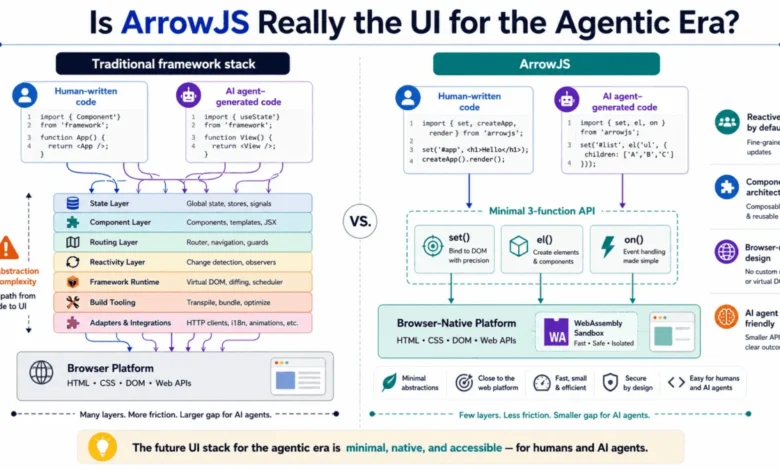
The rapid evolution of artificial intelligence and Large Language Models (LLMs) has fundamentally transformed the software development lifecycle. For the past decade, the foundational paradigm of web development has operated on a predictable three-tier assumption: human developers write the code, frameworks structure it, and browsers render it. Popular JavaScript ecosystems such as React, Vue.js, and Angular were meticulously architected to prioritize human ergonomics, cognitive readability, and robust component lifecycles. However, as autonomous coding assistants, agentic workflows, and generative AI development environments like Claude Code, GitHub Copilot, and Cursor transition from experimental novelties to mainstream production tools, this human-centric assumption is facing unprecedented pressure.
AI agents now routinely generate substantial portions of production-grade code across global engineering teams. Yet, as developers and AI researchers have quickly realized, frameworks optimized for human cognitive patterns are frequently poorly suited for automated agents. Statistical pattern-matching models frequently struggle with the hidden complexities, strict ordering constraints, and non-native syntax requirements of traditional web frameworks. Common failure modes include broken React hook rules, improperly managed component state, hallucinated JSX syntax, and complex build configurations that require manual debugging.
In response to these systemic limitations, the release of ArrowJS version 1.0 has introduced a radical paradigm shift. Positioned by its maintainers as the first UI framework built specifically for the agentic era, ArrowJS addresses the friction between AI generation capabilities and web execution environments. For data scientists, machine learning engineers, and software architects designing autonomous agentic workflows and generative user interfaces, the emergence of agent-optimized frameworks signals a transformative inflection point in how applications are conceptualized, built, and deployed.
The Architectural Mismatch Between AI Agents and Legacy Frameworks
To evaluate the necessity of agent-native frameworks, industry analysts must examine why dominant JavaScript frameworks introduce persistent friction for autonomous coding agents. React, commanding over 39 percent of global developer adoption, provides a powerful architecture for human developers who have thoroughly internalized its core philosophies. Nevertheless, these abstractions carry significant cognitive overhead that translates into structural vulnerabilities for generative AI.
In React, hooks must strictly maintain the exact same execution order across every render cycle. The delicate distinction between controlled and uncontrolled input components frequently leads to subtle bugs, while JSX requires compilation steps that prevent native browser execution without a transformer toolchain. When an AI coding assistant generates React code, it relies on statistical probability derived from billions of training tokens. Consequently, obscure edge cases and complex state transitions frequently produce syntactically plausible code that fails silently or crashes at runtime.
Vue.js offers a more approachable template syntax and a highly optimized reactivity system, introducing a gentler learning curve for human developers. However, it still interposes a substantial layer of framework-specific conventions between raw developer intent and underlying browser DOM manipulation. For an autonomous agent, this abstraction layer remains a primary source of unpredictability and hallucination. Similarly, Svelte minimizes runtime overhead by compiling components directly into vanilla JavaScript, but enforces its own unique compiler syntax, forcing the agent to master Svelte-specific DSLs rather than foundational web standards.
Across the entire spectrum of legacy frameworks, the core dilemma remains consistent. Each platform introduces proprietary abstractions that demand specialized knowledge beyond standard ECMAScript specifications. While these layers provide immense value to human engineers managing large-scale enterprise applications, they function primarily as noise for statistical token predictors, diminishing the reliability and autonomy of AI coding agents.
Core Architecture and Innovations of ArrowJS
ArrowJS was designed from the ground up to eliminate the abstractions that render traditional frameworks hostile to automated agents. The core design philosophy rests on a minimalist hypothesis: by aligning framework primitives directly with native web platform standards, both human engineers and machine agents can reliably generate, verify, and execute correct code without complex toolchains.
The execution model of ArrowJS relies on three foundational pillars designed for maximum transparency and minimal token overhead:
- Elimination of Compilers and Build Steps: ArrowJS completely bypasses JSX, proprietary template compilers, and complex build pipelines. Instead, it leverages standard JavaScript tagged template literals to define user interface components. The absence of a transformation step means code runs natively in modern browsers, while the entire core runtime library weighs in at under 5 kilobytes.
- A Minimalist Three-Function API Surface: The entirety of the ArrowJS API is encapsulated within three functions:
reactive,html, andcomponent. These primitives manage reactive state binding, DOM templating, and component composition, respectively. Notably, the entire framework documentation fits within a fraction of a standard LLM context window—roughly 5 percent of a 200,000-token limit. This ensures that an AI agent can ingest, process, and reason about the complete framework specification simultaneously without context degradation. - WebAssembly Sandboxes for Autonomous Code Generation: Perhaps its most disruptive feature for modern application architecture, ArrowJS integrates native WebAssembly (Wasm) sandboxing packages. This system compiles agent-generated JavaScript or TypeScript code into isolated Wasm binaries running securely away from the host application. This architecture permits real-time, natural-language-driven UI generation—enabling users to describe dynamic interfaces that agents instantly build, compile, and render safely in production without exposing the application to the security vulnerabilities of native
eval()execution or the layout constraints of traditional iframes.
Industry Implications and Strategic Trade-Offs
Despite its innovative positioning, adopting an emerging framework like ArrowJS involves significant strategic and technical trade-offs for enterprise engineering organizations. The primary barrier to mainstream enterprise adoption is ecosystem maturity. React’s enduring dominance is anchored not merely by its API design, but by a decade-long accumulation of third-party component libraries, robust design systems, extensive hiring pipelines, and millions of community discussions. With a relatively modest open-source footprint, ArrowJS currently operates at a distinct disadvantage regarding immediate enterprise integration.
Furthermore, critics argue that optimizing frameworks specifically for current AI limitations may represent a transitional strategy rather than a permanent architectural requirement. Large language model architectures, reasoning capabilities, and training methodologies are advancing at an exponential rate. Models that struggle with React hook rules today are systematically improving, and major generative UI platforms—such as v0 and Lovable—deliberately focus on React precisely because its massive training dataset ensures superior code generation quality.
Despite these caveats, the relevance of agent-optimized frameworks becomes acutely apparent when examining specialized domains, particularly data science and machine learning application development. Traditional data tooling stacks—such as Streamlit, Gradio, and FastAPI—excel at rapid backend prototyping and analytical dashboarding. However, they frequently lack the flexibility required for dynamic, agent-driven user interfaces. For organizations constructing generative data explorers, adaptive analytical dashboards, and conversational enterprise workflows where autonomous agents must instantiate custom UI elements on demand, ArrowJS provides specialized infrastructure that traditional frameworks cannot easily replicate.
Market Chronology and Outlook
The conceptual shift toward agent-native infrastructure accelerated significantly throughout 2024 and 2025, driven by the explosive growth of autonomous software engineering agents like Devin, Cursor, and Claude Engineer. As engineering workflows shifted from human-led coding with AI assistance to AI-led development with human supervision, the architectural bottlenecks of legacy frameworks became undeniable performance barriers.
By early 2026, the stabilization of ArrowJS 1.0 marked a formal milestone in addressing these systemic engineering challenges. Industry observers note that while mass migration from React or Vue to minimalist runtime libraries remains unlikely in the near term, the design principles pioneered by ArrowJS are heavily influencing the next generation of web tooling. Framework designers are increasingly evaluating how future libraries can reduce syntactic overhead, support zero-build execution models, and accommodate autonomous generation pipelines.
Conclusion
ArrowJS does not seek to dethrone React as the default choice for large-scale, human-engineered enterprise applications. Instead, its introduction initiates a vital industry conversation: as autonomous AI agents evolve from experimental assistants into core contributors within modern software engineering teams, the foundational tools of the web must adapt to accommodate their operational constraints.
By minimizing API surface areas, removing proprietary compilation steps, and introducing isolated WebAssembly sandboxing for untrusted generated code, ArrowJS offers a concrete blueprint for the future of agentic web development. Whether this minimalist philosophy becomes an industry standard or remains a specialized solution for generative UI applications will depend on the rapid trajectory of artificial intelligence capabilities and the strategic choices of software architects worldwide. For data scientists and machine learning engineers pioneering the next wave of autonomous, AI-driven applications, monitoring the evolution of agent-friendly infrastructure is no longer optional—it is an essential component of modern technical strategy.