Ten years ago, a visitor walking through the Musée Rodin in Paris might have been struck by the simplicity of the artist’s legacy: the assumption that every curve of marble and every textured bronze surface was the singular result of Auguste Rodin’s own hands. However, a deeper investigation into the studio records of the 19th-century master reveals a far more complex reality. Rodin was not merely a solo sculptor; he was the center of a sophisticated network of specialized craftspeople, including expert plaster casters, marble carvers, and foundry workers. He functioned as a director, orchestrating the talents of others—such as his protégé Camille Claudel—to realize his creative vision. This historical precedent provides a critical lens for the modern debate surrounding generative artificial intelligence: if the hand that strikes the chisel is not always that of the master, where does the true authorship lie?
As generative AI tools like ChatGPT, Claude, and Gemini become deeply integrated into the creative and professional workforce, the question of authorship has moved from an aesthetic debate to a central issue of professional integrity. The rapid adoption of these technologies has created a divide between those who advocate for a rigid, "pure" human-only creative process and those who embrace a model of AI-augmented production.
The Chronology of Cognitive Offloading
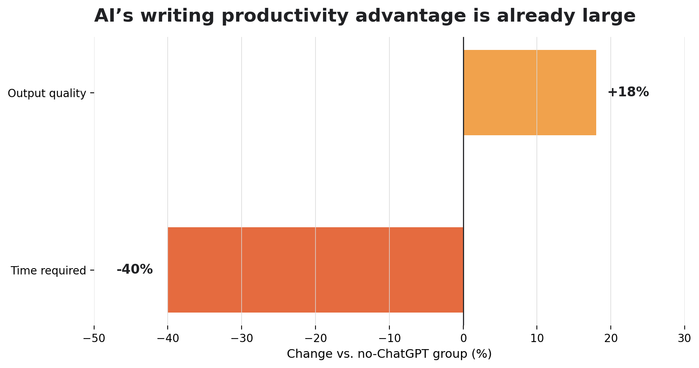
The integration of AI into professional writing tasks has occurred with unprecedented speed. By 2023, empirical studies began to quantify the impact of large language models on workforce efficiency. A randomized control trial conducted by Shakked Noy and Whitney Zhang, involving 453 college-educated professionals, demonstrated that access to generative AI reduced task completion time by 40% while simultaneously increasing the quality of the output by 18% as assessed by independent reviewers.

This shift represents a transition from "maker" to "architect." Historically, technological advancements—from the printing press to word processors—have moved human labor up the abstraction stack. The writer is no longer merely a sentence-maker; they are increasingly acting as a creative director. However, this transition is not without its risks. A 2026 review in Trends in Cognitive Sciences highlighted the dangers of "cognitive offloading," noting that delegating core intellectual tasks to machines can result in skill atrophy. The study suggests that while efficiency gains are immediate, the long-term cost may be a decline in the critical judgment required to curate and verify AI-generated content.
The Paradox of Homogenization
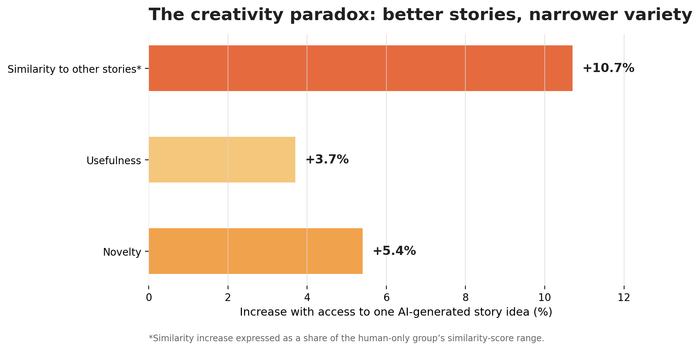
While AI can significantly boost individual productivity, large-scale data analysis indicates a concerning trend toward stylistic convergence. A 2024 experiment published in Science Advances by Anil Doshi and Oliver Hauser revealed that while AI-assisted writers produced stories rated as more novel and useful, the resulting narratives became statistically more similar to one another. The research found that access to a single AI-generated idea increased the similarity between stories by 10.7% compared to human-only control groups.
This phenomenon of homogenization is further supported by a 2025 analysis of 2,200 college admissions essays. The study found that human-authored essays demonstrated semantic diversity at a rate two to eight times higher than those generated by base models of GPT-4. By 2026, a meta-analysis spanning 19 separate studies confirmed that there is a small but statistically significant "homogenization effect" in human-AI co-creation. This suggests that without intentional human intervention, AI models tend to revert to the "average" of their training data, potentially leading to a cultural landscape characterized by what has colloquially become known as "AI slop"—content that is grammatically flawless but intellectually derivative.
Legal and Ethical Frameworks of Authorship
The legal community is currently grappling with how to define authorship in a post-AI world. In 2025, the U.S. Copyright Office released a comprehensive report on artificial intelligence, clarifying that while AI-generated output itself cannot be copyrighted, the human role in selecting, arranging, and modifying AI-produced material can meet the threshold for authorship. The report distinguishes between "assistive tools"—where the human retains creative control—and "generative autonomy," where the machine acts as the primary author.
Industry experts argue that this legal distinction provides a roadmap for professional ethics. If a writer uses AI to perform "frictionless" tasks—such as reformatting citations, transcribing interviews, or performing rote data entry—they are effectively using the machine as a tool to expand their capacity. However, when the machine is tasked with defining the argument, structuring the narrative, or deciding the core message, the human participant has abdicated their role. The ethical threshold, therefore, rests on the concept of "formative friction": the process of wrestling with an argument, testing counter-theories, and refining language, which is essential to the development of human judgment.
Implications for the Future of Professional Writing
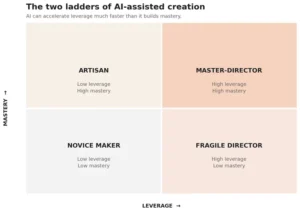
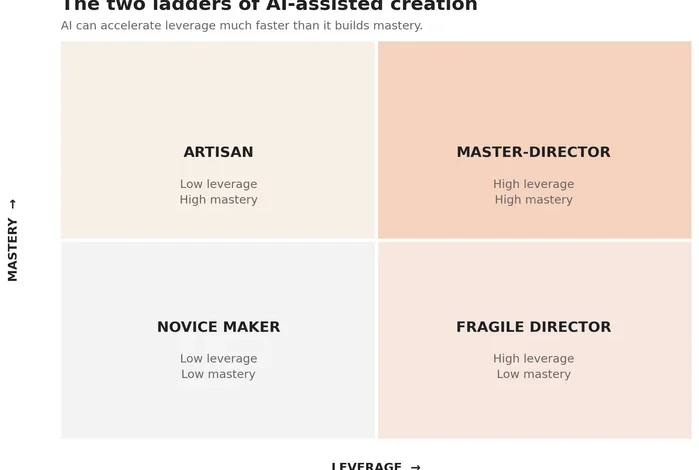
The challenge for the modern professional is to avoid the trap of the "fragile director"—the individual who possesses high leverage through AI but lacks the foundational mastery to evaluate the output. Rodin could effectively manage a team of carvers because he understood the physical properties of marble and the anatomy of the human body. Similarly, a master-director in the age of AI must possess the craft to know when the machine’s output is flawed, biased, or unoriginal.
The distinction between delegation and abdication is critical. Delegation is the act of using technology to multiply human intent; it requires the author to remain fully present throughout the creative process. Abdication, by contrast, is the act of treating the machine as the source of truth, effectively reducing the human to a mere distributor of automated content.
As the industry moves forward, the value of human authorship is likely to shift away from technical execution and toward the quality of the "input"—the lived experience, the specific point of view, and the unique curiosity that an algorithm cannot replicate. Professional writers are being forced to define what is worth their attention in an era of infinite content generation.
Analysis: Toward a New Model of Creativity
The future of creative work appears to be bifurcating into two distinct paths. On one side is the proliferation of high-volume, low-value content—the "slop" that fills digital voids. On the other is a renewed emphasis on "intentional authorship," where AI is used to handle the labor-intensive aspects of production, freeing the creator to focus on high-level synthesis and original thought.
This shift necessitates a change in how we measure success. Productivity metrics like "words per hour" are becoming obsolete, replaced by "insight per project" and the ability to defend the intellectual validity of the work. Organizations that successfully navigate this transition will likely be those that prioritize the development of human expertise, ensuring that even as tools become more capable, the individuals operating them remain deeply engaged in the craft.
Ultimately, the rise of AI is not a signal of the end of authorship, but rather a catalyst for its redefinition. Just as photography forced painters to move away from mere realism and toward abstract expressionism, AI is forcing writers to move away from mere word generation and toward a deeper, more intentional form of direction. The most successful creators will be those who can act as the architect of their own ideas, utilizing the machine to amplify their voice while maintaining the rigorous standards of quality and judgment that define genuine mastery. The question for the next decade is not what AI can do, but what we will choose to do with the leverage it provides. The responsibility remains, as it always has, with the author.
Related posts: