Russian Enterprises Under Siege: Analysis of NightEagle, Hacking Cat, and Toy Ghouls Threat Campaigns

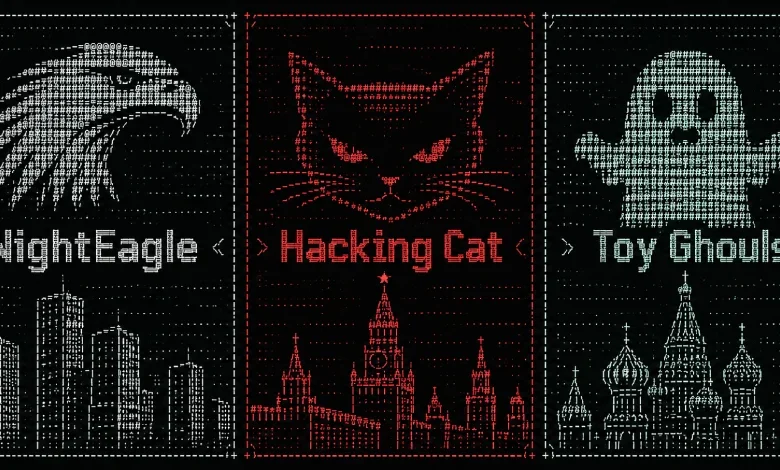
The landscape of cybersecurity threats targeting Russian infrastructure has undergone a significant transformation, characterized by the emergence of three distinct, highly active threat clusters: NightEagle, Hacking Cat, and Toy Ghouls. According to comprehensive technical reports released by Kaspersky, these entities are systematically infiltrating corporate environments, deploying modular backdoors, and, in some cases, pivoting toward destructive ransomware and wiper operations. This surge in activity represents a multifaceted challenge for Russian organizations, as the attackers leverage a combination of public domain exploits, sophisticated tunneling techniques, and novel command-and-control (C2) communication methods to maintain persistence and evade detection.
The NightEagle APT: Persistence and Lateral Movement
NightEagle, also identified in security circles as APT-Q-95, has maintained a consistent operational tempo since its identification in 2023. Recent forensic analysis indicates that the group has moved beyond basic intrusion techniques, adopting advanced persistence and lateral movement strategies that challenge standard enterprise defenses.
The group’s primary attack vector centers on the exploitation of compromised valid credentials, which are utilized to gain unauthorized access to corporate Virtual Private Networks (VPNs). Investigators have traced these connections to a variety of sources, including IP addresses within the Russian segment routed through Cloudflare WARP tunnels, as well as infrastructure hosted by European virtual private server (VPS) providers. This geographic obfuscation is designed to frustrate incident response teams attempting to isolate the source of the breach.
Once initial access is established, NightEagle deploys GhostContainer, a modular backdoor specifically engineered to target Microsoft Exchange Servers. By masquerading as a legitimate server component, the malware effectively blends into the noise of standard server operations. GhostContainer is a testament to the "living off the land" philosophy, incorporating several publicly available open-source projects—such as the Neo-reGeorg tunnel and exploits for the CVE-2020-0688 vulnerability—to perform file operations and execute arbitrary code.
The delivery mechanism for GhostContainer remains a subject of investigation, though experts hypothesize that the attackers utilize the extraction of server-side cryptographic keys from ASP.NET configurations. By overwriting the VIEWSTATE framework parameter, the actors inject a memory-resident payload that bypasses traditional file-system integrity checks. Once inside the network, NightEagle prioritizes the exploitation of Active Directory vulnerabilities, specifically leveraging legacy flaws like the BlueKeep vulnerability (CVE-2019-0708) to create local administrative accounts and conduct DCSync attacks to harvest domain controller credentials.

The Evolution of Hacking Cat: From Defacement to Destruction
If NightEagle represents the methodical, espionage-oriented side of the current threat landscape, Hacking Cat signifies a more volatile, ideologically motivated shift. Originally categorized as a pro-Ukrainian hacktivist entity known for website defacements and low-level data exfiltration beginning in February 2024, the group has recently pivoted toward high-impact destructive operations.
This shift has been marked by a collaborative operational model. Hacking Cat has been observed working in tandem with the Cyber Anarchy Squad and the Ukrainian Cyber Alliance. This coordination has introduced significant complexity in attribution, as the shared use of custom-built tools—such as the Go-based Gorilla RAT and the diverse Monkey ransomware family—suggests a centralized development pipeline rather than disparate individual efforts.
Gorilla RAT is particularly notable for its capability to establish persistent TCP tunnels, allowing operators to map internal network segments and execute commands remotely. The subsequent deployment of Monkey ransomware, which targets Windows, Linux, and VMware ESXi systems, demonstrates a level of technical maturity rarely associated with traditional hacktivism. The ransomware is written in multiple languages—including Rust, .NET, C++, and Golang—and is designed to terminate critical processes and clear system recovery points before initiating encryption.
Kaspersky analysts have noted that some variants of the Monkey ransomware function effectively as wipers, as they lack the capability to restore encrypted files, suggesting either extreme negligence in development or a deliberate intent to maximize damage. Interestingly, the discovery of remnants of AI-assisted code generation within these toolkits has sparked debate regarding the group’s technical pedigree. In response to these findings, Hacking Cat publicly disputed parts of the attribution via Telegram, claiming that while they utilize some of the identified tools, they are not responsible for the entire range of lockers linked to their operations.
Toy Ghouls: A Shift Toward Bespoke Tooling
Toy Ghouls, also known as Bearlyfy or Feral Wolf, represents the financially motivated segment of the current threat environment. Active since 2025, the group has moved away from utilizing off-the-shelf ransomware builders like Babuk and LockBit, opting instead for a transition toward proprietary, custom-built backdoors.
The group’s latest evolution, detected in July 2026, involves the deployment of a custom backdoor dubbed "Bird Agent." This malware is delivered primarily through Windows Remote Management (WinRM) protocols, utilizing tools like Evil-WinRM to move through a compromised environment. Bird Agent is designed to be highly modular, binding itself to the specific hardware configuration of the victim machine by deriving its encryption keys from the Windows Registry’s MachineGuid value.

What sets Toy Ghouls apart from its peers is its innovative use of non-standard C2 infrastructure. Instead of relying on traditional HTTP or DNS-based command servers, the Bird Agent communicates via the HiveMQ MQTT broker or the Matrix-based Element messenger. By utilizing these platforms, the attackers can mask their traffic as legitimate instant messaging or IoT communication, significantly lowering the probability of detection by network-based intrusion detection systems (NIDS).
Broader Implications and Strategic Analysis
The concurrent activity of these three groups highlights a critical inflection point for Russian enterprise security. The shift toward custom-built backdoors and the integration of diverse programming languages for malware development reflect a maturing threat landscape where the "barrier to entry" for sophisticated operations has been lowered by the availability of open-source components and collaborative development environments.
From a defensive standpoint, the tactics employed by NightEagle, Hacking Cat, and Toy Ghouls underscore the necessity of moving beyond signature-based detection. Because these actors frequently utilize legitimate administrative tools—such as WinRM, PowerShell, and various tunneling utilities—the focus must shift toward behavioral analysis and the strict monitoring of lateral movement within the network.
Furthermore, the collaboration between hacktivist entities and their apparent access to a shared pool of malware developers suggests that the "hacktivist" label may no longer accurately reflect the threat level. These groups are increasingly capable of performing operations that mirror the sophistication of state-sponsored Advanced Persistent Threats (APTs).
The implications for victims are severe. The combination of credential theft, Active Directory compromise, and the deployment of both ransomware and wipers means that a single successful breach can result in the total loss of administrative control over a corporate domain. For the security community, the task ahead is twofold: first, to deconstruct the shared toolsets currently being utilized by these groups to understand their common origins; and second, to harden internal network infrastructures against the abuse of legitimate administrative protocols that are currently being weaponized at an unprecedented scale.
As the situation evolves, international security observers remain focused on the potential for these campaigns to escalate. The transition from espionage to disruption—and from disruption to permanent data destruction—suggests that these actors are not merely seeking short-term gains but are instead refining their capabilities for more sustained, impactful campaigns against regional targets. Organizations operating within the region are advised to conduct immediate audits of their Microsoft Exchange and VPN configurations, implement robust multi-factor authentication, and monitor for the presence of the specific tunneling tools and custom backdoors identified in these recent campaigns.