
AI productivity is easy to demonstrate. Revenue impact is harder. When revenue questions come up in leadership updates, the answers often turn vague, focusing less on numbers and more on signals. A three-layer framework helps you show what AI delivers at each stage and what must happen before its impact reaches the revenue line.
As artificial intelligence moves from the experimental phase of 2023 into the operational maturity of 2026, the corporate narrative is shifting. Early excitement regarding generative AI—characterized by rapid prototyping and individual productivity boosts—is being replaced by intense scrutiny from CFOs and boards. Organizations are now entering a "prove it" era, where the initial infusion of capital into AI infrastructure must be reconciled with tangible P&L performance.
The Attribution Gap in Modern Enterprise AI
The current tension in boardrooms stems from a fundamental misunderstanding of the AI lifecycle. While teams can demonstrably ship faster and optimize workflows, revenue remains a lagging indicator. Attribution is further complicated by the reality that AI is rarely the sole driver of a sale; it is an accelerant for existing processes that are already subject to complex, multi-touch marketing and sales attribution models.
Data from the National Bureau of Economic Research confirms the productivity uplift, noting that access to generative AI assistants increases customer support resolution rates by roughly 14%. Similarly, research from GitHub indicates that developers using AI-assisted coding tools complete tasks 55% faster. Despite these operational efficiencies, a significant disconnect persists. The MIT 2025 State of AI in Business report highlighted a sobering statistic: 95% of generative AI pilots at large enterprises currently produce no measurable return on the bottom line. This suggests that while organizations have successfully deployed tools, they have failed to map those tools to the financial architecture of the business.

A Three-Layer Framework for Strategic Alignment
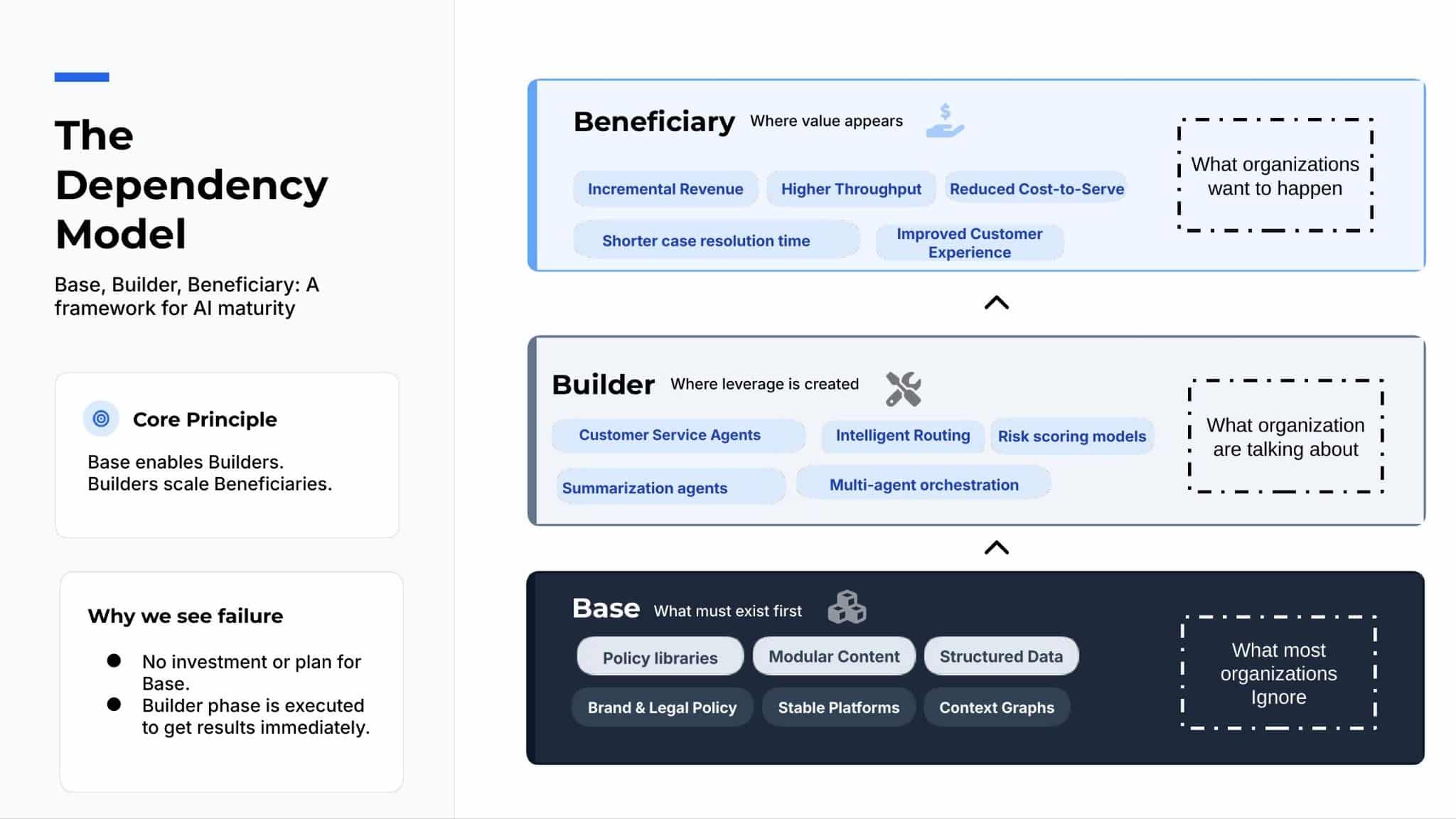
To bridge the gap between technical output and financial outcomes, leaders must adopt a structured, three-layer framework. By categorizing initiatives as Base, Builder, or Beneficiary projects, executives can provide stakeholders with a clear roadmap of how AI moves from a cost center to a revenue driver.
Layer 1: The Base (The Foundation of Trust)
The Base layer represents the structural integrity of an organization’s AI efforts. This includes the consistency of data, the codification of brand and policy guidance, the stability of the tech stack, and the creation of an audit trail for decision logic.
Without this layer, scalability is impossible. If data is scattered across disparate folders or team-specific inboxes, an agent built on that data will eventually experience "hallucinations" or provide inconsistent outputs. Investing in the Base layer is unglamorous but essential; it is the difference between a project that works in a sandbox and one that functions reliably in a high-stakes production environment.
Layer 2: The Builder (The Construction of Systems)
Once the Base is secured, the Builder layer focuses on construction: workflows, autonomous agents, routing logic, and systemic automation. This is where the enterprise defines the "how." For instance, an automated audience segmentation workflow or an AI-driven ticket routing system exists here.
Updating leadership on this layer does not require a revenue metric; rather, it requires metrics of reliability, scope control, and process efficiency. The objective at the Builder layer is to ensure that the system is becoming more disciplined and less prone to manual intervention.
Layer 3: The Beneficiary (The Realization of Value)
The Beneficiary layer is the final stage where the impact of the previous two layers is converted into business results. This includes reduced cost-to-serve, increased throughput, shorter turnaround times, and ultimately, incremental revenue. This is the only layer where ROI questions can be answered with precision. By clearly delineating these three layers, leaders can stop apologizing for a lack of revenue data and start explaining the sequence of maturity required to achieve it.
Chronology of the AI Maturity Curve
The industry’s transition toward this framework follows a clear timeline. Throughout 2023 and early 2024, the "Gold Rush" phase prioritized volume of deployment—getting any AI tool into the hands of employees to test the waters. By mid-2025, the focus shifted toward "Industrialization," where companies realized that disparate, siloed AI tools were creating technical debt rather than value.
In the current landscape of late 2026, the focus has moved to "Integration and Governance." Organizations are now auditing their stacks, consolidating vendors, and creating the "Base" layers described in the framework. This evolution reflects a broader trend: the market is punishing generalist experimentation and rewarding specialized, well-governed AI infrastructure.
Strategic Implications: The Lab-Factory Model
To maintain momentum while building a stable foundation, leading enterprises are adopting the "Lab-Factory" model. In this setup, the Lab serves as the testing ground for new, high-risk ideas, while the Factory manages the stable, production-grade systems.
The danger for most companies is failing to define a "graduation gate" between the two. When projects linger in the Lab, they never provide value; when they are rushed into the Factory, they break systems and lose trust. Establishing clear thresholds—such as stability metrics for the Base or accuracy benchmarks for the Builder—ensures that only high-quality initiatives reach the Beneficiary stage.

Why Breadth Often Undermines Depth
Data from the Boston Consulting Group (BCG) supports the case for focus over sprawl. Research indicates that companies concentrating on roughly 3.5 primary AI use cases generate more than double the ROI of firms that attempt to scale dozens of smaller, disjointed pilots simultaneously.
This finding underscores a critical strategic lesson: Depth beats breadth. When a company attempts to use AI to solve everything at once, they often fail to secure the "Base" for any of them. By limiting the number of active initiatives, organizations can ensure that each project moves sequentially through the Base, Builder, and Beneficiary layers, effectively creating a sustainable, long-term competitive advantage.
Reframing the Leadership Conversation
The next time a leadership team asks for the revenue impact of an AI project, the response should not be a defense of the technology, but a clear articulation of its stage. If an initiative is at the Base layer, the conversation should be about risk mitigation and future-proofing. If it is in the Builder phase, the discussion should center on reliability and scaling. Only when the initiative reaches the Beneficiary stage should the conversation be about P&L impact.
This shift in communication is essential. It moves the discourse from "What is AI doing for our revenue?" to "Where are we in the lifecycle of our AI investments?" This transparency creates trust, prevents the premature abandonment of valuable projects, and ensures that resources are allocated where they can produce the most significant long-term impact. As the enterprise AI market continues to mature, those who can clearly map their efforts to this framework will likely be the ones to successfully transition from pilot-stage experimentation to sustained, profitable AI-driven growth.