North Korean Cyber Operatives Orchestrate Global Financial Espionage Through Sophisticated Contagious Interview Campaign

A sophisticated and long-standing cyber-espionage and financial theft campaign, identified by security researchers as "Contagious Interview," has successfully compromised at least 30,000 devices across more than 100 countries. Orchestrated by state-linked North Korean threat actors, the operation has systematically targeted individual web designers, blockchain engineers, and Web3 specialists, resulting in the theft of over $10.71 million in cryptocurrency and the illicit harvesting of sensitive corporate and personal credentials from more than 7,000 digital wallets.
The severity of this campaign has triggered a rare, high-level joint cybersecurity advisory issued by intelligence and law enforcement agencies from Japan, the United States, Australia, and Germany. This collaborative warning highlights the evolving nature of North Korean cyber operations, which have shifted from large-scale institutional attacks to granular, human-centric social engineering schemes designed to infiltrate the global technology workforce.
The Anatomy of the Contagious Interview Campaign
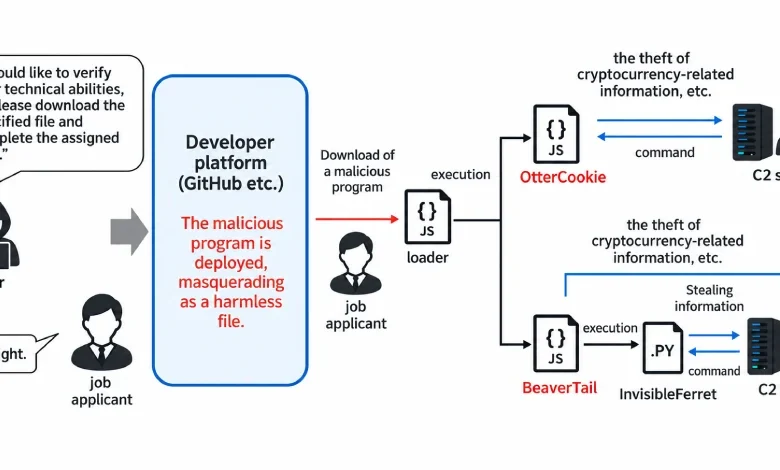
The Contagious Interview campaign represents a departure from traditional malware distribution. Instead of relying solely on zero-day exploits, the threat actors utilize a multi-layered social engineering framework. Operating under a variety of monikers—including WaterPlum, PurpleBravo, DEV#POPPER, and Famous Chollima—these actors pose as prospective employers or high-level recruiters on professional networking platforms such as LinkedIn.
By presenting lucrative job offers in the competitive tech and cryptocurrency sectors, the attackers establish rapport with unsuspecting software developers. Once a candidate expresses interest, they are invited to complete a "coding test" or a "job assessment." This step acts as the catalyst for the infection chain. Upon executing the provided materials, victims inadvertently install a suite of sophisticated malware, including the notorious BeaverTail and InvisibleFerret families.

These tools grant the attackers persistent backdoor access, allowing them to exfiltrate proprietary source code, private keys, and sensitive internal documentation. In many instances, the ultimate goal is not just the immediate theft of cryptocurrency, but the long-term infiltration of the target’s employer. By compromising a legitimate developer, the actors gain a foothold into corporate networks, facilitating intellectual property theft, espionage, and potential lateral movement into secure environments.
Chronology and Operational Evolution
The campaign, which has been under intense observation since at least 2022, has demonstrated a remarkable ability to adapt to changing defensive measures. Palo Alto Networks’ Unit 42 was among the first to document the early iterations of this strategy, noting the group’s focus on macOS-based malvertising.
The operation has since matured, integrating advanced "laptop farms"—physical arrays of devices managed by facilitators in jurisdictions like Japan and the U.S.—to mimic legitimate traffic and evade geographic security blocks. Intelligence assessments from 2025 and 2026 have confirmed that these clusters are deeply intertwined, frequently sharing infrastructure and IP addresses, suggesting a centralized command-and-control structure linked to the 313 General Bureau of the North Korean Munitions Industry Department.
The integration of artificial intelligence into these workflows marks a critical turning point. As noted by cybersecurity firm Sekoia, the current iteration of the North Korean IT worker program is an evolution of a decades-old practice involving the state-mandated dispatch of laborers to earn foreign currency. By using AI to generate realistic personas, resumes, and deepfake imagery, these operatives can maintain consistent communication with recruiters and corporate entities, effectively bypassing identity verification and anti-money laundering (AML) protocols.
The Rise of Proxy Hiring and Discord Recruitment
A significant expansion of this threat involves the use of "proxy hiring" to circumvent international sanctions. Recent investigations by Silent Push have uncovered evidence of North Korean actors utilizing the messaging platform Discord to recruit Western and Latin American individuals as proxies.

In this scheme, the North Korean actor performs the actual technical labor behind the scenes, while the proxy—often a financially incentivized local—acts as the "face" of the employee, attending video interviews and handling administrative communications. The financial arrangement is typically split, with the proxy receiving 35% of the compensation and the North Korean actor retaining 65%.
These proxies are essential for the regime’s objectives, as they allow the actors to pass KYC (Know Your Customer) checks and regional hiring restrictions. By embedding themselves into the payroll of legitimate Western companies, the actors not only generate hard currency but also secure a "trusted" status that provides deeper access to sensitive corporate assets. The "Mouse Review" Discord server serves as a primary example of this shift, where recruitment ads explicitly promise that the proxy only needs to handle "communication," while the technical heavy lifting is performed remotely by the state-sponsored operative.
Broader Implications and Strategic Analysis
The implications of this campaign extend far beyond the immediate financial losses. The successful infiltration of thousands of devices in over 100 countries suggests a systemic vulnerability in the current global hiring and remote-work landscape. As businesses increasingly rely on distributed teams and global talent pools, the attack surface for such operations has expanded exponentially.
From a geopolitical perspective, the revenue generated by these campaigns serves as a vital lifeline for North Korea’s weapons programs, providing the foreign capital necessary to bypass international sanctions. The joint advisory from international agencies underscores a growing realization that cybersecurity is now a pillar of national security.
The dismantling of a laptop farm in Japan, as noted in the recent advisory, serves as a significant tactical victory, but experts warn that the modular nature of the infrastructure makes it highly resilient. The actors can easily pivot to new VPN nodes, utilize different communication channels, and refine their social engineering tactics to exploit the latest trends in the tech industry.

Recommendations and Mitigation Strategies
For organizations and individual developers, the advisory provides clear, actionable guidance. Security agencies emphasize the need for rigorous verification processes for new hires, including:
- Enhanced Background Checks: Beyond standard identity verification, companies should implement more thorough checks, including video-verified interviews that incorporate randomized technical questions.
- Endpoint Security: Organizations should enforce strict device management policies and prohibit the use of unapproved software or external test files during the interview process.
- Behavioral Monitoring: Security teams should monitor for suspicious activity, such as remote access tools running during standard work hours or unexpected geographic anomalies in employee login patterns.
- Credential Hygiene: Developers working with cryptocurrency or sensitive intellectual property must employ hardware-based authentication and ensure that private keys are never stored on devices that have been exposed to external assessment tools.
The "Contagious Interview" campaign serves as a stark reminder that the human element remains the most vulnerable component of any security infrastructure. As North Korean actors continue to weaponize professional ambition and the demand for technical talent, the global cybersecurity community must remain vigilant, collaborative, and proactive in identifying and neutralizing these sophisticated threats before they can gain a foothold in the global economy.
As the situation develops, international cooperation will be paramount in disrupting the infrastructure that sustains these operations. The convergence of state-level espionage and cybercrime has fundamentally changed the risk landscape, necessitating a shift toward a "zero-trust" approach to hiring and remote collaboration in the modern digital age.