Abbott Laboratories Faces Dual Cybersecurity Crisis as Extortion Groups Claim Massive Data Breaches Targeting Cancer Diagnostics and Lab Systems


Abbott Laboratories, a global leader in medical diagnostics and healthcare technology, is currently navigating a complex and multi-faceted cybersecurity crisis following reports of two separate digital intrusions. The Chicago-based multinational has confirmed an investigation into unauthorized access within its Cancer Diagnostics business, specifically involving legacy systems associated with its Exact Sciences acquisition. Simultaneously, the company is contending with claims from a second threat actor alleging a breach of its LabCentral customer portal, which serves its core laboratory diagnostics division. These incidents highlight the escalating vulnerability of the medical technology (MedTech) sector, which has become a primary target for sophisticated extortion groups seeking both sensitive patient data and proprietary intellectual property.
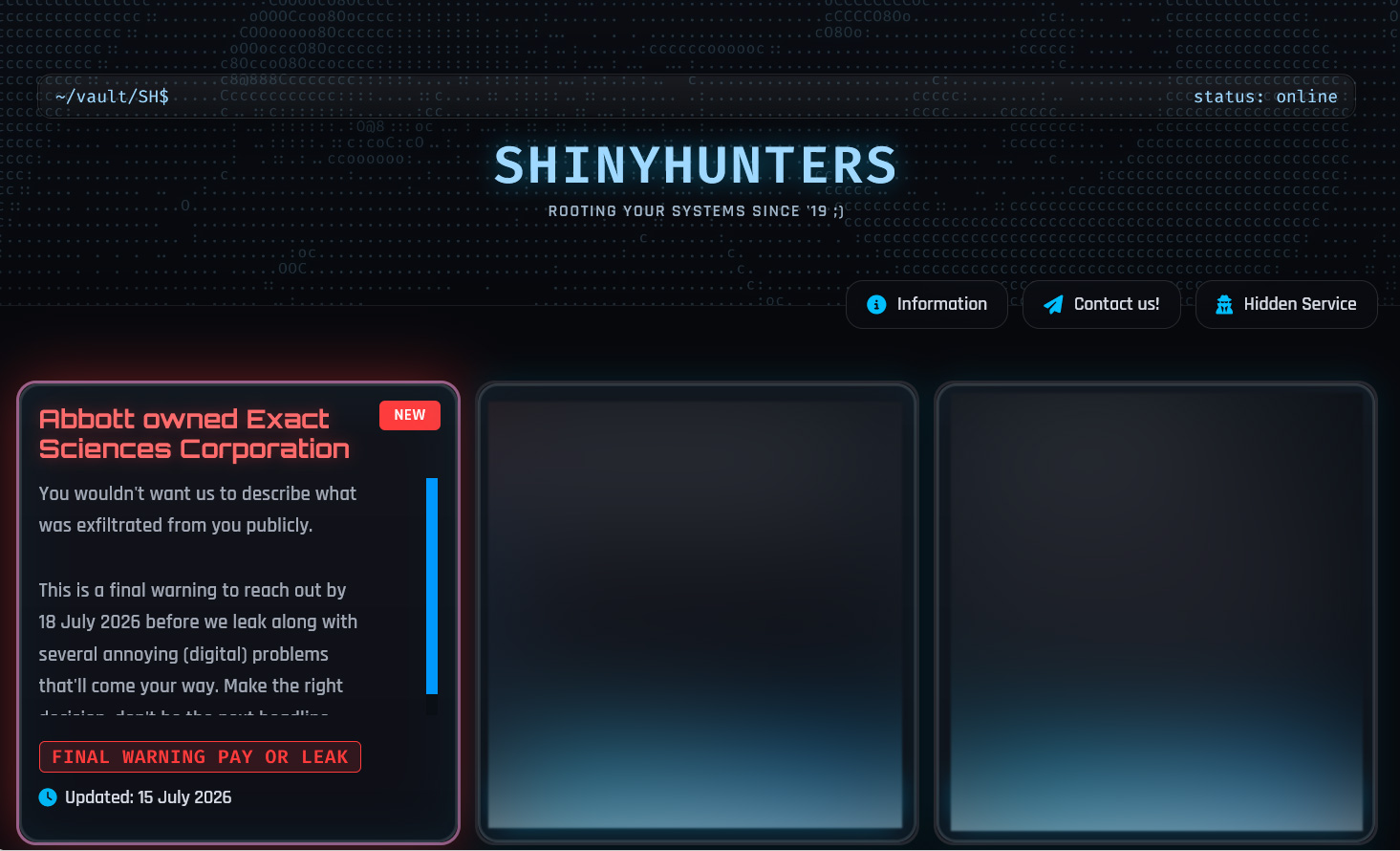
The first and more severe of the two reported incidents involves the notorious cybercriminal syndicate known as ShinyHunters. The group recently added Abbott to its public extortion site, initially setting a deadline of July 18 for the company to enter negotiations to prevent the release of stolen data. This deadline was subsequently extended to July 21, 2026. According to communications from the threat actors, the breach was initiated in mid-June through a highly targeted "vishing" (voice phishing) campaign. By impersonating IT personnel or trusted authorities, the attackers successfully deceived multiple Abbott employees, allowing them to compromise a Microsoft Entra single sign-on (SSO) account. This foothold allegedly granted the group broad access to various internal systems and cloud-based applications.
In a formal statement, Abbott acknowledged the breach but sought to characterize its scope as limited. The company confirmed unauthorized access to a restricted number of internal systems within its Cancer Diagnostics business. Crucially, Abbott emphasized that the affected infrastructure consists of legacy Exact Sciences systems, which are technically segregated from the company’s primary corporate network. "This does not impact any business operations, product or product availability, manufacturing or lab operations, or our ability to serve patients," the company stated, adding that it does not expect the incident to have a material impact on its financial results or overall business continuity.
However, the claims made by ShinyHunters paint a significantly more dire picture of the data exfiltration. The group asserts that they successfully moved laterally through Abbott’s environment, harvesting data from high-value platforms including ServiceNow, SharePoint, Databricks, and Coupa. The alleged haul includes more than 30 million rows of customer personally identifiable information (PII). This dataset reportedly contains names, physical addresses, phone numbers, email addresses, and dates of birth. Most alarmingly, the hackers claim to possess over one million Social Security numbers. Beyond standard PII, the group alleges they exfiltrated 22 million client notes documenting doctor-patient interactions and 20 million medical orders, alongside sensitive corporate documents such as non-disclosure agreements (NDAs) and customer contracts.

Chronology of the 2026 Abbott Cybersecurity Incidents
The timeline of these events suggests a concentrated period of activity during the summer of 2026:
- Mid-June 2026: ShinyHunters launches a vishing campaign against Abbott employees, successfully compromising Microsoft Entra SSO credentials.
- July 4, 2026: A separate threat actor, operating under the handle ShadowByt3$, claims to have gained access to the LabCentral customer portal using compromised credentials and exploiting a "weak point" in the API architecture.
- Early July 2026: Abbott detects unauthorized activity and activates its incident response protocols, engaging third-party cybersecurity experts and notifying federal law enforcement.
- July 15, 2026: ShinyHunters lists Abbott on its data leak site, threatening to publish data by July 18.
- July 17, 2026: Abbott issues a public statement confirming the investigation into the Cancer Diagnostics breach but disputing the severity of the LabCentral claims.
- July 18, 2026: ShinyHunters extends the ransom deadline to July 21, 2026, as negotiations or internal assessments continue.
The LabCentral Portal Intrusion
While the ShinyHunters incident focuses on patient and corporate data, the second alleged breach involving the LabCentral portal presents a different set of risks. The threat actor ShadowByt3$ informed security researchers that they spent several weeks slowly exfiltrating files from the portal by targeting specific API endpoints. LabCentral is an externally facing, third-party hosted platform used by Abbott’s core laboratory diagnostics business to provide technical documentation to clients.
ShadowByt3$ claims to have stolen sensitive business documents, including CE manufacturing certificates, technical specifications, regulatory filings, and product requirement archives. Unlike ShinyHunters, this group stated that they did not target customer PII, focusing instead on intellectual property and operational documentation.
Abbott’s response to this second claim has been dismissive regarding the sensitivity of the data. A company spokesperson clarified that LabCentral is designed to house "publicly available technical product reference documents," such as troubleshooting checklists and operating manuals. The company maintains that the portal does not contain proprietary or sensitive customer information, suggesting that while an intrusion may have occurred, the "stolen" data was largely information already intended for public or client consumption.
Threat Actor Profile: The Rise of ShinyHunters
The involvement of ShinyHunters is particularly concerning for Abbott and its stakeholders. This group has established a reputation for high-profile, large-scale data thefts targeting major corporations. Their tactics have evolved from traditional software exploitation to sophisticated social engineering. By targeting SSO providers like Microsoft Entra, Okta, and Google, they can bypass multi-factor authentication (MFA) and gain access to a company’s entire SaaS ecosystem, including Slack, Salesforce, and Microsoft 365.
In the past year, ShinyHunters has increasingly turned its attention toward the MedTech and healthcare sectors. The group was previously linked to data breaches at Medtronic, OneMedical, and AdaptHealth. They were also identified as the force behind the iRhythm data breach and a subsequent attempt to extort the medical device giant Stryker. This pattern suggests a calculated effort to exploit the healthcare industry’s reliance on interconnected cloud systems and the high "street value" of medical records on the dark web.
Technical Analysis and Vulnerability Trends
The Abbott incidents underscore a critical trend in modern cyber warfare: the vulnerability of the "human firewall." Despite billions of dollars spent on automated security solutions, the ShinyHunters breach was initiated through a phone call. Vishing remains an incredibly effective tool because it exploits the social norms of helpfulness and urgency. Once an SSO account is compromised, the "blast radius" of the attack expands exponentially, as the attacker can move seamlessly between disparate business applications without needing additional passwords.
Furthermore, the LabCentral incident highlights the risks associated with third-party hosted portals and API security. APIs (Application Programming Interfaces) are the connective tissue of modern digital services, but they are often poorly monitored. "Shadow APIs" or insecure endpoints can allow attackers to scrape data incrementally—a technique known as "low and slow" exfiltration—making detection difficult for standard perimeter defenses.
Broader Implications for the Healthcare Sector
The dual attacks on Abbott Laboratories serve as a stark reminder of the systemic risks facing the healthcare industry. As medical companies undergo digital transformation, their attack surface grows. The integration of legacy systems (such as those from the Exact Sciences acquisition) often creates security gaps where modern protections may not be fully implemented.
From a regulatory perspective, Abbott may face significant scrutiny. Under the Health Insurance Portability and Accountability Act (HIPAA) in the United States, the unauthorized disclosure of protected health information (PHI) can lead to substantial fines and mandatory multi-year audits. Additionally, the Securities and Exchange Commission (SEC) now requires public companies to disclose "material" cybersecurity incidents within four business days of determining their significance. While Abbott currently maintains that the incident is not material, a verification of the hackers’ claims regarding 30 million rows of PII could force a reassessment of that position.

The potential exposure of one million Social Security numbers and millions of doctor-patient notes also raises the specter of class-action litigation. Patients whose sensitive medical history is leaked are at risk not only of identity theft but also of medical fraud and personal distress.
Conclusion and Future Outlook
As of late July 2026, Abbott Laboratories remains in a state of high-alert investigation. The company’s internal security teams, bolstered by external forensic experts, are working to verify the extent of the data exfiltration and ensure that all entry points have been remediated. The divergence between the hackers’ claims and the company’s official statements is a common feature of modern ransomware and extortion cases, where "signal-to-noise" ratios are often skewed to increase pressure on the victim.
For the broader MedTech industry, the Abbott case is a call to action. It demonstrates that legacy systems, third-party portals, and employee susceptibility to social engineering remain the "Achilles’ heels" of even the most well-resourced organizations. As ShinyHunters and similar groups continue to refine their methods, the focus of corporate defense must shift from mere perimeter security to a "zero-trust" architecture that assumes compromise and focuses on limiting the movement of attackers within the network. The resolution of this incident will likely serve as a benchmark for how the medical technology sector handles dual-threat scenarios in an increasingly hostile digital landscape.
Related posts: