AWS Announces Managed Daemon Support for Amazon ECS Managed Instances to Streamline Platform Operations

Amazon Web Services has officially launched managed daemon support for Amazon Elastic Container Service Managed Instances, a strategic enhancement designed to provide platform engineers with independent control over essential operational software. This new capability builds upon the managed instances framework introduced in September 2025, addressing a long-standing friction point in container orchestration: the tight coupling of application code and operational tooling. By decoupling the lifecycle of daemons—such as monitoring, logging, and tracing agents—from the applications they support, AWS aims to significantly reduce the operational burden on enterprise platform teams while enhancing the overall reliability and security of containerized environments.
For years, managing containerized workloads at scale has required a delicate balancing act between infrastructure stability and application agility. Platform engineers, responsible for the underlying health and compliance of the cluster, often found themselves at the mercy of application development cycles. If a security patch was required for a logging agent, or if a monitoring tool needed an update, platform teams typically had to coordinate with various application owners to modify task definitions and trigger redeployments. In organizations managing hundreds or thousands of microservices, this coordination created significant bottlenecks, often delaying critical updates and leading to inconsistent tooling across the infrastructure. The introduction of managed daemons effectively eliminates this dependency, allowing platform teams to manage their own stack independently of the developers.
The Evolution of Managed Infrastructure in Amazon ECS
The journey toward fully managed container infrastructure has been a multi-year effort for AWS. In September 2025, the company introduced Amazon ECS Managed Instances, which simplified how users managed the underlying compute capacity for their ECS clusters. This allowed AWS to handle the scaling, patching, and lifecycle management of the Amazon EC2 instances within a cluster, effectively bridging the gap between the flexibility of EC2 and the "serverless" ease of AWS Fargate.
Despite the success of Managed Instances, the management of auxiliary software—often referred to as "sidecars" or "daemons"—remained a manual and often frustrating process. Traditionally, engineers had two primary methods for running these tools: including them as sidecars within an application’s task definition or baking them directly into the Amazon Machine Image (AMI). Both methods had drawbacks. Sidecars required application team intervention for updates, while custom AMIs added complexity to the image pipeline and made rapid updates difficult.
The launch of managed daemons represents the next logical step in this evolution. It introduces a dedicated "managed daemons" construct within the ECS ecosystem, allowing for a centralized management layer that operates across multiple capacity providers. This ensures that every instance provisioned within a specific environment automatically runs the necessary operational tools before any application code is even executed.
Decoupled Lifecycle Management and Reliability
The core innovation of the managed daemon feature lies in its decoupled lifecycle. Under this new model, managed daemons are guaranteed to start before application tasks and are the last to drain when an instance is decommissioned. This "start first, stop last" logic is critical for maintaining a continuous "line of sight" for logging and monitoring. In previous configurations, if an application started before the logging agent was ready, the initial—and often most critical—startup logs could be lost. Conversely, if a monitoring agent shut down before the application, the final metrics of a task’s lifecycle would vanish.
Furthermore, resource management is now centralized and granular. Platform teams can define CPU and memory parameters for their daemons independently of application configurations. This ensures that operational tools have the resources they need to function without over-provisioning the entire application task. Because each instance runs exactly one copy of the daemon that is shared across all application tasks on that host, resource utilization is optimized, leading to potential cost savings at the cluster level.

Technical Implementation and the Daemon Bridge
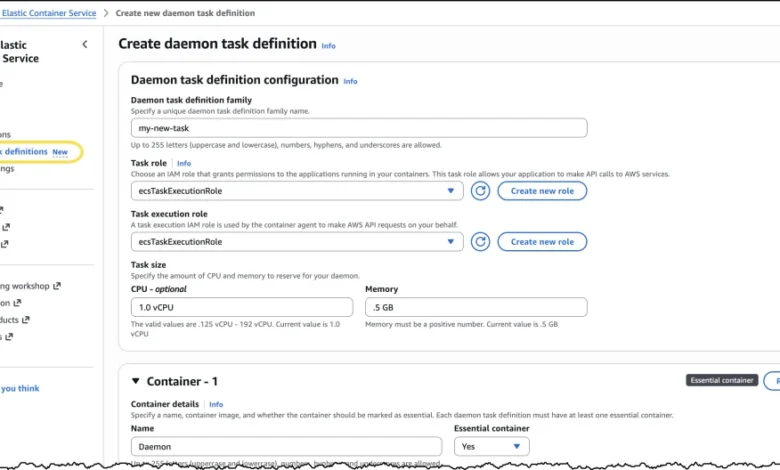
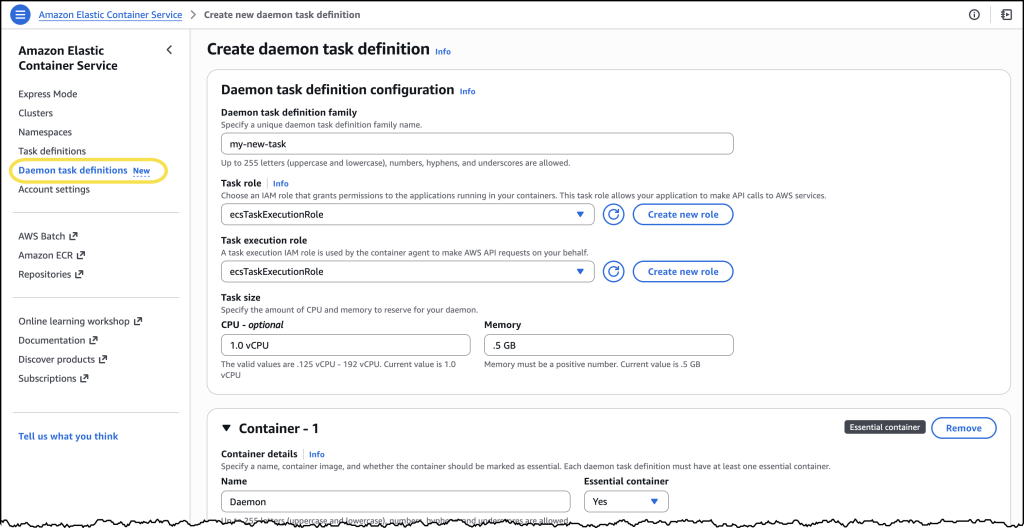
To facilitate this new level of management, AWS has introduced a new daemon task definition type. This definition is distinct from standard task definitions, featuring its own set of parameters and validation schemes tailored for host-level operations. One of the most significant technical additions is the daemon_bridge network mode. This specialized networking layer enables daemons to communicate with application tasks while remaining isolated from the specific networking configurations of those applications.
For security and deep-observability tools, managed daemons support advanced host-level access. Platform engineers can configure these tasks as privileged containers, allowing them to add specific Linux capabilities or mount paths directly from the underlying host filesystem. This is a vital requirement for modern security agents that need to monitor system calls, process tables, or host-level metrics to detect anomalies or potential breaches.
Operational Workflow: A Case Study in CloudWatch Integration
The practical application of managed daemons can be seen in the deployment of the Amazon CloudWatch Agent. In a typical scenario, a platform engineer initiates the process via the Amazon ECS console or API by creating a new daemon task definition. For instance, an engineer might allocate 1 vCPU and 0.5 GB of memory to a CloudWatch Agent container, pulling the image from the Public Amazon Elastic Container Registry (ECR).
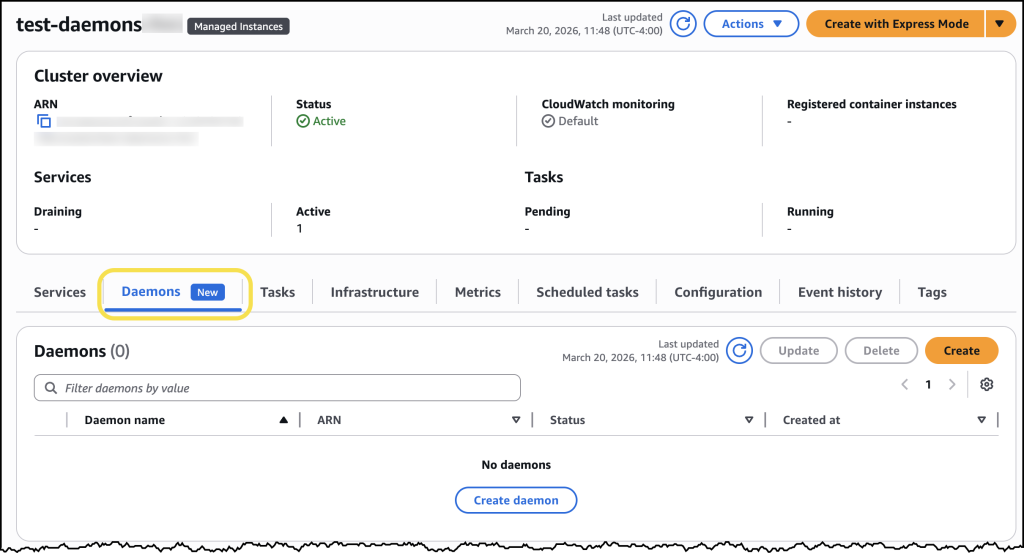
Once the daemon task definition is established, it is associated with an ECS Managed Instances capacity provider. From that point forward, the orchestration is automated. When a new instance is provisioned, ECS ensures the CloudWatch Agent is the first container to launch. As application services—such as an Nginx web server—are deployed, they land on instances already equipped with the necessary monitoring tools.
The update process is equally streamlined. When a platform team pushes an update to the daemon, ECS manages a rolling deployment. It provisions new instances with the updated daemon, migrates application tasks to these new hosts, and then terminates the legacy instances. A configurable "drain percentage" allows engineers to control the velocity of these updates, ensuring that infrastructure changes do not cause application downtime or data gaps.
Strategic Implications for Enterprise DevOps
Industry analysts suggest that this move by AWS aligns with the growing "Platform Engineering" trend, where dedicated teams build internal platforms to abstract away infrastructure complexity for developers. By providing a native way to manage daemons, AWS is reducing the "cognitive load" on application developers, allowing them to focus strictly on business logic rather than infrastructure telemetry.
From a compliance and security perspective, the implications are significant. Security teams can now mandate that every instance in a production cluster must run a specific version of a vulnerability scanner or a file integrity monitor. Because the platform team controls the daemon deployment, they can guarantee 100% coverage across the fleet without needing to audit every individual application’s task definition.
This update also positions Amazon ECS as a more formidable competitor to Kubernetes, specifically regarding the "DaemonSet" functionality. While Kubernetes has long offered DaemonSets, the AWS managed version integrates more deeply with the underlying EC2 lifecycle and AWS-managed capacity, offering a more "hands-off" experience for teams that prefer the ECS ecosystem over the complexity of Kubernetes.
Availability and Pricing
Managed daemon support for Amazon ECS Managed Instances is now available across all global AWS Regions, including standard regions, AWS GovCloud (US), and China regions. This broad availability ensures that global enterprises can standardize their operational workflows across their entire geographic footprint.
In terms of cost, AWS has maintained its standard "pay only for what you use" philosophy. There is no additional orchestration fee for using managed daemons. Customers are only responsible for the standard compute and memory costs consumed by the daemon tasks on their EC2 instances. Given the efficiency of running a single shared daemon per host rather than multiple sidecars per task, many organizations may see a net reduction in their overall compute spend.
As organizations continue to scale their containerized footprints, the ability to manage infrastructure tools independently of applications will likely become a baseline requirement. With the launch of managed daemons, AWS has provided a robust framework for platform teams to achieve higher levels of operational excellence, security, and reliability in an increasingly complex cloud landscape. To get started, users can access the new managed daemons API or utilize the Amazon ECS console to begin migrating their operational agents to this new managed model.