A Comprehensive Guide to Integrating Large Language Models with Scikit-Learn Using Scikit-LLM Estimators

The intersection of traditional machine learning workflows and modern generative artificial intelligence has long been characterized by friction, forcing data scientists to choose between the rigorous, standardized paradigms of libraries like scikit-learn and the ad-hoc, script-heavy reality of Large Language Model (LLM) API integrations. Historically, leveraging LLMs required writing custom wrapper scripts replete with loops over API endpoints, intricate string parsing logic, and defensive programming structures—such as try/except blocks—designed to catch instances where a model returned unstructured prose instead of a deterministic classification label. While these custom scripts achieved the functional goal of classification, they lacked the reusability, composability, and structural elegance of standard machine learning pipelines featuring automated cross-validation, integrated performance metrics, and hyperparameter tuning.
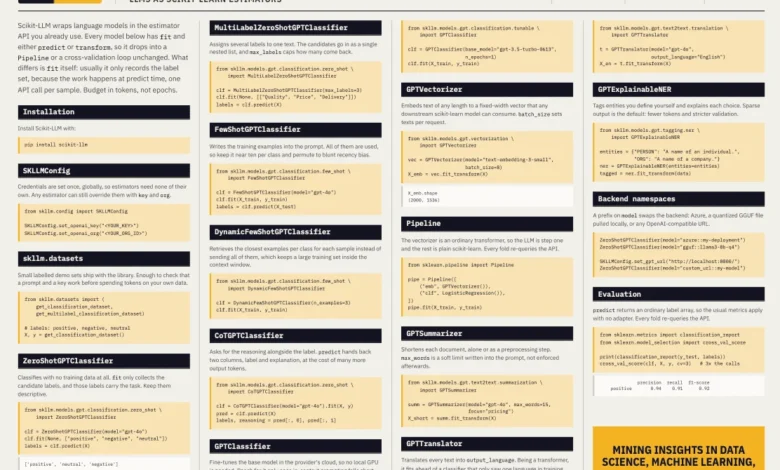
To bridge this operational divide, the development of Scikit-LLM introduced a standardized architecture that encapsulates large language models directly within the scikit-learn estimator application programming interface. By adhering to the familiar design patterns of the Python data science ecosystem, Scikit-LLM ensures that every integrated model implements standard methods such as fit, predict, and transform. Consequently, these advanced language models can be dropped natively into scikit-learn Pipelines, GridSearchCV objects, and cross-validation routines. This structural alignment allows practitioners to conceptualize, plan, and optimize their machine learning architectures in terms of tokens and standard estimator behaviors, a methodology further clarified by recently published technical documentation, including the Scikit-LLM Estimators Cheat Sheet.
Understanding the Mechanics of Scikit-LLM Estimators
The core philosophy of Scikit-LLM is to harmonize the inference capabilities of proprietary and open-source large language models with the established idioms of classical machine learning. In a traditional scikit-learn estimator, the fit method processes training data to learn internal parameters, such as regression coefficients or tree splits, which are subsequently applied during the predict phase. When utilizing Scikit-LLM estimators, however, the role of the fit method is often fundamentally altered. Because the foundational reasoning and pattern recognition capabilities are pre-trained into the underlying language model, the fit method frequently serves merely to record the target label set or configure systemic parameters, deferring the primary computational workload to the predict phase, where API calls are executed dynamically per sample.
Among the various estimators provided by the library, the ZeroShotGPTClassifier has emerged as one of the most frequently utilized components for text classification tasks. For practitioners accustomed to training models on large historical datasets, the initial experience of invoking the fit method with null data—such as passing None alongside a list of candidate labels—can appear counterintuitive. However, this design underscores a paradigm shift in modern artificial intelligence engineering: the explicit labels provided during initialization function as the task specification itself.
Because the language model relies heavily on semantic interpretation rather than statistical frequency learned from training sets, vague or ambiguous category labels invariably yield unpredictable or substandard classification results. Consequently, data scientists must treat classification labels as descriptive instructions rather than terse categorical indices. For scenarios where zero-shot inference proves insufficient due to domain-specific complexities or nuanced stylistic variations, the library offers the DynamicFewShotGPTClassifier. Rather than statically appending the entire training corpus to every prompt—a practice that rapidly exhausts token budgets and degrades model focus—this dynamic estimator intelligently retrieves the most contextually relevant examples per class for each individual sample, optimizing both accuracy and token consumption.
Advanced Pipeline Integration and Feature Engineering
Beyond direct classification, Scikit-LLM expands the utility of language models by integrating them into broader, multi-stage data processing pipelines. One of the most powerful architectural components in this regard is the GPTVectorizer. This estimator processes text strings of arbitrary length and projects them into fixed-width numerical vector spaces. By functioning as the initial step in a scikit-learn pipeline, the GPTVectorizer converts unstructured textual inputs into dense embeddings that can be seamlessly consumed by downstream, classical machine learning algorithms.
Under this hybrid architecture, an enterprise can leverage a large language model to distill semantic representations, while delegating the final classification or regression task to computationally efficient, highly interpretable algorithms such as logistic regression or support vector machines. This modular approach significantly reduces operational latency and inference costs during production deployment, as complex language models are invoked solely for feature extraction rather than end-to-end decision-making.
Furthermore, the library addresses multilingual data challenges through specialized utility estimators such as the GPTTranslator. Functioning as a transformer within a scikit-learn pipeline, the GPTTranslator can be positioned directly upstream of a downstream classifier that was exclusively trained on English-language corpora. By programmatically translating incoming multilingual text into a unified target language prior to classification, organizations can deploy robust predictive models globally without the capital-intensive requirement of retraining entire machine learning systems on diverse multilingual datasets.
Economic Implications and Token Cost Management
While the architectural synergy between scikit-learn and large language models offers unprecedented flexibility, it introduces significant economic and operational considerations that practitioners must carefully manage. The most critical constraint involves the financial and computational overhead associated with token consumption. In classical machine learning workflows, executing performance validation routines—such as a cross-validation score with a parameter of three (cv=3)—incurs negligible computational cost, relying solely on local CPU or GPU cycles.
When applied to Scikit-LLM estimators, however, identical validation procedures translate directly into a multiplicative increase in external API requests. A three-fold cross-validation routine triples the volume of API calls, a figure that escalates exponentially when combined with automated hyperparameter optimization techniques such as grid search. Habits and workflows that were economically negligible within traditional programming frameworks—such as iterative model tuning and exhaustive validation splits—can incur substantial financial expenditures when routed through commercial LLM endpoints. Consequently, data science teams must adopt rigorous cost-benefit analyses and implement aggressive caching mechanisms to mitigate runaway operational expenses.
Broader Industry Impact and Future Outlook
The emergence of libraries like Scikit-LLM reflects a broader maturation phase in the field of artificial intelligence engineering. As organizations transition from deploying isolated, experimental prompt-engineering scripts to constructing robust, enterprise-grade machine learning systems, the demand for standardized integration patterns has intensified. By anchoring advanced language model capabilities within the battle-tested paradigms of scikit-learn, developers can lower the barrier to entry for generative AI integration while preserving the structural integrity of their existing codebases.
This synthesis of classical machine learning and generative artificial intelligence provides a reliable pathway for developers seeking to harness the reasoning power of large language models without abandoning familiar development workflows. As technical documentation, cheat sheets, and community best practices continue to evolve, the integration of LLMs into traditional pipelines is expected to become an increasingly standardized practice across the software engineering and data science industries.