Proving Causation in AI Search: How seoClarity’s Split Testing Methodology Unlocked Tangible Results and New Google Search Console Data

The rapidly evolving landscape of artificial intelligence in search has presented a formidable challenge for marketers: how to accurately measure the impact of content optimizations on AI visibility. For too long, the industry has grappled with the distinction between correlation and causation in AI citations. However, a recent webinar hosted by Search Engine Journal, featuring experts from seoClarity, unveiled a robust split-testing methodology that definitively proves causation, marking a significant leap forward in AI Engine Optimization (AEO). The most compelling demonstration involved the strategic addition and subsequent removal of FAQ sections on test pages, which directly correlated with a rise and fall in AI citations, respectively. This controlled reversion provided the irrefutable evidence of causation that most AI search measurement teams currently lack.
The Causation Conundrum in AI Search
The difficulty in attributing specific content changes to AI citation gains stems from the dynamic and often opaque nature of large language models (LLMs) and AI-powered search interfaces. Traditional A/B testing, where live traffic is split 50-50 between variations, is often impractical or impossible to implement directly within LLM environments like ChatGPT, Claude, Perplexity, Gemini, and Google’s AI surfaces. This limitation has historically forced marketers to rely on inferential data or sampling, leading to a landscape where many "best practices" for AI optimization were based on correlation rather than proven causation.
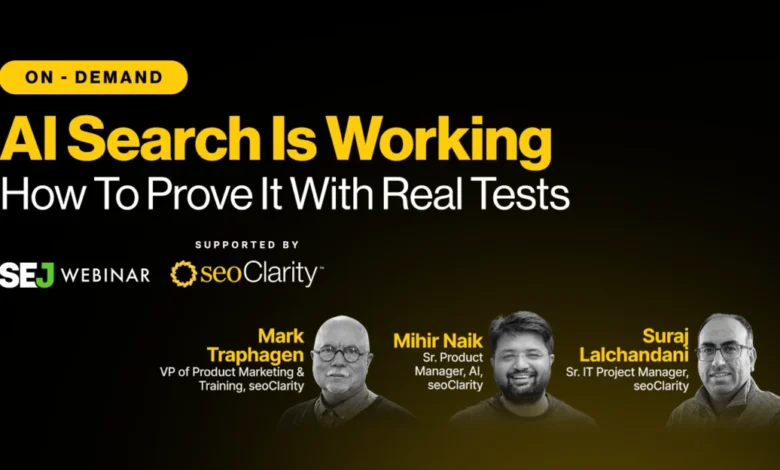
The seoClarity webinar, anchored by Mark Traphagen, VP of Product Marketing & Training; Mihir Naik, Senior Product Manager, AI; and Suraj Lalchandani, Sr. IT Project Manager, aimed to redefine the standard of proof. Their core argument was clear: "Visibility scores tell you if you showed up. Page-level performance and split testing tell you if what you did actually mattered." This distinction is crucial for businesses investing heavily in content creation and optimization for the AI era. The webinar detailed a sophisticated split-testing methodology tailored for enterprise clients, designed to navigate the complexities of LLMs and deliver actionable, data-backed insights.
A New Era of Measurement: Google Search Console’s AI Reports
A significant development bolstering AI search measurement capabilities arrived on June 3, when Google launched dedicated Search Console reports for AI Overviews and AI Mode. This new feature provides site owners with page-by-page data, illustrating how frequently each URL appears within Google’s AI search features. This first-party data from the source is a game-changer for a subset of sites, offering an unprecedented level of transparency.
Suraj Lalchandani hailed this as the "biggest measurement upgrade AI search testing has received." He elaborated on the historical challenges, stating, "This has been the hardest thing to measure in AI search. Everyone was sampling. Everyone was inferring. But now Google is just giving it to you." The directness and trustworthiness of Google’s proprietary data offer a more reliable foundation for analysis than any third-party tool could previously provide.
However, the seoClarity team was quick to contextualize the limitations. While invaluable, these new reports cover only a segment of a comprehensive AI search testing program. Optimization for other prominent LLMs like ChatGPT, Claude, and Perplexity still necessitates structured third-party tracking and robust measurement frameworks. The webinar provided a detailed map of the gaps these new reports close, those they leave open, and a platform-by-platform reference detailing what each AI engine can crawl and render. Marketers are advised to check Search Console for these new AI reports and strategically integrate this first-party data into their existing testing programs, rather than building an entire strategy around it exclusively.
Strategic Prompt Optimization: Identifying "Golden Sets"
One of the foundational elements of seoClarity’s methodology is the strategic selection of prompts for testing. Instead of a scattershot approach, the team advocates for building a "golden set" of prompts. This curated collection spans the entire AI search funnel, from initial awareness queries to those focused on retention. Each prompt is meticulously tagged by its stage in the funnel, and crucially, sorted into tiers based on the brand’s current standing in the AI’s response for that specific prompt.
Tier 1 prompts represent the "easy wins," as Lalchandani described them: "You’re relevant, but AI just hasn’t been given a URL worth linking to." These are instances where a brand’s content is conceptually aligned with the prompt, but simply needs a structural or content tweak to earn a citation. Tier 2 encompasses prompts requiring a heavier lift, indicating a greater disparity between the content and the AI’s preferred response. Interestingly, certain buckets of prompts are intentionally dropped from testing altogether—a decision that surprised many attendees.
This sequencing is a deliberate strategic choice. Securing early wins with Tier 1 prompts generates "political capital," fostering internal buy-in and confidence, which then allows teams to undertake more challenging tests later. The webinar delved into the specifics of how to construct and tag this golden prompt set, define the tiers, and establish the precise tracking unit that pairs each prompt with the exact target page intended for citation. This meticulous approach ensures that testing efforts are focused, efficient, and yield meaningful results.
Mastering Split Testing for LLMs: The Control Group Imperative
Since direct 50-50 split testing of live traffic is not feasible with LLMs, seoClarity’s methodology employs a sophisticated alternative: the control group. This involves identifying a set of correlated pages that serve as a "noise filter" against the inherent fluctuations of model updates and algorithmic shifts. As Lalchandani emphasized, "Without a control group, every result would be guesswork. With one, you can tell a real win from the background noise." This controlled environment allows marketers to isolate the impact of their specific changes, providing a clear signal amidst the constant churn of the AI landscape.
A critical, and often overlooked, aspect of this methodology is timing. Many teams skip the discipline of setting specific baseline periods before a change goes live and a minimum test window after. AI search, unlike traditional SEO, does not always respond overnight. Cutting the testing window short can lead to misinterpretation, as Lalchandani warned: "you could be reading noise." The methodology dictates precise baseline and test windows to ensure that observed changes are statistically significant and attributable to the optimization efforts.
Every test, regardless of its outcome, lands in one of three categories, each offering valuable insights into the underlying hypothesis. These outcomes help teams understand whether their change directly improved citations, had no measurable effect, or even inadvertently decreased visibility. The full session elaborates on how to construct the correlated control group, define the exact baseline and test windows, and interpret all three potential outcomes, transforming every test into a learning opportunity.
Case Studies in Causation: The FAQ Success and Unexpected Outcomes
Applying this rigorous methodology across three different client scenarios yielded three distinct, yet equally valuable, outcomes—underscoring the core premise that every result, positive or negative, provides actionable evidence.
The FAQ test emerged as the definitive success story. With approximately 1,000 prompts under measurement, the addition of FAQ sections to a set of test pages resulted in a measurable increase in AI citations compared to a control group. Crucially, these citations remained elevated as long as the change was live. The true power of this test, however, came with the reversion. The team intentionally removed the FAQ sections, and as predicted by the hypothesis, "The citations fell back down. That’s the second half of proof. Not that citations just went up when we added FAQs, but that they went back down when we took them away. That’s causation, not correlation." This demonstrated an unambiguous cause-and-effect relationship, providing a clear blueprint for content optimization in AI search. It highlights the AI’s preference for structured, clear, and directly answerable content, which FAQs inherently provide.
In contrast, two other client tests—one focusing on meta descriptions and another on listicle formatting—concluded very differently. While the specifics were reserved for the full webinar, the outcomes held critical lessons for anyone considering investing in either tactic for AI optimization. These results exemplify the scientific approach: not every hypothesis will be confirmed, but every test provides data that refines understanding. Naik succinctly framed this philosophy: "Every result is a win, because you have evidence instead of guesses. That is more than most teams in AI search have today." The webinar also outlined blueprints for testing schema and markdown, two of the most debated questions in current AEO practices, alongside fast structural tests for high-value templates achievable within weeks.
Demystifying AI Authority and Content Visibility
The Q&A portion of the webinar addressed several pertinent questions from attendees, further clarifying the nuances of AI search optimization.
One key query focused on measuring "AI authority" in the absence of a clean, singular metric. Lalchandani explained, "AI authority is basically how much the model trusts you as a source for this topic. I don’t think there’s a clean number for it or a single number for it, but there’s a couple of signals that you can stack to give you kind of a working picture." He identified four stackable signals, starting with citation share on top prompts and cross-engine consistency. The rationale for cross-engine consistency is compelling: "consistency across engines just means that you become the authoritative source in your category for specific kinds of questions." This multi-faceted approach helps build a comprehensive understanding of a brand’s trustworthiness in the eyes of AI models.
Another practical question concerned the readability of FAQ answers hidden behind collapsible toggles by AI bots. Lalchandani clarified that "Collapsible can mean many different things. It’s how you are having it collapsible." The implementation is critical: some common setups ensure collapsed FAQs remain fully readable to both AI search engines and Google, while others render the content invisible, as "even Google will not click around on your site." His standing advice underscored the methodology’s core principle: "If you’re unsure of something, just test it out. It takes effort, but it’ll give you a sure answer."
The crucial question of ROI for AI citations that do not directly drive referral traffic was also addressed. Mihir Naik explained that "You want to be cited because you are controlling the answer that is actually going to be showing up." Even without a direct click, a cited page significantly shapes the narrative within the AI’s answer, especially in comparison queries where citations play a vital role in positioning brands. The focus shifts from direct traffic to representation: ensuring unique selling propositions (USPs) are highlighted, comparison sets are accurate, and no inaccuracies surface. Lalchandani reinforced this with a cautionary example from a restaurant client, illustrating the negative consequences when AI cannot access relevant content. This highlights the intangible but critical value of brand control and reputation management within AI responses.
The Enduring Foundation: Traditional SEO’s Role in the AI Landscape
Perhaps one of the most reassuring takeaways for many in the SEO community was the emphatic confirmation of traditional SEO’s continued relevance. When asked if traditional SEO still influences AI findability, Mark Traphagen unequivocally stated, "Absolutely. It is foundational. It is the foundation." He noted that seoClarity’s longest-standing clients, those with well-optimized content and technically robust sites, are consistently outperforming others in AI search. AI optimization, in this context, functions as an additional, advanced layer built upon a solid SEO foundation.
Lalchandani further solidified this synergy: "When we run tests with our clients, we’ve rarely, if ever, found a situation where something works for SEO and does not work for AI search." This suggests a strong positive correlation between good SEO practices and success in AI search, indicating that investments in fundamental SEO principles will continue to yield dividends in the evolving AI-powered search ecosystem. The principles of clear, well-structured, authoritative, and user-focused content remain paramount, simply needing refinement for AI consumption.
Conclusion and Future Outlook
The seoClarity webinar represents a significant milestone in the journey toward effective AI Engine Optimization. By introducing a rigorous split-testing methodology capable of proving causation, rather than mere correlation, it provides marketers with the tools to confidently invest in AI content strategies. The advent of Google Search Console’s AI reports further enhances transparency, though the need for comprehensive third-party tracking across all LLMs remains. The insights into prompt optimization, control group construction, and the tangible results from client tests offer a clear pathway for businesses seeking to understand and dominate the AI search landscape. Ultimately, the message is clear: in the age of AI, data-driven experimentation and a commitment to understanding true causation are not just best practices, but essential for sustained visibility and brand influence.