AWS Builder Center Marks One-Year Milestone with Launch of Free Sandbox Environments and Community Expansion

Amazon Web Services (AWS) has officially celebrated the first anniversary of the AWS Builder Center, marking a year of significant growth for the platform that has evolved from a nascent community hub into a comprehensive ecosystem for cloud developers. Originally launched on July 9, 2025, the platform was designed to bridge the gap between technical documentation and community-driven knowledge sharing. In the twelve months since its inception, the Builder Center has expanded its utility by integrating sandbox environments, interactive workshops, specialized "Spaces," and an extensive Builders’ Library, effectively centralizing the resources necessary for modern cloud architecture and deployment.
To commemorate the milestone, AWS leadership and key contributors released a series of retrospectives and technical updates that highlight the platform’s trajectory. Rick Suttles, a prominent figure in the platform’s development, published an exhaustive feature timeline detailing the rapid iteration of the service. According to the report, the Builder Center now hosts data on more than 1,500 AWS services across 37 global Regions, providing builders with a granular view of service availability and regional capabilities. This tool, known as "AWS Capabilities by Region," has become a foundational resource for architects tasked with designing low-latency or compliant global infrastructures.
The first year of the AWS Builder Center has been defined by a shift toward interactive and experiential learning. While the platform began with basic features such as community profiles and a wishlist for feature requests, it has since matured into a sophisticated social and educational network. The introduction of "Spaces"—community-created groups—has allowed developers to congregate around specific niches, such as serverless computing, generative AI, or sustainability in the cloud. Furthermore, the implementation of a workshop system equipped with complexity and category filters has enabled users to tailor their learning paths to their specific skill levels and professional requirements.
Quantitative Success and Community Engagement
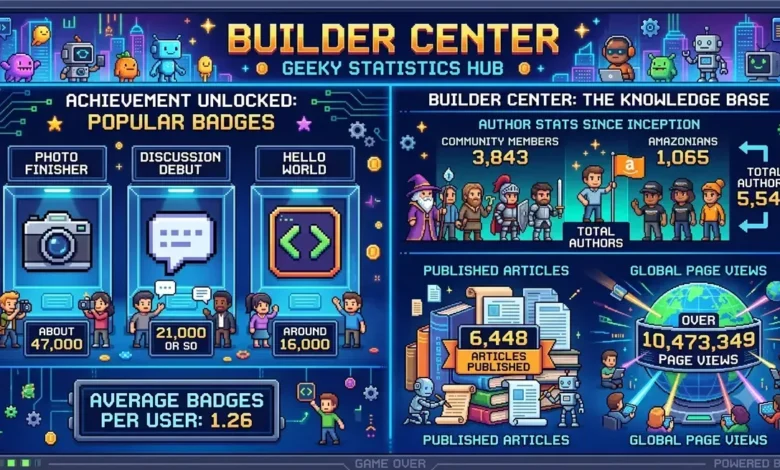
The scale of the platform’s adoption is evidenced by the data released by Jeff Barr, Chief Evangelist at AWS. In a detailed retrospective, Barr noted that the community-driven aspect of the Builder Center has surpassed initial projections. Over the past year, 5,548 unique authors have contributed a total of 6,448 technical articles. These contributions have garnered more than 10.4 million page views, signaling a high level of demand for peer-to-peer technical guidance.
The engagement metrics also highlight the success of the platform’s gamification strategy. Since the launch of a formal badge and streak system in March 2026, community members have earned 99,226 digital badges. These incentives are designed to encourage consistent participation and recognize technical expertise within the community. Beyond individual recognition, the platform has fostered a direct feedback loop between users and AWS engineers. The "Wishlist" feature has seen 565 submissions from the community, 10 of which have already been implemented as live features, with an additional 20 currently prioritized on the near-term development roadmap. This level of transparency in product development is seen as a strategic move to align AWS service updates with the actual needs of the developer workforce.
Breakthrough Community Contributions
The anniversary report also spotlighted specific community members whose contributions have defined the platform’s first year. The most-viewed article to date, "Building an AWS Study Buddy with MCP + Strands Agents SDK" by Dineshraj Dhanapathy, reached over 50,000 views. This piece exemplifies the community’s focus on cutting-edge integration, specifically utilizing the Model Context Protocol (MCP) and agent-based software development kits to automate learning workflows.
Other high-impact publications include Chris Miller’s "Migrating an EOL Linux Server to AWS in 8 Hours with Kiro," which achieved 45,000 views by addressing a critical pain point for enterprise IT departments: the migration of legacy systems facing end-of-life (EOL) support. Additionally, Yash Aggarwal’s "AIdeas: NeuroVoice – Multimodal AI for Early Screening of Neurological Diseases" garnered 38,000 views, showcasing the application of AWS machine learning services in the healthcare and life sciences sectors. These articles demonstrate that the Builder Center is not merely a troubleshooting forum but a repository for high-level architectural innovation and social impact projects.
The Introduction of Sandbox Environments
Perhaps the most significant technical announcement coinciding with the anniversary is the introduction of "Sandbox Environments." Authored by Rick Suttles, this new feature addresses one of the most persistent barriers to cloud education: the cost and complexity of maintaining a personal AWS account for experimentation.
The Sandbox Environments provide users with a free, pre-provisioned AWS account specifically designed to complete workshop exercises. These environments are temporary, remaining active for a duration of eight hours. Once the time limit expires, the account and all associated resources—such as EC2 instances, S3 buckets, or Lambda functions—are automatically de-provisioned. This automated cleanup ensures that users do not incur "zombie" costs or security risks associated with forgotten resources.
Under the current policy, builders can have one active sandbox at a time and are eligible to request one sandbox per week. Crucially, the system does not require a personal credit card or a pre-existing AWS account, making it highly accessible to students and developers in regions where traditional financial verification may be a hurdle. This move is interpreted by industry analysts as an attempt to democratize cloud access and compete with other cloud providers who offer similar "playground" environments for learning.
Strategic Implications for Cloud Education
The evolution of the AWS Builder Center reflects a broader trend in the technology industry toward "DevRel" (Developer Relations) as a core business function. By providing a centralized location for documentation, community support, and free hands-on practice, AWS is aiming to reduce the friction associated with cloud adoption.
The inclusion of features such as sign-in with GitHub and Amazon, availability notifications, and student status verification indicates a desire to integrate the platform into the existing workflows of developers. The "Builders’ Library," which offers deep dives into how Amazon itself builds and operates software, provides a level of institutional knowledge that was previously inaccessible to the public. This transparency helps build trust and establishes AWS not just as a service provider, but as a thought leader in distributed systems and operational excellence.
From a competitive standpoint, the Sandbox Environments are a direct response to the growing demand for "no-risk" learning. By eliminating the need for manual cleanup and financial risk, AWS is likely to see an uptick in the completion rates of its technical workshops. This, in turn, bolsters the ecosystem of AWS-certified and proficient developers, which is a key driver for enterprise cloud migration and long-term platform loyalty.

A Chronology of Platform Development
The journey of the AWS Builder Center from July 2025 to July 2026 can be categorized into four distinct phases:
- The Launch Phase (Q3 2025): The platform debuted with the "Wishlist" and basic user profiles. The primary goal was to establish a central repository for community feedback and to provide a "toolbox" of basic developer utilities.
- The Community Integration Phase (Q4 2025 – Q1 2026): AWS introduced "Spaces" and "Article Series," allowing for more structured content delivery. This period also saw the integration of regional capability tracking, helping users navigate the global footprint of AWS services.
- The Gamification and Recognition Phase (Q2 2026): The launch of the badge and streak system in March 2026 transformed the platform into a more engaging, social-media-like experience for developers. Features such as view counts and "saved items" were added to improve the user interface and content discoverability.
- The Experiential Learning Phase (Q3 2026): The introduction of Sandbox Environments and advanced workshop filtering marks the current phase. The focus has shifted from passive consumption of information to active, hands-on experimentation.
Future Outlook and Industry Impact
As the AWS Builder Center enters its second year, the focus is expected to shift toward further integration of generative AI tools to assist builders in real-time. The success of Dineshraj Dhanapathy’s "Study Buddy" article suggests a high community interest in AI-assisted development, and it is likely that AWS will incorporate similar functionalities directly into the platform.
The implications for the global workforce are notable. By providing high-quality, free resources and sandboxed environments, AWS is contributing to the closing of the "cloud skills gap." This gap has been a significant bottleneck for digital transformation projects across various industries. As more developers gain access to these tools without financial barriers, the barrier to entry for cloud-native innovation continues to lower.
The anniversary celebrations conclude with a look toward the future of the platform’s roadmap. With 20 community-requested features already in the pipeline and a growing roster of over 5,000 authors, the AWS Builder Center is positioned to remain a central pillar of the AWS developer experience. The platform’s ability to balance official corporate resources with authentic community-generated content will be the key factor in its continued relevance in an increasingly competitive cloud landscape.
Builders are encouraged to visit the platform to explore the new Sandbox Environments, participate in community Spaces, and contribute to the ongoing technical dialogue that has defined the platform’s first successful year. As the industry moves toward more complex, multi-modal, and AI-driven architectures, the Builder Center stands as a testament to the power of collaborative learning and the democratization of high-scale technology.