The Art and Science of Naming UI Components and Design Systems: A Comprehensive Guide to Professional Nomenclature

The fundamental challenge of naming in digital product design is that language acts as both a vehicle for thought and a bridge for collaboration. When developers, designers, and product managers struggle to align on terminology for UI components, variables, or design tokens, the resulting friction often manifests as technical debt, poor user adoption, and internal operational delays. As design systems grow in complexity across multi-brand and multi-platform environments, the necessity for a standardized, scalable, and intuitive naming taxonomy has become a mission-critical objective for engineering and design teams globally.

The Linguistic Foundation of Design Systems
At the core of the naming crisis is a conflict between specificity and flexibility. Generic names—such as "box" or "button"—fail to convey intent, leading to ambiguity in codebases. Conversely, overly specific names—such as "red-banner-fixed-width"—hinder reusability and scalability. The industry has increasingly moved toward "semantic naming," where labels describe the purpose or role of an element rather than its visual appearance.
Professional naming is not merely an aesthetic choice; it is a structural requirement. Research indicates that teams with a well-documented and enforced taxonomy reduce the time spent in design-to-development handoffs by as much as 25%. By aligning the internal language of the design system with the user’s mental model, organizations can reduce the cognitive load required to navigate complex interfaces.

Chronology of Naming Evolution
The evolution of naming conventions has mirrored the progression of web development. In the early 2000s, naming was largely dictated by the limitations of CSS and the necessity of keeping file sizes small, leading to shorthand and cryptic abbreviations. As component-based architectures became the industry standard in the mid-2010s, the focus shifted toward component-driven development.
Recent years have seen the rise of "Design Tokens"—a methodology popularized by design system leads at companies like Salesforce, Intuit, and Shopify. These tokens serve as the single source of truth for design decisions, such as color, typography, and spacing. The shift in 2020 toward multi-brand systems—where one set of tokens must support different themes for diverse products—has necessitated a more rigorous, hierarchical approach to naming. Today, sophisticated teams utilize a multi-layered taxonomy: Global (primitives), Semantic (purpose), and Component-specific (implementation).

Data-Driven Naming: The Role of Industry Resources
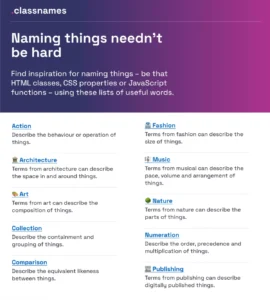
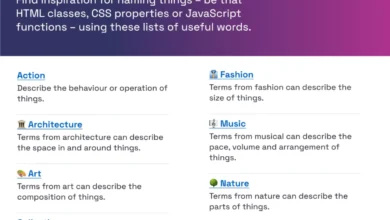
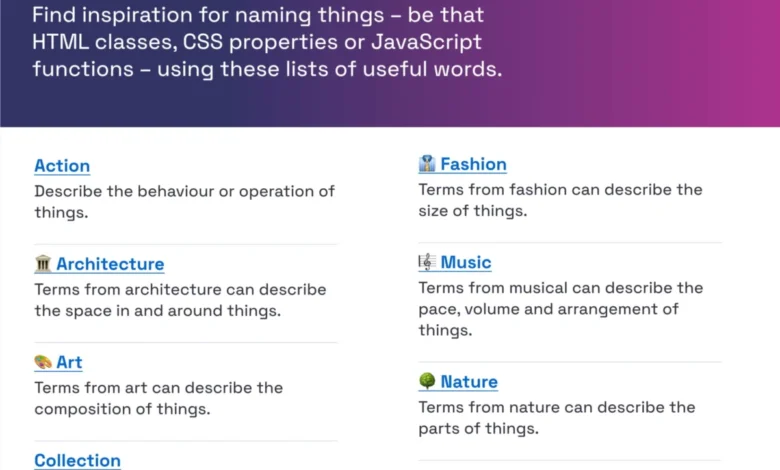
Several key resources have emerged to standardize the professional lexicon. Tools like Classnames have become essential for developers looking to move beyond simple adjectives, offering thematic categories that aid in creating intuitive class structures. For color management, the Color Parrot repository has effectively crowdsourced a library of over 30,000 unique color names. This repository is critical for maintaining consistency in design tokens, ensuring that "Brand Blue" is not inconsistently labeled across various product repositories.
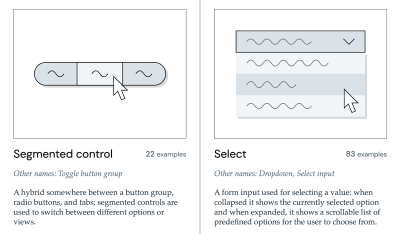
Furthermore, the Component Gallery project provides an empirical view of how top-tier organizations name their UI elements. By analyzing industry-standard naming patterns for common components like accordions, modals, and input fields, teams can adopt naming conventions that are already familiar to developers, thereby accelerating onboarding and reducing the learning curve for new team members.

Strategic Implications for Feature Adoption
A critical, often overlooked aspect of naming is the impact on end-user discoverability. As highlighted in recent UX research, low feature adoption is frequently a symptom of "naming mismatch." When a feature is named according to internal technical specifications—such as "Extended Data Validation Utility"—rather than the user’s "job-to-be-done"—such as "Bulk Data Cleaner"—the user fails to recognize the value proposition.
Successful organizations now mandate that new feature names be tested against user feedback. By conducting linguistic audits, teams can identify the vocabulary their target demographic uses to describe their own problems. Aligning the interface’s language with the user’s vernacular is a proven strategy for increasing engagement and reducing the need for extensive user documentation.

The Multi-Brand Challenge: A Case Study in Taxonomy
The complexity of modern enterprise design systems is best exemplified by multi-brand entities such as Vodafone. When managing a design system that must scale across multiple countries and brand themes, the naming of variables becomes a mapping exercise. The adoption of a "Variables Taxonomy Map" allows for a clear lineage: a token starts as a primitive (e.g., blue-500), moves to a semantic state (e.g., action-primary-default), and eventually finds a role within a specific page or component.
This hierarchical approach, pioneered by design system experts like Nathan Curtis, enables teams to swap out themes without altering the underlying component structure. By decoupling the visual output from the semantic naming of the token, teams can achieve a high degree of brand flexibility while maintaining a single, unified codebase.
Official Guidelines and Best Practices
The industry consensus on naming best practices can be summarized through four primary directives:
- Logical Structure: Names should follow a predictable format, such as
category-property-modifier-state. - Contextual Meaning: Labels should describe what the element does or its relationship to the system, not how it looks. Avoid naming components after specific colors or sizes (e.g.,
LargeRedButtonis a poor practice, whereasPrimaryActionis superior). - Universality: Names must be understood by all stakeholders, including product owners, developers, and designers.
- Consistency: The naming convention must be applied rigorously across all documentation and code. If a component is named an "Accordion" in the design file, it must be an "Accordion" in the repository and the documentation site.
Impact on Organizational Efficiency
The broader impact of adopting these naming standards is a reduction in the "dialect gap" between departments. In many organizations, developers and designers speak different languages, leading to misunderstandings that can stall product launches. A unified taxonomy acts as a common language, forcing alignment during the planning phase rather than the implementation phase.

Professional analysis suggests that the implementation of a comprehensive naming taxonomy acts as a form of insurance against the "Big Ball of Mud" architectural pattern. When teams define their naming structures early, they prevent the accumulation of redundant or conflicting styles that plague large-scale projects. Furthermore, it aids in the automation of design systems; if components are named correctly, documentation tools can automatically generate accurate reference materials, saving hundreds of engineering hours annually.
Future Directions
As artificial intelligence begins to assist in code generation, the importance of human-readable, logical naming becomes even more paramount. AI models are trained on existing repositories; if the underlying naming conventions of an organization are inconsistent or nonsensical, the output provided by AI-assisted coding tools will mirror those flaws. Consequently, investing in a robust, human-centric naming strategy is not just a best practice for current operations—it is a foundational requirement for the future of automated software development.

Ultimately, the goal of naming is to eliminate the noise that prevents teams from focusing on their primary objective: delivering high-value, usable experiences to the end user. By treating naming as a critical design discipline, organizations can transform their design systems from a collection of isolated files into a powerful, scalable asset that serves as the backbone of their digital ecosystem.