The Shift from Pilot Projects to Production Economics
For many technology leaders, the journey of generative AI (GenAI) begins with high-velocity, low-friction pilot projects. These initiatives often demonstrate clear potential by automating basic tasks or summarizing documentation. However, the transition to production often reveals a "valuation gap." In the pilot phase, costs are often subsidized by R&D budgets or cloud credits, and performance is evaluated based on subjective user satisfaction rather than hard KPIs.
As businesses attempt to scale these solutions, they encounter the "production wall"—where inference costs, latency issues, and the need for high-level security compliance become unavoidable. According to industry analysts, nearly 70% of AI projects struggle to move beyond the pilot stage precisely because they lack a robust, lifecycle-oriented ROI framework. To move past this, enterprises must treat GenAI not as a monolithic technology, but as a series of distinct, measurable workflows.
Defining the Workflow as the Unit of Value
A core principle for achieving sustainable ROI is the definition of a "workflow" as the primary unit of measurement. A model is merely a component of a larger system; the value is generated by the outcome of a business process, such as customer support resolution, supply chain vendor onboarding, or software engineering change management.
To accurately measure success, organizations must establish a baseline of current performance before the introduction of AI tools. This baseline should account for seasonality and standard operational variances. By documenting metrics such as "time to first response" in support centers or "defect escape rates" in engineering before deployment, companies create an objective foundation that lends credibility to their post-deployment analysis. When AI-driven improvements are measured against these stable baselines, the financial impact becomes visible and defensible to stakeholders.

Constructing the ROI Equation
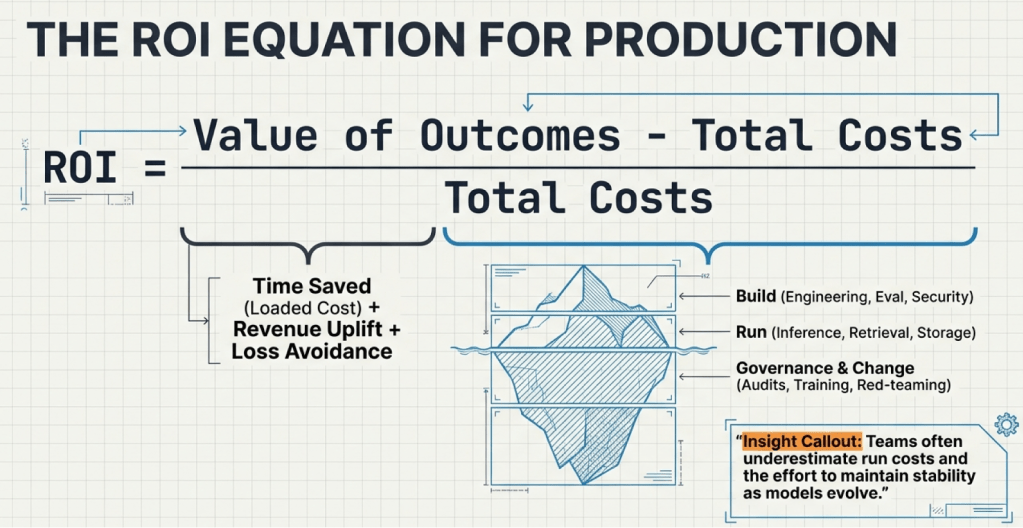
The financial viability of a GenAI initiative is best expressed through a comprehensive ROI equation that accounts for both direct and indirect costs. The formula—ROI = (Value of outcomes – Total costs) / Total costs—requires a granular approach to data collection.
Value of Outcomes must be calculated by aggregating:
- Labor Efficiency: The total time saved multiplied by the loaded cost of personnel.
- Revenue Uplift: Direct financial gains from improved sales conversion or faster market entry.
- Loss Avoidance: Reductions in compliance fines, security breaches, or customer churn rates.
Total Costs must include more than just API usage fees. A comprehensive cost analysis should include:
- Build Costs: Engineering labor, integration with existing systems of record, and initial security and red-team testing.
- Run Costs: Inference costs, vector database storage, monitoring tools, and ongoing incident response.
- Governance Costs: Periodic auditing, compliance policy updates, and model validation.
- Change Management: Training programs, internal communication, and the redesign of workflows to accommodate human-in-the-loop oversight.
The Four-Layer Metrics Stack
To ensure that activity is effectively converted into outcomes, enterprises should adopt a four-layer metrics stack. This stack ensures that every interaction is traceable and purposeful.
- Usage Layer: Measures raw activity, such as the number of requests or active users.
- Performance Layer: Monitors system-level metrics like latency, error rates, and token consumption.
- Quality Layer: Tracks output accuracy through user feedback, rejection rates, and consistency checks.
- Outcome Layer: Maps the results back to business goals, such as the reduction in ticket backlog or the speed of code reviews.
Linking these layers via instrumentation is critical. If usage grows but quality declines, it signals a drift in data or a breakdown in retrieval-augmented generation (RAG) processes. By instrumenting outcomes directly within existing systems—such as CRM platforms or ticketing systems—teams can gather objective data on how the AI is affecting real-world processes.

Strategic Selection of Use Cases
Not all use cases are created equal. Organizations should prioritize initiatives with "operational leverage"—tasks that are high-frequency, repeatable, and governed by established policies. Examples include automated security triage or standardized vendor document ingestion. These use cases offer durability, as the criteria for success remain stable over time, making them easier to measure and optimize.
Conversely, teams should avoid use cases that provide isolated, "one-off" savings that fail to compound. If a process requires constant manual intervention even after AI deployment, the operational leverage is low, and the ROI will likely remain stagnant or negative due to the high cost of maintenance.
The 90-Day Production Transition Plan
For organizations looking to move past the pilot phase, a structured 90-day plan is essential.
- Days 1–30: Conduct a full audit of current pilot workflows. Identify "drift" and document baseline performance metrics.
- Days 31–60: Integrate the AI tool directly into the production environment. Implement "feedback loops" where users can flag incorrect outputs with specific reason codes.
- Days 61–90: Conduct a cohort analysis. Compare teams utilizing the AI tools against control groups. Use this period to refine the cost model and adjust the "Total Cost" projections based on actual production consumption.
Overcoming Common Failure Modes
The most common reasons for ROI failure include "hidden costs" (such as the massive overhead of data cleaning), "integration friction" (where the tool is siloed away from where the work actually happens), and "poor feedback loops."
A critical component of success is ensuring that the tool fits into the existing workflow rather than forcing the user to switch contexts. The most successful AI assistants are those that appear as a native feature in a developer’s IDE or a support agent’s ticketing console. Furthermore, training should not be generic; it must be role-specific, providing playbooks that mirror the actual tasks performed by the employee on a daily basis.
Broader Implications and Future Outlook
As of late 2026, the industry is seeing a clear maturation in how companies approach generative AI. The initial "hype-driven" phase has given way to a period of pragmatic scrutiny. Investors and executive boards are no longer satisfied with anecdotal evidence of productivity; they are demanding a clear, audited, and scalable financial return.
The implication of this shift is that the barrier to entry for "production-grade" AI is rising. Smaller vendors and internal teams must now account for security, observability, and compliance as core requirements, not as afterthoughts. Organizations that successfully navigate this shift will be those that view GenAI as a persistent operational capability rather than an experimental project.
By grounding AI initiatives in rigorous accounting, operational transparency, and a clear understanding of the full cost of ownership, enterprises can move beyond the "pilot trap" and realize the genuine potential of generative AI. The goal is to move toward a state where the AI system is as predictable, maintainable, and measurable as any other core enterprise application, ensuring that technology investments translate directly into long-term institutional value.