Mastering the Holiday Shift: How Social Media Customer Service Has Become the Front Line of Retail Success

The traditional image of holiday shopping—defined by long lines, physical storefronts, and frantic in-store customer service desks—has been irrevocably transformed. In 2026, the retail battlefield has shifted decisively to the digital realm. Consumers are no longer waiting for a store representative to open a register; they are seeking product discovery, research, and support through social media channels. As the peak holiday shopping season approaches, data from the Sprout Social Q3 2026 Pulse Survey reveals that 86% of consumers plan to utilize social media for customer service, with 27% indicating they will use these channels more frequently than they did in 2025. This transition marks a critical turning point for retail and hospitality brands, forcing a re-evaluation of how customer care teams manage volume, sentiment, and data security during the year’s most demanding quarter.
The Evolution of the Digital Customer Journey

Social media has evolved from a simple marketing channel into a comprehensive virtual mall. Modern platforms, such as TikTok, Instagram, and Facebook, now facilitate the entire consumer lifecycle: discovery, research, social proof, and final transaction. The Q3 2026 Pulse Survey confirms that social media now ties with traditional retail stores as the primary resource for gift discovery, with 46% of consumers identifying social platforms as their go-to destination for holiday shopping inspiration.
This shift is particularly pronounced among younger demographics. Among Millennials, 85% plan to use social media for gift research at the same or higher levels than in previous years, while Gen Z participation reaches a staggering 88%. For these cohorts, the "TikTok made me buy it" phenomenon is not merely a social trend; it is a standardized buying behavior. Consequently, when shoppers encounter issues—whether related to a shipping delay, a faulty product, or a billing discrepancy—they expect the resolution to occur within the same ecosystem where they initiated the purchase. Brands that fail to integrate their customer service infrastructure into their social presence risk losing not only the sale but the long-term loyalty of their most active digital consumers.
The Surge in Demand and the Mechanics of Support

The expectation of instantaneous, high-quality support on social media is placing unprecedented pressure on customer care departments. According to the 2025 Sprout Social Index, 70% of consumers demand personalized responses when they reach out via public comments or private messages. The challenge for brands is that the communication methods are fragmented. Data indicates that 55% of consumers prefer direct messaging (DMs) to communicate with brands, while a significant minority still relies on public tagging or commentary.
This complexity is compounded by the integration of social commerce features. With platforms like TikTok Shop and Instagram Checkout seeing wider adoption, 57% of consumers report they intend to make purchases directly within social apps this season. When a transaction occurs within the app, the "support" phase must also happen there. If customer care teams remain siloed, focusing only on traditional email or telephone support, they are effectively blind to a significant portion of their consumer base’s needs.
Strategic Implementation: 10 Pillars for Holiday Readiness

To navigate the high-volume environment of Q4, leading brands are adopting a structured approach to social care. The following framework serves as the industry standard for managing the holiday influx:
-
Proactive Planning and Seasonal Alignment: Brands must align their support strategy with key retail milestones, including Black Friday, Cyber Monday, and the final shipping cut-off dates. By analyzing historical data from previous years, companies can forecast message spikes and prepare for the specific stressors that affect consumers, such as financial constraints—a major factor in 2026, with 56% of consumers planning to reduce their total holiday spending.
-
Comprehensive FAQ Integration: Proactive communication is the most effective way to reduce ticket volume. By developing holiday-specific FAQs that address common concerns like return policies, gift card activation, and shipping deadlines, brands can automate answers. Successful organizations, such as the Educational Testing Service (ETS), have demonstrated that monitoring recurring queries allows for the creation of self-service resources that reduce response times by nearly 40%.

-
Optimized Staffing and Triage: With the expectation for personalized, fast service, hiring seasonal support staff is often necessary. The critical factor is training. Utilizing platforms that provide centralized case management allows brands to assign and track inquiries without duplicating efforts or losing the thread of a conversation.
-
Sentiment-Based Prioritization: Not all inquiries carry the same weight. Using machine-learning models to categorize messages—identifying "High Brand Risk" or "Urgent Support" cases—allows teams to prioritize critical issues. Sentiment analysis ensures that a customer reporting a fraud attempt is prioritized over a general inquiry about a product color.
-
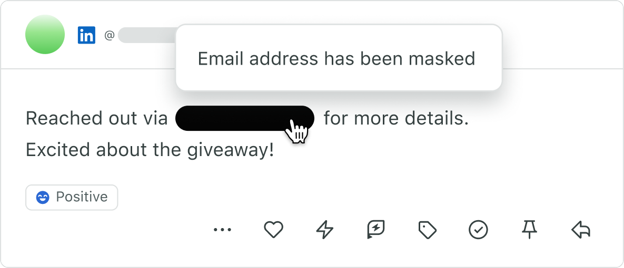
Data Security in a Digital Environment: The rise in social shopping has invited a corresponding rise in digital crime. The Internet Crime Complaint Center (IC3) reported that non-payment and non-delivery scams cost consumers over $503 million in 2025. Brands have an ethical and legal duty to protect user data. Agents should never request sensitive information like credit card numbers in public comments. Modern tools now include automatic data masking and secure, PCI-compliant forms that allow customers to share information without exiting the social platform.
-
Leveraging AI as an Assistant: While consumers generally demand human-like interaction, there is a growing acceptance of AI as a speed-enhancing tool. 70% of survey respondents expressed comfort with companies using AI chatbots to facilitate faster service. AI-powered tools can assist agents by drafting responses that match the brand’s voice, ensuring that "speed" does not come at the expense of quality.
-
Unified Tech Stacks: The most significant bottleneck in social care is the "tool-switching" fatigue. Integrating social media management platforms with enterprise CRMs, such as Salesforce, allows agents to view a customer’s entire order history in a single interface. This level of context is essential for resolving complex issues efficiently.
-
Structured Collaboration Norms: Clear protocols for internal communication are vital. When agents have questions, they should have a defined chain of command. Centralizing internal discussions within the same platform where the customer conversation occurs prevents the "lost in translation" errors that often plague remote or large-scale support teams.

-
Crisis Monitoring and Predictive Analytics: The speed of social media means that a minor issue can become a PR crisis in hours. Predictive monitoring, utilizing tools that track brand mentions across news and social media, allows teams to spot anomalies before they escalate.
-
Continuous Feedback Loops: Finally, the holiday season should be viewed as a data-gathering exercise. Implementing real-time feedback surveys, such as Net Promoter Score (NPS) or Customer Satisfaction (CSAT) polls, immediately following a social interaction provides actionable data to refine processes for the subsequent year.
The Broader Implications for Brand Loyalty

The holiday season is more than just a period of high volume; it is a stress test for a brand’s commitment to its customers. The data suggests that consumers are increasingly discerning. They are no longer just buying products; they are buying the experience of the transaction. A seamless, responsive, and secure interaction on social media can turn a casual browser into a brand advocate. Conversely, a failure to provide support on the platform where the customer resides can lead to public dissatisfaction, which is amplified by the viral nature of social networks.
As we look toward the conclusion of 2026, the brands that succeed will be those that have successfully humanized their digital connections. By investing in the right tools—automating the mundane, protecting the sensitive, and empowering the human agents—retailers can ensure that their holiday season is defined by efficiency and growth rather than chaos and reputational risk. The tools are available; the strategy is clear. The only remaining variable is the proactive adoption of these standards before the holiday rush reaches its inevitable peak.