Anthropic Claude Fable 5.1 Launches on AWS Bringing Advanced Long-Running Capabilities and Enhanced Enterprise Safeguards

Amazon Web Services has officially announced the integration and general availability of Anthropic Claude Fable 5.1 across its cloud infrastructure. The launch marks a significant milestone in the evolution of enterprise-grade generative artificial intelligence, bringing frontier-level cognitive capabilities to software development, scientific research, and complex multi-application workflows. Designed specifically to handle long-duration, high-stakes computational tasks, the new model is poised to transform how organizations manage extensive engineering pipelines and automated project lifecycles.
As enterprises increasingly demand artificial intelligence systems capable of maintaining context, reasoning through ambiguous logic, and executing multi-step operations over extended periods, traditional AI models have often faced limitations in attention span and reliability. Claude Fable 5.1 addresses these bottlenecks directly. According to release documentation and technical benchmarks provided by Anthropic, the model is engineered to operate autonomously for hours at a time, spanning multiple applications and massive codebases without degrading performance or losing contextual thread.
Main Facts and Architectural Capabilities
Claude Fable 5.1 arrives on Amazon Web Services with a primary focus on autonomy, precision, and deep integration into enterprise development environments. Unlike previous iterations that excelled primarily in conversational tasks or short-form code generation, Fable 5.1 is optimized to take full ownership of software engineering projects.
The model’s functional scope extends far beyond basic syntax completion. It is capable of managing feature implementations across an entire codebase, conducting rigorous code reviews, performing intricate performance optimizations, and debugging complex runtime errors over extended operational sessions. This capability significantly reduces the cognitive load on human engineering teams, allowing developers to shift their focus from routine maintenance and boilerplate coding to architectural design and strategic innovation.
In the domain of scientific research, Claude Fable 5.1 offers advanced data synthesis, hypothesis evaluation, and literature analysis. By processing vast troves of unstructured technical documentation and empirical data sets simultaneously, researchers can leverage the model to accelerate discovery pipelines in fields such as bioinformatics, materials science, and quantum computing.
Chronology of the Partnership and Release
The arrival of Claude Fable 5.1 on AWS is the latest development in a deepening strategic alliance between Amazon Web Services and Anthropic. The partnership, which began with major capital investments and foundational infrastructure agreements, has consistently aimed to democratize access to state-of-the-art frontier models while addressing enterprise concerns regarding security, compliance, and governance.

Over the past year, the collaboration has yielded successive integrations of the Claude model family into Amazon Bedrock—AWS’s fully managed service for building and scaling generative AI applications with foundational models. The initial rollouts focused on conversational proficiency and document processing. However, as enterprise adoption matured, clients signaled an urgent need for models capable of autonomous execution in production environments.
In response to these demands, Anthropic and AWS accelerated the development and testing cycles for Fable 5.1, culminating in its deployment last week. The release was synchronized across primary AWS touchpoints, ensuring immediate accessibility for enterprise architects, data scientists, and software engineering leads operating within the cloud ecosystem.
Governance, Data Retention, and Security Frameworks
Integrating frontier artificial intelligence into corporate environments invariably raises critical questions regarding data privacy, intellectual property protection, and regulatory compliance. To mitigate these risks, Anthropic has designated Claude Fable 5.1 as a "Covered Model." This specific classification subjects the model to rigorous data retention policies, specialized safety reviews, and strict access protocols wherever it is made available.
A central component of this governance structure is the introduction of the aws_review data retention mode. Under this configuration, AWS retains user prompts and model outputs strictly within the secure confines of the customer’s cloud boundary for the purpose of human safety review by authorized Amazon personnel. This mechanism ensures that potential safety violations, hallucination anomalies, or adversarial exploits can be identified and addressed without compromising broader data sovereignty.
Furthermore, the legacy provider_data_share mode is no longer applicable to this tier of deployment, guaranteeing that Amazon Bedrock does not share customer payloads with the model provider for external training or telemetry. Complementing these retention controls are the Enterprise Frontier Safeguards (EFS). Developed jointly by AWS and Anthropic, EFS allows eligible enterprise customers to harness the computational power of Covered Models while ensuring that sensitive corporate data remains sequestered within a controlled, compliant cloud infrastructure. These safeguards align with stringent international regulatory frameworks, including GDPR and HIPAA, making the model viable for highly regulated industries such as finance, healthcare, and defense.
Accessibility and Deployment Pathways
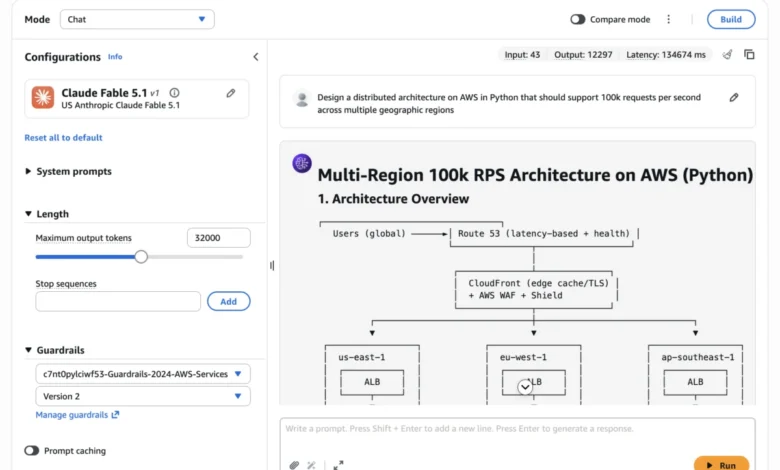
To facilitate seamless integration into existing technical workflows, AWS has made Claude Fable 5.1 available through two primary deployment channels: Amazon Bedrock and the Claude Platform on AWS.
Amazon Bedrock provides developers with serverless access to the model via standard API calls, eliminating the need to provision, manage, or scale underlying GPU infrastructure. Through Bedrock, teams can easily combine Claude Fable 5.1 with other AWS services—such as Amazon Athena for data querying, AWS Lambda for serverless event handling, and Amazon OpenSearch for retrieval-augmented generation (RAG)—to build sophisticated, multi-agent enterprise applications.

Alternatively, the Claude Platform on AWS offers a dedicated environment tailored for organizations seeking specialized tuning, direct platform interfaces, and advanced orchestration tools. Detailed documentation, model cards, and configuration guides have been published across the official AWS documentation portals to assist engineering teams in mapping out their migration and implementation roadmaps.
Industry Implications and Future Outlook
The introduction of Claude Fable 5.1 on AWS represents a paradigm shift in how artificial intelligence is deployed within enterprise architectures. By bridging the gap between conversational assistance and autonomous execution, the model signals the transition from AI as a reactive tool to AI as an active, independent contributor within digital workflows.
Industry analysts note that as software projects grow increasingly complex and distributed, the ability of an AI model to maintain long-term context across an entire codebase will become a decisive competitive advantage. Organizations that successfully integrate long-running autonomous models into their software development life cycles (SDLC) can expect substantial reductions in time-to-market, enhanced code quality, and lower operational overhead.
However, widespread adoption will also require organizations to establish robust internal governance frameworks. As models like Fable 5.1 take on greater autonomy in code review and feature implementation, human-in-the-loop validation protocols will remain essential to prevent unintended cascading errors in production environments.
As AWS and Anthropic continue to refine their joint offerings, the broader developer community anticipates further innovations in agentic workflows, multi-model orchestration, and domain-specific fine-tuning. The launch of Claude Fable 5.1 establishes a new benchmark for what is achievable in cloud-based artificial intelligence, setting the stage for subsequent advancements in enterprise automation throughout the technology sector.