AWS Unveils Enhanced Custom Event Bus in Amazon EventBridge to Eliminate Multi-Account Serverless Complexity

As organizations increasingly adopt cloud-native and serverless paradigms, the architectural blueprint of choice has shifted toward multi-account environments. While this operational model provides enhanced security isolation, resource governance, and autonomy for growing engineering teams, it has historically introduced significant friction in asynchronous event routing. To address these growing pains, Amazon Web Services (AWS) has officially announced the launch of an enhanced custom event bus for Amazon EventBridge, a major architectural upgrade engineered to streamline event-driven applications scaling across complex enterprise organization structures.
The announcement marks a significant milestone in the evolution of serverless orchestration, directly targeting the operational overhead that has plagued platform engineering teams for years. By introducing a centralized, organization-wide event backbone equipped with native ordering guarantees, simplified resource bundling, and a modernized economic model, AWS aims to redefine how distributed systems communicate at enterprise scale.
Background Context: The Multi-Account Dilemma in Serverless Architectures
When enterprises first embark on building event-driven applications utilizing Amazon EventBridge, the standard entry point typically involves deploying a single custom event bus housed within a solitary AWS account. In the early stages of cloud adoption, when a monolithic team or a singular business unit governs the codebase, this centralized pattern operates with remarkable efficiency. Events are published, rules evaluate payloads, and targets process asynchronous tasks seamlessly.
However, as cloud adoption accelerates and organizational growth mandates decentralization, best practices dictated by the AWS Well-Architected Framework heavily favor a multi-account strategy. In this distributed paradigm, individual product teams operate within dedicated, sandboxed AWS accounts to maintain strict security boundaries and blast-radius containment.
To bridge the communication gap between these isolated accounts, engineering teams historically had to construct intricate webs of cross-account resource policies, complex rules, and multi-bus routing configurations. Paradoxically, this workaround reintroduced the exact operational complexity that serverless architectures were fundamentally designed to eliminate. Platform engineering teams found themselves struggling with a lack of centralized visibility, unable to effectively audit who was subscribing to specific enterprise events. Furthermore, multi-bus routing charges compounded rapidly, inflating cloud bills, while teams requiring strict event sequencing were forced to architect fragile, custom workarounds or abandon serverless tooling entirely in favor of alternative messaging platforms.
Core Innovations of the Enhanced Custom Event Bus

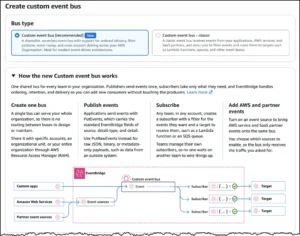
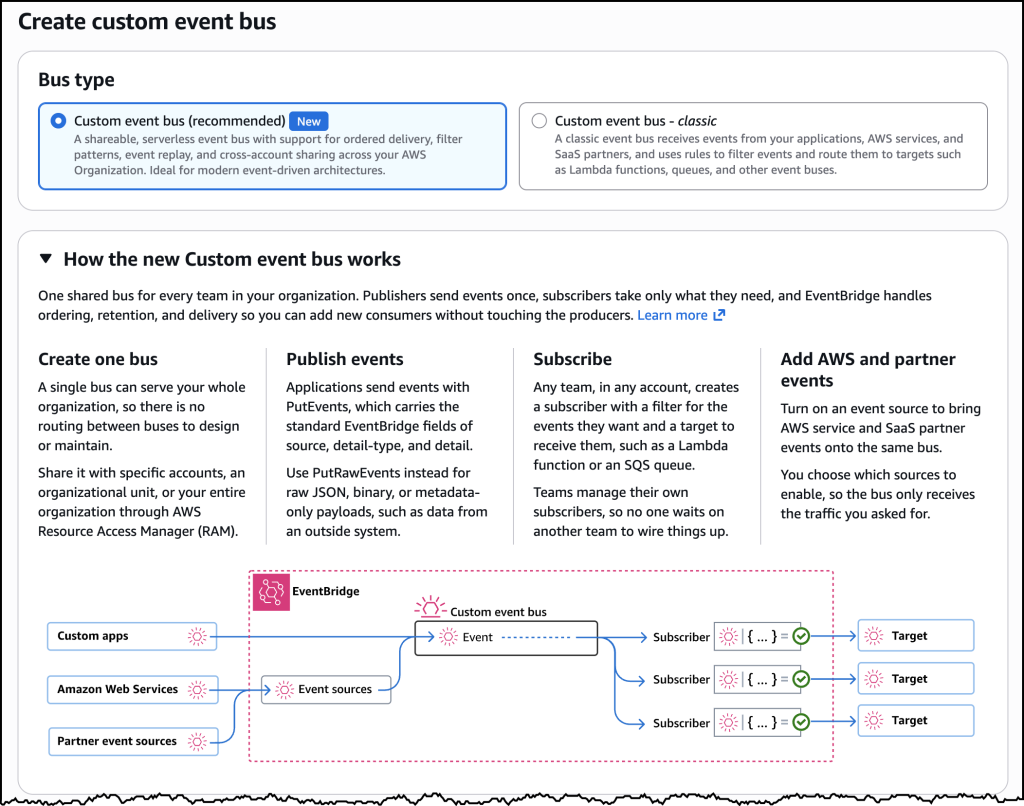
The newly introduced enhanced custom event bus fundamentally alters this architectural calculus. Rather than forcing organizations to deploy and manage dozens of interconnected event buses across disparate accounts, platform teams can now provision a single, centralized event bus that spans the entirety of an AWS Organization.
Through native integration with AWS Resource Access Manager (AWS RAM), platform operators can effortlessly share this single bus across specific AWS accounts, organizational units, or dedicated IAM roles and users. This eliminates the tedious manual provisioning of cross-account permissions, allowing application teams to publish and subscribe to vital business events instantly without waiting for infrastructure deployment cycles.
Furthermore, the new architecture significantly raises operational thresholds, featuring a robust default quota of up to 10,000 distinct subscribers per event bus, with provisions for higher limits upon request. This high ceiling directly mitigates the previous architectural fragmentation where arbitrary subscriber limits forced organizations into premature and inefficient multi-bus scaling patterns.
Balancing Asynchronous Flexibility with Strict Event Ordering
A foundational tenet of event-driven design is the reliance on decoupled, asynchronous patterns where the chronological arrival of messages is largely inconsequential to downstream consumers. However, real-world enterprise workloads frequently introduce exceptions where absolute sequencing is non-negotiable.
For instance, in logistics and fleet management applications, real-time telemetry updates concerning driver locations must be processed in strict chronological sequence. If an out-of-sequence event bypasses the correct order, routing and logistics algorithms can make critical operational decisions based on stale or contradictory data.
The enhanced custom event bus resolves this long-standing industry dilemma by seamlessly supporting both asynchronous and ordered delivery paradigms on the exact same infrastructure. Publishers can optionally append an EventGroupId parameter to outbound payloads. Amazon EventBridge then guarantees that events sharing the identical identifier are delivered in strict sequence to subscribers configured for ordered processing. Simultaneously, other consumers on the same bus can continue to process events concurrently and asynchronously without artificial bottlenecks.
To reinforce this capability, AWS has introduced synchronous invocation support for downstream targets such as AWS Lambda. This synchronous operating mode confirms successful downstream execution before officially acknowledging receipt of the event, effectively removing the historical necessity of placing an Amazon Simple Queue Service (Amazon SQS) queue between the event bus and the compute layer merely to guarantee processing reliability.

Streamlining Subscriptions and Event Evaluation
Managing event subscriptions at scale has historically required juggling a fragmented array of discrete resource types, including individual rules, target configurations, retry policies, and dead-letter queue destinations. The enhanced custom event bus introduces a unified resource construct known simply as the Subscriber.
The Subscriber resource consolidates event filtering, target definition, retry behavior, and failure handling into a single, cohesive, and easily manageable entity. Additionally, it incorporates variable start time parameters, drastically simplifying the onboarding of new consumer applications or enabling rapid event replay scenarios to recover gracefully from unforeseen application errors.
To combat duplicate data transmission caused by network timeouts or partial failures, the platform now features native content-based deduplication. Rather than requiring developers to programmatically generate and track unique deduplication tokens, EventBridge cryptographically hashes meaningful elements of the event payload. If duplicate payloads arrive within a strict five-minute window, EventBridge automatically collapses them, delivering true exactly-once semantics for sources that lack native idempotency mechanisms.
Data transformation has also been modernized through the integration of JSONata expressions. Consumers can now dynamically reshape incoming event payloads—extracting specific fields, renaming attributes, or computing new values—before the data ever reaches the target service. Moreover, for organizations utilizing structured serialization formats like Apache Avro or Protocol Buffers, EventBridge can natively deserialize these payloads into JSON, empowering subscribers to perform granular filtering and routing across the entire dataset without writing custom deserialization code.
Economic Restructuring: A New Ingress and Egress Pricing Model
Financial governance is a critical consideration for enterprise cloud architects. Under legacy multi-bus architectures, compounding per-event charges for cross-account routing frequently created unpredictable cost spikes.
The enhanced custom event bus introduces a modernized ingress and egress throughput pricing model designed to align financial expenditure directly with actual resource utilization. Under this structure, publishers incur costs solely for events successfully ingested into the system, while subscribers pay exclusively for events delivered to their respective endpoints. This transparent accounting model dramatically improves cost allocation visibility across publishers and subscribers alike, delivering superior enterprise economics at scale.
Deployment and Backward Compatibility
To ensure a seamless enterprise transition, AWS has confirmed that existing custom event buses will remain fully operational and supported. These legacy resources will henceforth be designated as "Custom event bus – classic" and will continue processing existing workloads without requiring any immediate code modifications or refactoring. The enhanced custom event bus exists as a distinct, modern resource, enabling engineering organizations to adopt the new capabilities incrementally and at their own operational pace.
The enhanced custom event bus is generally available today across a robust footprint of global AWS Regions, including US East (N. Virginia, Ohio), US West (Oregon), Europe (Ireland, Frankfurt, Stockholm, Spain), and Asia Pacific (Hong Kong, Malaysia, Mumbai, Singapore, Sydney, Thailand, Tokyo). Organizations can provision and manage these new resources utilizing the AWS Management Console, the AWS Command Line Interface (AWS CLI), or programmatic EventBridge APIs.
Industry Implications and Future Outlook
The introduction of the enhanced custom event bus represents a mature evolution in the serverless computing landscape. By addressing the operational friction points of multi-account governance, event ordering, and cost transparency, AWS has lowered the barrier to entry for large-scale event-driven architectures.
As enterprises increasingly migrate mission-critical, state-sensitive workloads to serverless environments, tools that harmonize developer autonomy with centralized operational control will dictate the success of cloud transformation initiatives. With this release, Amazon EventBridge reinforces its position as the foundational nervous system of modern enterprise cloud infrastructure, promising greater architectural resilience and economic efficiency for organizations navigating the complexities of multi-account cloud operations.