How to Secure Your Astro Web Application Using Native HTTP Basic Authentication and Middleware


Securing modern web applications during development and staging phases remains a critical priority for engineering teams worldwide, particularly as the complexity of edge computing and serverless architectures continues to expand. Web developers frequently build client projects, internal tools, and work-in-progress platforms using modern static site generators and hybrid frameworks like Astro, only to find themselves requiring immediate, reliable access control to prevent search engine indexing and unauthorized public viewing. While traditional infrastructure solutions—such as deploying complex Virtual Private Networks (VPNs), configuring Nginx reverse proxy authentication, or installing third-party Node.js packages—successfully restrict traffic, they inherently introduce technical debt, additional configuration files, and potential points of failure.
To address this challenge within the Astro ecosystem, developers can leverage the framework’s native middleware system combined with standard HTTP Basic Authentication. Supported universally by all modern web browsers, this approach eliminates the need for external dependencies, unnecessary npm packages, or complicated infrastructure layers. By utilizing an Astro adapter or runtime supporting on-demand server-side rendering, alongside a straightforward middleware function and two environment variables, engineering teams can lock down an entire application in less than five minutes using only tools already native to the project.
Main Facts and Technical Overview
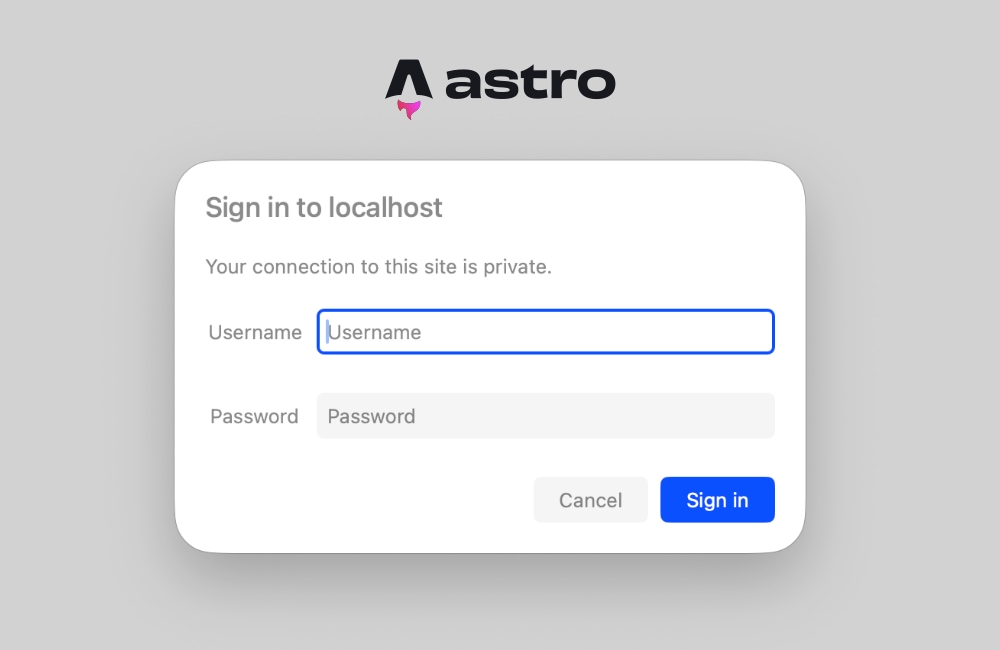
The implementation of native HTTP Basic Authentication within an Astro application relies entirely on standard web platform specifications and Astro’s built-in server-side execution pipeline. When a client browser requests a protected resource, the server evaluates the incoming request headers. If valid credentials are absent, the server responds with a 401 Unauthorized status code accompanied by a WWW-Authenticate header. Upon receiving this specific header, the browser automatically intercepts the request lifecycle, rendering a native login dialog box that prompts the user for a username and password. Once the user submits their credentials, the browser automatically encodes them and attaches an Authorization header to all subsequent requests, completely bypassing the need for custom JavaScript forms or frontend state management.
To achieve this seamlessly, the architecture requires an Astro project configured for on-demand rendering. Static pre-rendering, which builds HTML files at compile time without a live HTTP server, cannot evaluate incoming request headers because no active server request exists during the static build phase. Consequently, enabling server-side rendering via an appropriate adapter—such as those available for Cloudflare Pages, Vercel, Netlify, or Node.js environments—is a fundamental prerequisite for dynamic request interception.
Chronology and Implementation Workflow
Implementing this security layer follows a precise, step-by-step engineering chronology that integrates smoothly into standard web development workflows.
The process begins by establishing the middleware file within the project directory structure. Astro automatically detects middleware located at src/middleware.ts (or src/middleware.js for JavaScript projects). Within this file, developers export an onRequest handler wrapped by Astro’s defineMiddleware utility function. This utility wraps the handler and grants runtime access to the request context alongside a next function that controls whether the request pipeline continues to the requested page or endpoint.
import  defineMiddleware  from 'astro:middleware';

export const onRequest = defineMiddleware(async (context, next) =>
  // Authentication logic executes here
  return next();
);
Following the initialization of the middleware structure, the next phase involves writing the core authentication verification logic. This function reads environment variables containing the authorized administrative credentials and inspects the incoming request headers for the expected authorization schema. If the designated environment variables are intentionally left unconfigured, the system gracefully bypasses the check to prevent accidental lockouts during local development initialization.
function isAuthenticated(request: Request): boolean
  const user = import.meta.env.BASIC_AUTH_USER;
  const pass = import.meta.env.BASIC_AUTH_PASS;

  if (!user
In this validation routine, the system extracts the Base64-encoded credential string following the "Basic " prefix of the authorization header. Utilizing the global atob decoding function—or a compatible Buffer implementation for legacy Node.js environments—the string is converted back into plain text, split at the colon separator, and evaluated against the secure environment variables.
Supporting Data and Configuration Parameters
Successful deployment of this authentication pattern depends heavily on proper configuration of runtime environment variables and HTTP header parameters. The credentials must be explicitly defined within the environment settings of both local development environments and production hosting platforms.
For local testing, developers populate a .env file situated in the project root directory:
BASIC_AUTH_USER=staging-user
BASIC_AUTH_PASS=staging-password
When deploying to production or staging platforms—such as Cloudflare Pages, Vercel, or AWS Amplify—these identical environment variables must be registered within the platform’s dashboard under site settings or environment configuration menus.
When the authentication check fails, the middleware constructs a precise 401 response:
export const onRequest = defineMiddleware(async (context, next) =>
  if (!isAuthenticated(context.request))
    return new Response('Unauthorized',
      status: 401,
      headers:
        'WWW-Authenticate': 'Basic realm="Staging Environment", charset="UTF-8"',
      ,
    );


  return next();
);
The realm directive inside the WWW-Authenticate header provides a contextual text string that modern browsers display within the native authentication popup dialog, informing the user which specific application or staging server is requesting credentials.
Official Responses and Engineering Best Practices
Web development and platform engineering teams emphasize that while HTTP Basic Authentication is not designed to protect highly sensitive enterprise databases or user-facing consumer accounts without HTTPS encryption, it remains an optimal, lightweight solution for non-public environments. Because the credentials travel over the network encoded in Base64 rather than encrypted, enforcing HTTPS across the entire staging domain is mandatory to intercept potential man-in-the-middle interception attempts.
Engineering leads note that developers frequently encounter build-time or runtime errors if their project structure mixes static pre-rendering with dynamic middleware execution. Specifically, attempting to access Astro.request.headers inside a prerendered page component will trigger an explicit runtime exception:
Astro.request.headers was used when rendering the route `src/pages/index.astro'. Astro.request.headers is not available on prerendered pages.To resolve this architectural conflict, developers have two distinct options. The first option involves explicitly marking individual pages for server-side rendering by inserting frontmatter declarations into specific page files:
---
export const prerender = false;
---
The second, more comprehensive option involves shifting the entire project configuration to server-side rendering mode by updating the central configuration file:
// astro.config.mjs
export  defineConfig  from 'astro/config';

export default defineConfig(
  output: 'server',
);
By configuring the project output to ‘server’, Astro treats all routes as dynamically rendered by default, ensuring that runtime headers, cookies, and authentication contexts remain universally available across the entire web application. Individual routes that do not require authentication can still be selectively returned to static pre-rendering by explicitly setting export const prerender = true within their respective frontmatter blocks.
Broader Impact and Industry Implications
The adoption of native framework features for security configuration reflects a broader industry shift away from bloated dependency trees and toward minimalist, standards-compliant web engineering. Historically, locking down static or hybrid sites required integrating heavy external authentication libraries, configuring complex server blocks, or purchasing proprietary access-management tools. By utilizing native web standards—such as Fetch API Request objects, standard HTTP status codes, and browser-native dialog prompts—developers reduce software supply chain vulnerabilities, decrease build times, and maintain cleaner, more maintainable codebases.
As organizations increasingly rely on preview deployments, headless architectures, and rapid client-review cycles, the ability to secure staging environments efficiently without adding infrastructure bloat becomes a vital competency for modern web developers. Implementing native HTTP Basic Authentication via Astro middleware demonstrates how leveraging underlying platform capabilities can solve complex operational requirements with minimal friction, maximum performance, and zero external dependencies.