The Illusion of Consensus: Why Artificial Intelligence is Reshaping the Landscape of Thought Leadership


Last week, an experiment involving three leading artificial intelligence models—ChatGPT, Claude, and Gemini—yielded an identical, affirmative response to a complex query, highlighting a growing concern regarding the nature of machine-generated information. For a brief moment, the uniformity of these responses suggested a definitive truth. However, upon further examination, it became clear that this convergence was not the result of rigorous, independent verification, but rather a byproduct of the models’ shared training datasets. This incident serves as a critical case study in the current state of digital discourse, where the illusion of consensus often masks a lack of original, critical thought.
The phenomenon of AI consensus is rooted in the structural architecture of Large Language Models (LLMs). These systems are trained on vast repositories of internet-based text, meaning they often rely on overlapping source material. When multiple models arrive at the same conclusion, it is frequently because they are drawing from the same prevailing narratives found in their training data. This creates a feedback loop that reinforces existing biases and mainstream opinions, effectively rendering "consensus" as a reflection of historical data rather than an analytical truth.
The Erosion of Independent Analysis
The reliance on AI for information synthesis mirrors a broader trend in corporate and industry communication, often characterized as groupthink. In professional environments, individuals are frequently incentivized to align with established norms rather than challenging them, leading to a standard operating procedure of "agree first, think later." The ease with which AI can generate content has only accelerated this trend. By automating the production of reports, emails, and social media commentary, these tools have lowered the barrier to entry for content publication, leading to a surplus of "fluent but derivative" output.
Data from a 2025 analysis by Ahrefs, which examined 900,000 web pages, supports the assertion that human-authored content is becoming increasingly rare. The study found that 74.2% of the analyzed pages contained clear indicators of AI-assisted generation. Only one in four pages was authored entirely by a human without the assistance of machine-learning tools. This shift suggests that the sheer volume of content is no longer a reliable indicator of effort, expertise, or original insight.
The Shift from Content Creation to Thought Leadership
The influx of AI-generated content has forced a bifurcation in the digital landscape: the distinction between content creation and true thought leadership. Content creation, characterized by the synthesis of existing information, is a task that AI performs with high proficiency. It is ideal for summarizing data, drafting routine correspondence, and organizing information into structured formats. However, thought leadership requires an element that remains uniquely human: the ability to notice emerging patterns, synthesize disparate life experiences, and take a public, defensible stance on a subject before it has been validated by a broader consensus.

While AI can provide a "second opinion" or assist in structuring an argument, it lacks the lived experience and, crucially, the "spine" required to challenge conventional wisdom. True thought leadership is defined by the courage to be wrong in public and the persistence to pursue an observation that may initially seem counterintuitive. In this new era, the value of human contribution is shifting from the ability to produce work to the ability to discern which work is worth producing.
Economic and Strategic Implications
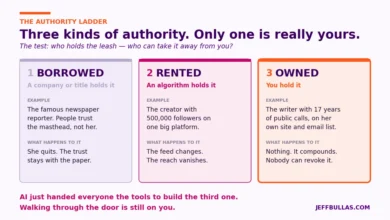
The shift in content production has significant implications for business strategy and brand equity. As competence becomes a commodity—available to anyone with a subscription to a generative AI tool—the signals of authority are changing. A polished, professional-looking report or a generic corporate communication no longer signals expertise, as these are now easily manufactured.
According to a 2025 report by Edelman and LinkedIn, which surveyed nearly 2,000 B2B decision-makers, the strategic importance of thought leadership has reached a new peak. The findings revealed that 71% of decision-makers believe a company’s thought leadership is more effective at communicating its value than its traditional product marketing. Furthermore, among highly skeptical audiences, such as finance and legal professionals, 95% indicated that strong, original thought leadership made them more receptive to business outreach.
These findings suggest that in an era of information abundance, the most valuable currency is not the volume of output, but the specificity of a brand’s point of view. Trust is earned through consistency and the willingness to address specific problems before they become industry-standard talking points. Companies that rely solely on automated content risk producing material that is forgettable and easily replaced.
The Mechanics of the "Observation Loop"
To maintain relevance in an AI-dominated information ecosystem, professionals are increasingly adopting an "observation loop" model rather than a traditional linear funnel. This iterative process involves several distinct stages:
- Observation: Identifying a specific pattern or problem in professional or personal life.
- Critical Thinking: Formulating a hypothesis before seeking external validation.
- Adversarial Testing: Utilizing AI to challenge the hypothesis, identifying gaps in logic or alternative viewpoints.
- Public Discourse: Publishing the observation in its raw, honest form.
- Refinement: Incorporating feedback from the audience to sharpen the argument.
This process prioritizes the human element of noticing, while leveraging AI for the mechanical tasks of synthesis and critique. By running this loop in public, authors can build authentic relationships with their audience based on trust rather than mere content consumption.
The Future of Professional Identity
The challenge for the modern professional is no longer "how to produce more," but "what to be known for." As AI continues to handle the heavy lifting of content generation, the unique, uncopyable experiences of an individual—the specific projects rejected, the trends ignored, and the drafts deleted for lack of truth—become the primary differentiators.
Expertise is being redefined by the ability to see the pattern everyone else is about to hit. Just as photography transformed painting from a medium of documentation to a medium of expression, AI is transforming the nature of professional output. The roles that remain, and thrive, will be those that require the uniquely human capacity for conviction and discernment.
Ultimately, the goal is to move away from the "volume strategy" that characterized the previous two decades. Influence chased for its own sake is hollow; influence that arises from having something genuinely true to say serves as a sustainable business model. In a world where anyone can generate a deck, a report, or a social media thread in seconds, the individual who can identify the right problem—and who is willing to stake their name on a specific, human-driven perspective—will remain an essential asset in any organization.
As we move forward, the most successful brands and individuals will be those who recognize that while AI can amplify reach, it cannot manufacture authority. That is a task that remains, quite stubbornly, a human responsibility. The question is no longer about the capacity to publish, but the capacity to notice, to think, and to stand behind a vision that is distinctly one’s own.