AWS CloudFormation Express Mode Accelerates Infrastructure Deployments with New Rapid Provisioning Capabilities

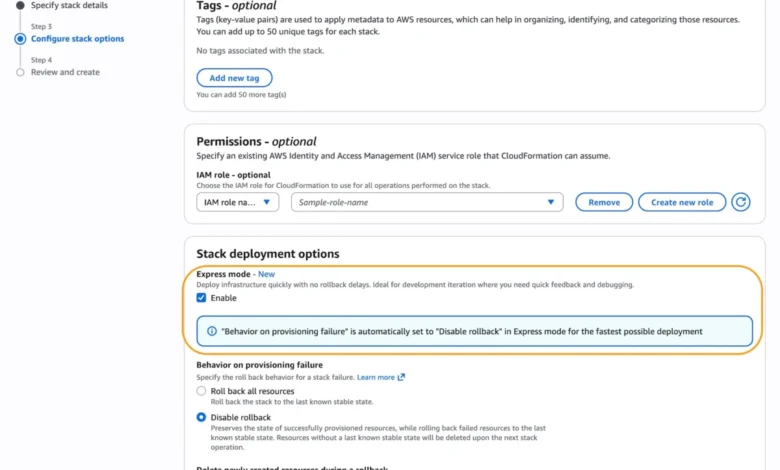
Amazon Web Services has officially launched AWS CloudFormation Express mode, a significant evolution in its Infrastructure as Code (IaC) service designed to drastically reduce deployment wait times for developers and automated artificial intelligence tools. This new deployment mode prioritizes speed and iterative feedback by completing stack operations as soon as resource configurations are successfully applied, bypassing the traditional stabilization checks that often account for the majority of deployment latency. By eliminating these extended wait periods, AWS reports that developers can experience deployment speeds up to four times faster than the standard operating mode, a shift that promises to redefine the productivity of cloud engineering workflows and the efficiency of AI-assisted infrastructure generation.
The Evolution of Infrastructure as Code and the Stabilization Bottleneck
Since its introduction in 2011, AWS CloudFormation has served as the bedrock for managing cloud resources through declarative templates. For over a decade, the service’s primary value proposition has been its reliability and "Standard mode" behavior. In Standard mode, CloudFormation follows a rigorous protocol: it sends a configuration request to an AWS service—such as Amazon EC2 or Amazon RDS—and then enters a polling state. During this state, CloudFormation waits for the resource to undergo "stabilization," a process where the resource confirms it is not only created but also fully operational and ready to handle traffic.
While stabilization is critical for production environments where a resource must be 100% healthy before shifting traffic, it has increasingly become a bottleneck for modern development cycles. In a world of serverless architectures, microservices, and rapid prototyping, waiting several minutes for a network interface to detach or a load balancer to pass health checks can disrupt the "flow state" of a developer. As cloud architectures grow more complex, involving hundreds of interdependent resources, these minutes accumulate, leading to significant delays in the Continuous Integration and Continuous Deployment (CI/CD) pipeline.
Technical Architecture of Express Mode
AWS CloudFormation Express mode fundamentally changes the lifecycle of a stack operation. Instead of the synchronous "wait-for-success" model, Express mode operates on a principle of "applied configuration." Once the CloudFormation engine receives confirmation from the underlying resource provider that the configuration has been accepted and the provisioning process has started, the stack operation is marked as complete.
This does not mean that resources are left in an indeterminate state. Rather, the stabilization occurs asynchronously in the background. To maintain stack integrity, CloudFormation has introduced built-in resilience features for Express mode. If a dependent resource encounters a transient failure during its background provisioning—such as a timing issue where one resource is ready slightly after another—CloudFormation automatically retries the operation without requiring manual intervention. This ensures that while the developer receives a "success" signal almost immediately, the infrastructure eventually reaches the desired state.
Crucially, Express mode changes the timing of the deployment notification, not the underlying security or configuration protocols of the AWS resources themselves. All Identity and Access Management (IAM) permissions, service quotas, and resource specifications remain identical to those used in Standard mode.
Benchmarking Performance: A Comparative Analysis
The performance gains associated with Express mode are most visible in resources that traditionally require long stabilization periods. AWS provided benchmarking data that highlights the disparity between the two modes:
- Amazon SQS Implementation: In a standard workflow, creating an Amazon Simple Queue Service (SQS) queue along with a dedicated Dead Letter Queue (DLQ) typically requires approximately 64 seconds. Under Express mode, this same operation is completed in roughly 10 seconds.
- AWS Lambda Deletion: One of the most notorious "wait states" in AWS management involves deleting Lambda functions associated with Virtual Private Clouds (VPC). Because CloudFormation must wait for the Elastic Network Interface (ENI) to detach and stabilize, the process can take between 20 and 30 minutes in Standard mode. Express mode reduces this specific operation to approximately 10 seconds.
- Iterative Microservices: For a standard microservice stack consisting of an IAM role, a Lambda function, and an SQS trigger, the cumulative time saved across multiple iterations can reduce a developer’s daily "idle time" by several hours, depending on the frequency of updates.
Strategic Integration with AI and Modern Tooling
The timing of this release is closely linked to the surge in AI-assisted development. Generative AI tools, such as Amazon Q Developer or independent platforms like Kiro, are increasingly responsible for writing and deploying IaC templates. These AI agents function best when they have a tight feedback loop; if an AI generates a template with a minor configuration error, waiting 10 minutes to discover that error is inefficient. Express mode provides the sub-minute feedback loop necessary for AI tools to iterate, test, and self-correct infrastructure code in near real-time.
Furthermore, Express mode is integrated into the broader AWS ecosystem. It is accessible via the AWS Management Console, the AWS Command Line Interface (CLI), and various Software Development Kits (SDKs). For users of the AWS Cloud Development Kit (CDK), a new flag—cdk deploy --express—allows developers to leverage these speed gains without changing their existing TypeScript, Python, or Java codebases.
Implementation Guidelines and Safety Mechanisms
While Express mode offers substantial speed advantages, AWS has implemented specific controls to ensure it is used appropriately. By default, Express mode disables automatic rollbacks. In Standard mode, if a resource fails to stabilize, CloudFormation rolls back the entire stack to its previous known-good state. In the rapid-fire environment of iterative development, rollbacks can sometimes be more frustrating than the failure itself, as they erase the progress made.
However, for production scenarios where stability is paramount, developers can re-enable rollbacks by setting the disableRollback parameter to false within their deployment configuration. The deployment command for a stack using Express mode via the CLI would look as follows:
aws cloudformation create-stack
   --stack-name production-app
   --template-body file://infrastructure.yaml
   --deployment-config '"mode": "EXPRESS", "disableRollback": false'
This flexibility allows teams to use Express mode during the "build" phase of a feature and switch back to Standard mode (or keep Express mode with rollbacks enabled) for the final production deployment.
Chronology of the Release and Regional Availability
The development of Express mode follows a series of updates aimed at making CloudFormation more modular and faster. In recent years, AWS introduced features like "Hooks" for proactive compliance and "Import" for existing resources. The announcement of Express mode marks the first time the service has offered a fundamental alternative to its core stabilization logic.

As of today, AWS CloudFormation Express mode is generally available in all AWS commercial Regions. This global rollout ensures that multinational organizations can standardize their deployment scripts across various geographic locations without worrying about regional feature parity. AWS has confirmed that there is no additional cost for using Express mode; users continue to pay only for the underlying resources they provision and any standard CloudFormation charges that may apply to large-scale operations.
Industry Implications and Expert Analysis
The introduction of Express mode is likely to have a ripple effect across the DevOps industry. Analysts suggest that this move is a direct response to the rising popularity of alternative IaC tools that emphasize speed, as well as the internal needs of AWS to support its own rapidly growing serverless and AI services.
By providing a "fast track" for resource provisioning, AWS is addressing one of the longest-standing criticisms of CloudFormation: its perceived slowness compared to manual scripting or imperative tools. For enterprise organizations, this could lead to a significant reduction in the cost of developer hours. If a team of 50 engineers saves 15 minutes a day each due to faster deployments, the organization recovers over 3,000 hours of productivity annually.
Furthermore, the "eventual stabilization" model aligns CloudFormation more closely with the distributed systems philosophy that governs the cloud itself. It acknowledges that in a cloud-native world, readiness is often a fluid state, and the infrastructure management layer should be flexible enough to accommodate different levels of urgency.
Conclusion and Future Outlook
AWS CloudFormation Express mode represents a pivotal shift in how cloud infrastructure is managed. By decoupling configuration application from operational stabilization, AWS has provided a tool that meets the demands of modern, high-velocity development teams and AI-driven automation.
As developers begin to integrate --deployment-config '"mode": "EXPRESS"' into their CI/CD pipelines, the industry will likely see a new standard for infrastructure iteration. While Standard mode remains the gold standard for high-stakes production cutovers, Express mode is poised to become the default choice for the vast majority of development, testing, and non-critical update cycles. Moving forward, AWS is expected to continue expanding the capabilities of Express mode, potentially adding more granular controls over which specific resources within a stack should undergo full stabilization while others proceed at "Express" speed.