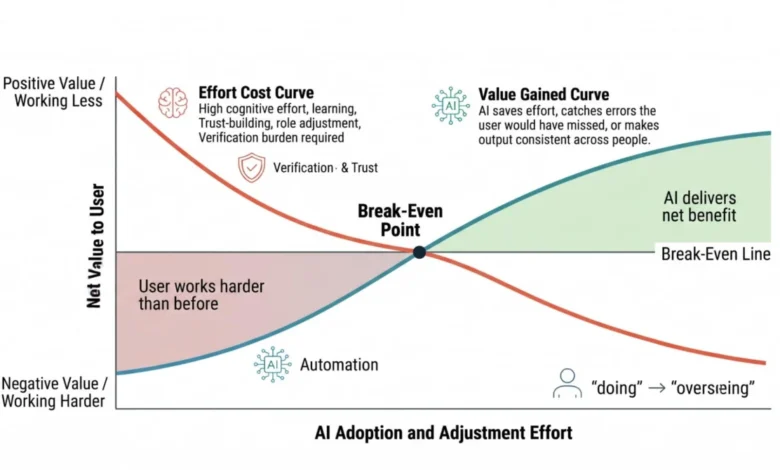
The rapid integration of artificial intelligence into enterprise software has often been driven by the "pro-innovation bias," a phenomenon identified by sociologist Everett Rogers in 2003, where organizations assume new technology automatically equates to progress. However, a growing body of evidence suggests that without rigorous auditing of human-AI workflows, these tools can inadvertently decrease productivity. For product teams at major organizations, the challenge lies in identifying the "break-even line"—the point at which the value of an AI-driven output outweighs the cognitive cost required for a user to verify its accuracy. When this threshold is not met, AI features do not merely fail to help; they actively impose a "verification tax" on employees, turning skilled professionals into rote checkers of machine-generated content.
The Case of the Health Insurance Appeals Process
A recent, illustrative case study involving a large health insurance provider highlights the dangers of deploying AI without a thorough task analysis. The insurer aimed to streamline its appeals process by implementing an AI tool designed to draft full written determinations for benefits specialists. On paper, the technology performed exactly as specified: it ingested case data and produced coherent, legally sound documents.
Despite the technical success, the implementation resulted in a productivity paradox. Specialists who utilized the AI tool spent significantly more time on each case than those who relied on manual drafting. Subsequent internal evaluations revealed that the time required to meticulously review, fact-check, and edit the AI-generated text for errors was equivalent to the time required to draft the determination from scratch. Furthermore, the specialists were forced to look for subtle inaccuracies—errors they would not have made themselves—thereby increasing their cognitive load and diminishing their professional confidence.
Following this feedback, the product team rescoped the feature. Instead of generating full documents, the second iteration surfaced relevant policy provisions and prior case decisions, leaving the actual writing to the specialists. By automating the search phase while maintaining human agency over the final synthesis, the company successfully reduced the time spent on each appeal. This shift demonstrated that the value of AI is not inherent in the technology itself, but in the specific segment of a task it chooses to augment.
The Economics of Cognitive Load
The failure of the initial appeals tool can be explained through the lens of cognitive psychology. Research into working memory, such as the 2001 review by Nelson Cowan, suggests that humans can only hold approximately four items in their minds simultaneously. Every time a user interacts with a new AI interface, they must expend limited cognitive resources to understand the tool’s functionality, navigate its output, and calibrate their trust in the machine.
When an AI feature automates the "synthesis" portion of a job, the user is relegated to the role of a supervisor. If the AI also provides a recommendation, the user’s role is further reduced to a mere sign-off, which many professionals report as a threat to their identity and sense of competence. A 2025 study by Sophia Ackerhans and colleagues found that physicians tasked with signing off on AI-assisted decisions experienced significant professional strain. Interestingly, providing explanations for the AI’s reasoning—intended to build trust—often simultaneously increased the user’s perception of the threat to their professional autonomy.
To determine if a feature is worth building, product teams must calculate the net value to the user. This involves measuring whether the return (in speed, consistency, or error detection) outweighs the adjustment cost. If the user is left working harder than they were before the introduction of the tool, the feature is effectively below the break-even line.
A Four-Question Framework for Product Teams
To avoid the pitfalls of ill-conceived AI deployment, product managers should implement a standardized audit before any design work begins. This audit should be conducted in consultation with the actual practitioners who perform the task, rather than just developers or stakeholders.
The first question, "Does this reduce the total effort the task takes for this user?" is critical. Automation of repetitive, monotonous tasks is often praised, but if that automation requires the user to spend significant time verifying the machine’s input, the task has not been reduced; it has been relocated. The goal must be to identify tasks where the bottleneck is truly the cognitive burden of synthesis, not the act of data entry.
The second question, "Does this beat the way the user does the task now?" requires a candid assessment of existing workflows. If a team already has a fast, reliable method for completing a task—such as drafting an email—adding an AI layer may simply introduce unnecessary complexity. AI excels in scenarios involving high ambiguity, massive scale, or patterns that are too complex for humans to spot manually, such as large-scale fraud detection.

The third question, "Can the user catch the errors?" addresses the "error surface" of the system. Research by Raja Parasuraman and Dietrich Manzey in 2010 highlighted the prevalence of "automation bias," where users defer to machine output even when it is demonstrably incorrect. This is particularly dangerous when the errors are subtle or "invisible," such as a suggested flight itinerary that contains a scheduling conflict. To mitigate this, features must incorporate "provenance," providing users with clear access to the sources and data points behind the AI’s output.
The final question, "After a year, can the user still tell when the AI is wrong?" addresses the long-term degradation of skills. If an AI tool takes over a judgment-heavy task, the user’s ability to perform that task will eventually atrophy. A 2023 study by Thomas Dratsch and colleagues involving radiologists demonstrated that even highly experienced professionals saw their diagnostic accuracy decline after prolonged reliance on a flawed AI suggestion. To maintain quality, organizations must implement mechanisms—such as periodic blind reviews or rotating cases off AI assistance—to ensure that the user’s core critical thinking skills remain sharp.
Strategic Implications and Best Practices
The integration of AI is not a binary choice between "manual" and "automated." It is a design challenge that requires balancing efficiency with human oversight. For meeting summaries, for instance, the audit yields a different result than for complex insurance appeals. While a meeting summary might require a quick check, it rarely demands the high-level expertise required for legal determinations. By including timestamps linked to source transcripts, the system can provide the necessary provenance, allowing the user to maintain accountability without becoming overwhelmed.
To institutionalize this approach, product teams should include these "design conditions" directly into their project briefs. If a feature fails the audit, the result should not be an outright cancellation, but a pivot in scope. For example, if a tool is too complex for senior analysts but beneficial for junior staff, the deployment should be segmented accordingly.
The current competitive climate, where companies feel pressured to release AI-enabled products to appease investors and market expectations, has led to a rush of poorly integrated tools. By moving from a "ship first, fix later" mentality to a structured, audit-based approach, organizations can avoid the hidden costs of AI. The ultimate success of any AI implementation should not be measured by the sophistication of the model, but by the tangible improvement in the user’s ability to perform their job effectively and independently. In the end, the most successful AI tools will be those that function as a force multiplier for human expertise, rather than a replacement for it.