Every Excuse in This AI Era to Transform Your Life Is Gone. What’s Left Is Permission.


The advent of artificial intelligence has irrevocably altered the landscape of professional and personal development, dismantling traditional barriers and presenting a stark, unvarnished reality: the era of excuses is over. What remains, for those willing to embrace it, is the profound gift of permission – the freedom to forge new paths and redefine success. This shift, though revolutionary, is often discussed in terms of technological prowess rather than its fundamental human implications.
The author’s personal journey serves as a powerful allegory for this transformation. At 17, a leap of faith was taken, a journey of 24 hours by train to a new city for college. This was not merely a physical relocation but a symbolic passage through the first of many doors. "I have spent my whole life leaving rooms that were too small," the author reflects, a sentiment that encapsulates a lifelong pursuit of growth. The "room given" often represents comfort and familiarity, while the "door chosen" signifies the inherent fear and uncertainty of the unknown. Yet, it is through these chosen doors that the world expands. Today, AI has collectively thrown open a monumental door for humanity, a threshold that most are only beginning to comprehend, let alone step through.
The Four Gifts of Artificial Intelligence
AI is not a deceptive ploy; its contributions are tangible and measurable. However, these gifts usher in an era of unprecedented unknowns.

1. Unearned Expertise: Bridging the Skill Gap
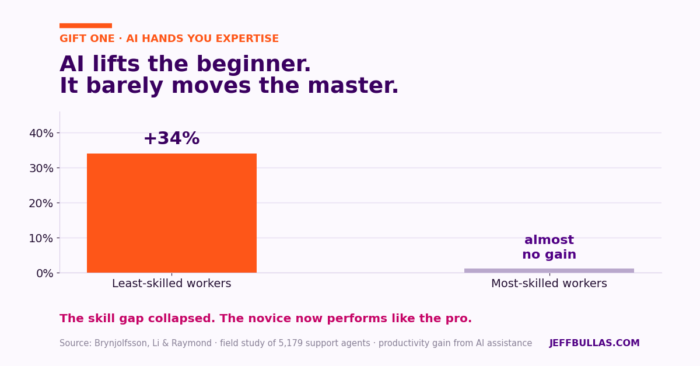
A groundbreaking study by researchers at Stanford and MIT, analyzing the impact of AI assistants on 5,179 customer support workers, revealed a significant productivity surge of 14% on average. Crucially, the least skilled workers experienced an astonishing 34% improvement, while the most experienced saw minimal gains. This disparity highlights AI’s transformative potential for novices. By providing immediate access to knowledge and refined processes, AI effectively hands beginners the playbook of seasoned professionals, collapsing the experience gap. This democratization of expertise means that foundational skills can be acquired and applied with remarkable speed, leveling the playing field in numerous professions.
2. The Demise of Friction: Accelerating Creation
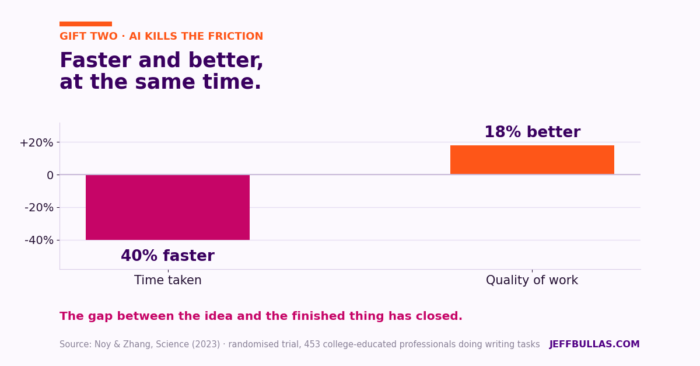
A controlled trial published in Science demonstrated the profound impact of AI on creative output. When 453 professionals were tasked with real writing assignments, those utilizing ChatGPT saw their completion time drop by an average of 40%, while the quality of their work simultaneously rose by 18%. This represents a paradigm shift where the distance between conceptualization and execution has been drastically reduced. Tasks that once demanded extensive time and effort can now be accomplished with unprecedented speed and enhanced quality, freeing up valuable human capital for higher-level strategic thinking and creative endeavors.
3. The Collapse of Complexity: Simplifying the Intricate
Work that historically necessitated large teams, substantial budgets, and years of specialized training can now be accomplished with relative ease, often within an afternoon, armed with a well-formulated query. AI’s ability to process vast datasets, identify patterns, and generate sophisticated outputs has transformed complex challenges into manageable tasks. This simplification has profound implications for innovation, allowing individuals and smaller organizations to tackle ambitious projects that were previously out of reach. The barrier to entry for complex problem-solving has been dramatically lowered, fostering a more accessible and dynamic innovation ecosystem.
4. The Unnamed Gift: Permission for Personal Adventures
Perhaps the most profound, yet least discussed, gift of AI is the liberation it offers for individuals to embark on their own entrepreneurial or creative journeys. Traditional obstacles such as lack of capital, insufficient skills, no established team, limited time, or uncertainty about where to begin have been significantly eroded by AI’s capabilities. AI tools can assist with market research, content creation, coding, design, and a myriad of other functions, effectively dismantling the excuses that have historically held back aspiring creators and innovators. The primary hurdle that remains is not a lack of resources or skills, but an internal "permission problem"—the psychological barrier to self-authorization.
The Internal Gatekeeper: Permission and Action
The assertion that "everything standing in your way is behind your own eyes" serves as a critical reminder. The path forward requires two fundamental steps: granting oneself permission and then taking decisive action. A brilliant idea, unacted upon, fades into obscurity. This internal gate, however, is one that no machine can open for its human counterparts.
The Unmentioned Catch: A Crowded Room
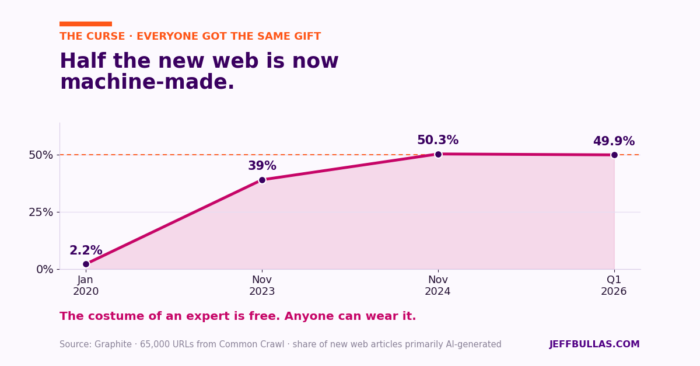
The pervasive nature of these AI gifts presents a significant challenge. The democratization of expertise and efficiency means that the "door" has swung open for everyone simultaneously, leading to an exponentially more crowded "room." Data from Graphite, analyzing 65,000 URLs from Common Crawl, illustrates this trend: in January 2020, machine-generated web articles accounted for approximately 2% of new content. By late 2024, this figure surpassed 50%, indicating that roughly half of online articles are now machine-produced. This arithmetic is undeniable: increased ease of creation inevitably leads to an exponential increase in output. The once-exclusive domain of content creation is now a bustling marketplace, with AI enabling a surge of participants.
The True Adversary: Not the Machine, but Difficulty
The real villain in this narrative is not artificial intelligence itself, but the historical reliance on difficulty as a gatekeeper. For years, the arduous nature of certain tasks served as an unintentional protector of professional domains. When the author launched a blog in 2009, what was perceived as simple was, in fact, a technical undertaking that required significant effort. Difficulty acted as a moat, deterring casual entry and protecting established practitioners.
AI has effectively drained this moat, not just for established professionals but for the millions who now possess the tools to compete. The trade-off presented by AI is clear: access to powerful tools comes with the consequence of increased competition and traffic. The ease of production, while beneficial, has also led to an unprecedented influx of content and a heightened need for differentiation.
The Price of Passage: Beyond the Dream’s Poster
Stepping through the doors of opportunity, as illustrated by the author’s personal experiences, invariably involves a cost. Leaving home at 17 was a profound transition. At 27, departing from a deeply ingrained religious upbringing involved navigating fear of rejection and ostracization, a difficult conversation with loved ones about a larger reality. At 52, the decision to become one’s own boss, dedicating years to writing with no guaranteed outcome, demanded resilience, significant time investment, and financial risk.
This price—fear, anxiety, uncertainty—is rarely advertised on motivational posters. Yet, it is the very cost that yields invaluable rewards: the freedom to grow, the resilience forged through failure, and an intrinsic drive that transcends mere discipline. This profound motivation, the "reason you got up this morning," is an internal engine that AI cannot provide. It can furnish the tools, the speed, and the polished product, but the fundamental purpose must originate from within.
What AI Has Collapsed, and What It Cannot
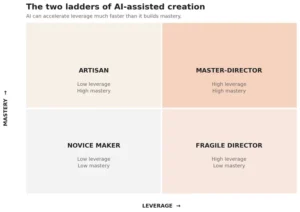
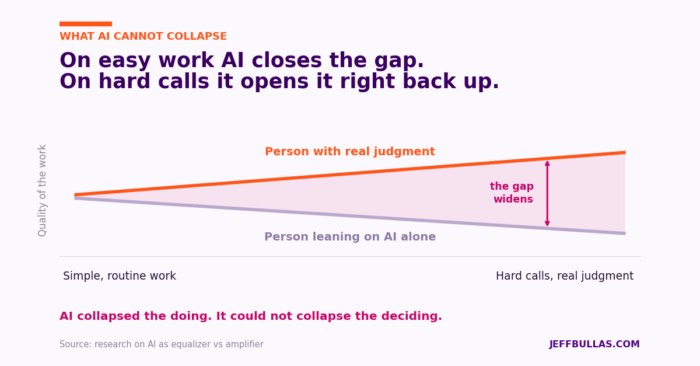
The narrative of AI’s capabilities often overlooks a crucial distinction. While AI excels at democratizing routine tasks, bridging the gap between novice and expert in areas of straightforward execution, it falters when confronted with the nuanced demands of judgment, taste, and context. In these more complex scenarios, AI acts as an amplifier for existing human expertise rather than an equalizer. It magnifies the skills of those who already possess a deep understanding and the capacity for critical decision-making.
AI has collapsed the ‘doing,’ but it has not collapsed the ‘deciding.’
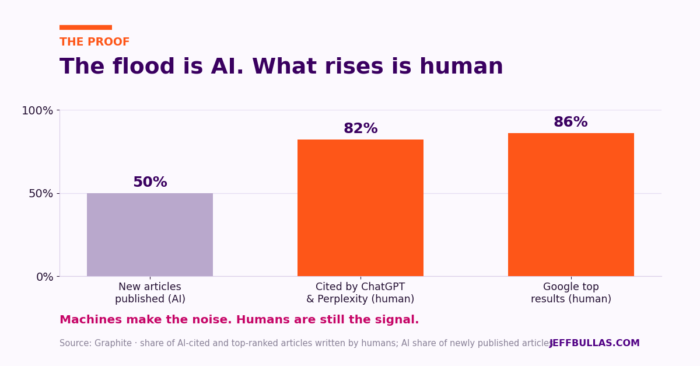
The market’s reaction to this reality is evident. Despite the proliferation of AI-generated content, human-authored articles continue to dominate search engine rankings and citations by advanced AI models. Graphite’s research indicates that 86% of articles ranking in Google Search were human-written, and 82% of articles cited by leading AI tools like ChatGPT and Perplexity were also human-produced. In essence, while machines generate the sheer volume of noise, human intelligence and discernment remain the signal that captivates and earns trust.
Building on Enduring Authority
If mere production is no longer the ultimate prize, then what is? The answer lies in cultivating an "owned authority"—a verifiable record of judgment that garners genuine trust. This authority is built not on fleeting trends or borrowed credibility, but on principles that are enduring and difficult to replicate.
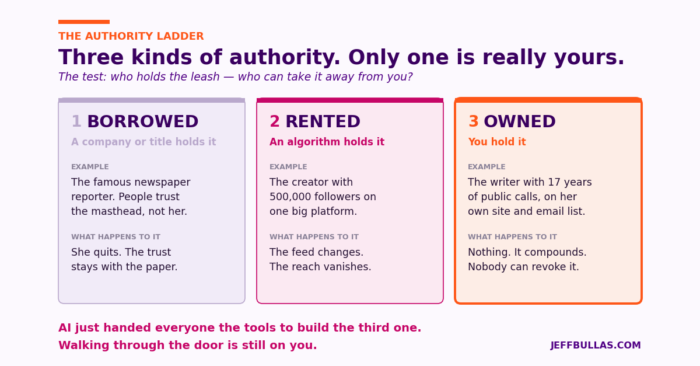
There are three fundamental types of authority, distinguished by a critical question: "Who holds the leash?"
- Borrowed Authority: This is transient, dependent on external validation or platforms. It ends when the platform shifts its algorithms or when external validation wanes.
- Rented Authority: This is granted by institutions or entities, but it can be revoked. It is contingent on maintaining favor or meeting specific criteria, making it inherently unstable.
- Owned Authority: This is earned and independent, built through consistent, authentic engagement and the development of a unique voice and perspective. It is the only form of authority that cannot be revoked.
The erosion of trust in traditional institutions—government officials, business leaders, and journalists—is a significant indicator of this shift. The Edelman Trust Barometer 2025 reports that 69% of people worldwide worry about deliberate deception from these figures, and a majority feel institutions serve narrow interests. In this environment, trust is increasingly being earned on a person-to-person basis, through authentic interaction and demonstrable integrity.
Owned authority is constructed upon five foundational pillars:
- Authenticity: A genuine and transparent presentation of self and ideas.
- Consistency: Regular and reliable engagement with an audience.
- Value: Providing demonstrable benefit, insight, or utility to others.
- Vulnerability: Willingness to share struggles, learnings, and imperfect knowledge.
- Curiosity: An ongoing commitment to learning, exploration, and intellectual growth.
This framework operates within an "Authority Loop," a continuous cycle of creation, engagement, and refinement:
- Create: Develop original content, insights, or solutions.
- Share: Disseminate your work through appropriate channels.
- Engage: Interact with your audience, respond to feedback, and foster dialogue.
- Listen: Pay attention to audience needs, market shifts, and emerging trends.
- Learn: Continuously acquire new knowledge and refine your skills.
- Iterate: Adjust your approach based on feedback and learnings.
- Earn Trust: Build credibility through consistent, valuable contributions.
The final step, earning trust, is the most critical and the most frequently overlooked. It is the least complex to initiate but requires sustained effort and unwavering integrity. This is precisely why it represents the most potent and accessible form of authority available today, largely unclaimed.
The Door, Not the Room: The Path to Enduring Value
The author’s writing is characterized by a pursuit of understanding rather than a performance of certainty. This reflective process resonates with readers who witness the journey of thought unfold, not a polished presentation. The true secret lies not in having all the answers, but in the process of seeking them. A machine can provide an answer instantaneously, but it cannot replicate a lifetime of earned judgment, forged through the deliberate act of walking through countless doors, one uncertain morning at a time.
The current landscape is defined by accessible tools, diminished barriers, and a crowded marketplace. In this environment, the ultimate differentiator—the asset that cannot be copied, faked, or revoked—is the demonstrable journey of a person who consistently learns, takes calculated risks, and speaks truth in the public sphere until their credibility is unassailable.
Artificial intelligence has undeniably opened a door for everyone. The decision to step through it, and what one chooses to build on the other side, remains an intensely personal undertaking. The question that now looms large is not what technological advancements are available, but rather, "What room are you still standing in?"