The Rise of Social-First AI: Why General-Purpose Models Are Failing Modern Marketing Teams


The landscape of digital marketing is undergoing a profound transformation as artificial intelligence shifts from a novelty tool to a fundamental operational requirement. However, a significant disconnect has emerged between the capabilities of general-purpose AI models and the high-velocity, real-time demands of social media management. As organizations pour billions into AI infrastructure, a new category—social-first AI—has gained prominence, promising to bridge the gap between static algorithmic output and the volatile, split-second nature of global social trends.

For years, the industry relied on large language models (LLMs) trained on vast, static repositories of historical web data. While effective for drafting long-form blog posts or emails, these tools suffer from significant latency. In the context of social media, where a viral trend can emerge, peak, and fade within a 48-hour window, a model with a knowledge cutoff of several months is effectively obsolete the moment it is deployed. This structural limitation has led to a crisis of efficacy, where social media managers find themselves spending more time correcting AI-generated content than they would have spent writing it from scratch.
The Anatomy of the Data Disconnect
The core tension in current AI adoption lies in the grounding of the data. General-purpose models operate on a "batch" logic: they process information that has already been crawled, indexed, and sanitized. In contrast, social-first AI operates on a "stream" logic. It is architected to ingest live signals from platforms like X, TikTok, Instagram, and LinkedIn. By prioritizing real-time data ingestion, these specialized systems can identify emerging sentiment shifts or breaking news cycles as they occur, rather than after they have been summarized in a post-mortem report.

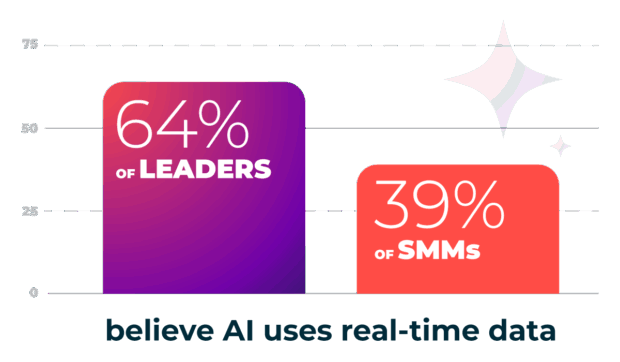
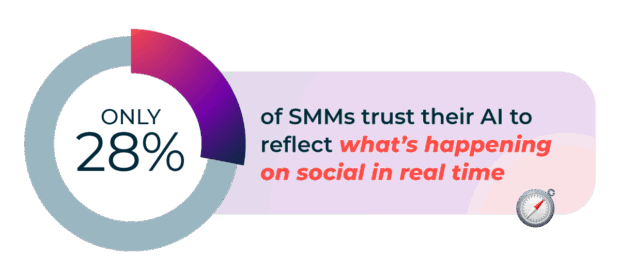
Data from recent industry surveys underscores the severity of this misalignment. According to recent Gartner findings, while 64% of senior marketing executives believe their existing AI tools are leveraging real-time data, only 39% of the social media managers tasked with daily execution agree. This 25-percentage-point gap represents more than a simple misunderstanding; it indicates a failure of communication between strategic leadership and the operational realities of the front lines. When tools fail to reflect the current pulse of an audience, the result is content that feels sterile, tone-deaf, or fundamentally disconnected from the cultural moment.
The Cost of Inefficiency: A Growing Burden
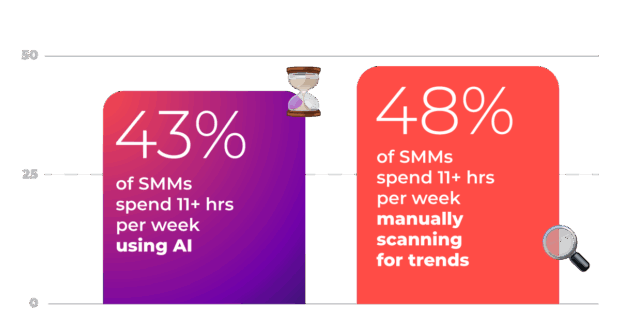
The promise of AI was the automation of "busywork"—the mundane tasks of scheduling, caption writing, and basic reporting. Yet, for many teams, the reality has been a net increase in labor. Current data indicates that 43% of social media managers now dedicate more than 11 hours per week specifically to managing AI tools. Rather than serving as a force multiplier, these platforms have become a secondary management layer, requiring constant "babysitting" to ensure the output aligns with brand standards and current platform norms.
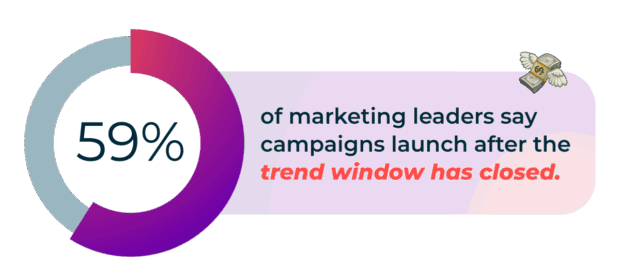
This inefficiency carries a heavy price tag. Nearly 40% of senior marketing leaders report that at least 10% of their annual AI budget has been effectively wasted on tools that failed to deliver measurable results. In an economic climate defined by rigorous fiscal scrutiny and a demand for demonstrable ROI, this level of waste is unsustainable. When campaigns launch after the relevant trend window has closed—a fate reported by 59% of senior marketers—the financial loss extends beyond the software subscription fee to include lost engagement, missed market share, and diluted brand authority.
The Strategic Shift Toward Platform-Native Intelligence
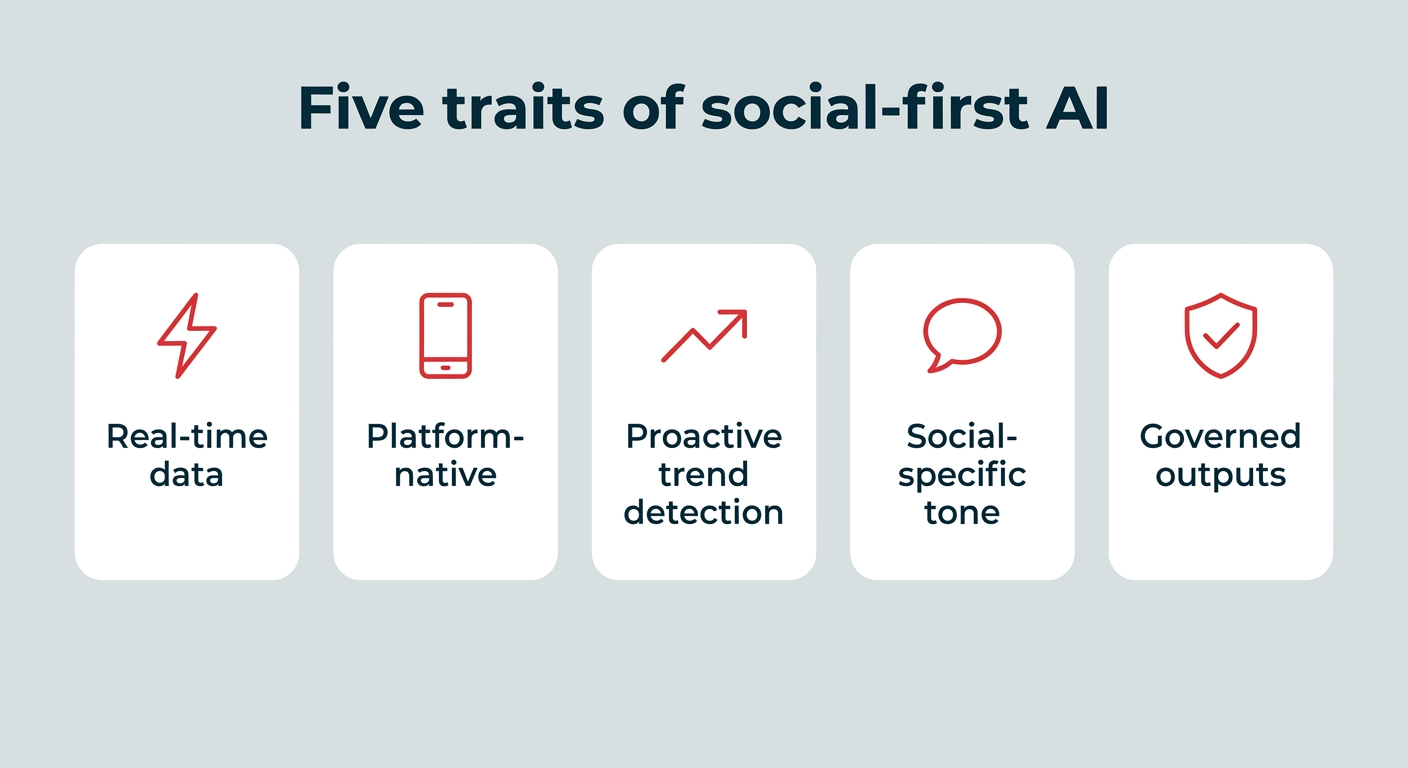
To mitigate these risks, the industry is pivoting toward "social-first" architectures. Unlike generic chatbots, these systems are designed with platform-specific constraints in mind. They understand that the tone appropriate for a professional LinkedIn update is fundamentally incompatible with the vernacular of a TikTok video.
Modern social-first systems, such as the Hootsuite Social OS, are built on the principle of integrated intelligence. By combining listening, content creation, and governance into a single ecosystem, these platforms eliminate the "swivel-chair" effect—the process of switching between separate, siloed tools to execute a single social task. In a social-first environment, an alert about a rising trend captured by a listening module can immediately trigger a content draft in an editing module, which is then routed through a compliance layer before publication. This continuous loop, often managed by "agentic" workflows, reduces the time-to-market from days to minutes.
Governance as a Competitive Advantage
As AI adoption scales, the primary concern for enterprise-level organizations is no longer just quality—it is risk management. Unchecked AI can lead to unauthorized posts, legal liabilities, or the accidental disclosure of sensitive information. A robust social-first framework mandates the inclusion of governance layers, such as the "Vigil" approach, which enforces strict approval workflows and audit trails for every AI-generated interaction.
By embedding governance into the workflow, companies can harness the speed of AI without sacrificing the security of their brand reputation. This requires a shift in how teams define "success." It is no longer about how much content an AI can generate, but rather how much "governed, high-quality" content can be deployed in response to real-time market signals.
The Road Ahead: Coordination over Generation
The next phase of AI in marketing will be defined by coordination rather than mere generation. As organizations move beyond the initial phase of AI experimentation, the focus will shift toward integrating social intelligence into broader enterprise systems. Through the use of connectors and APIs, social data will soon inform decisions in customer service, product development, and supply chain management.
For instance, if social-first AI detects a sudden spike in negative sentiment regarding a product feature, the system should ideally trigger an automated workflow that notifies the product engineering team while drafting a public-facing response for the social team. This represents the ultimate goal of social-first AI: to turn social media into a primary business intelligence stream that flows through the entire organization.
Establishing New Criteria for Success
For marketing leaders currently evaluating their technology stacks, the following six criteria serve as a roadmap for identifying viable, social-first tools:
- Data Freshness: Does the tool pull from live social signals, or does it rely on static historical data?
- Platform Nuance: Can the AI distinguish between the linguistic norms and format requirements of different platforms?
- Proactive Detection: Does the system alert the team to trends before they peak, or does it simply report on what has already happened?
- Workflow Integration: Can the tool handle the entire lifecycle of a post, from insight to approval, within a single environment?
- Governance Controls: Are there built-in mechanisms to ensure compliance and prevent unauthorized or off-brand output?
- Citations and Transparency: Does the tool provide clear, traceable sources for its insights, allowing human managers to verify the data?
The transition to social-first AI is not merely a technological upgrade; it is a fundamental shift in how organizations perceive their role in the digital ecosystem. As consumers spend more time in social environments, the companies that thrive will be those that view social not as a separate marketing channel, but as a real-time pulse of the global market. By investing in tools that prioritize speed, context, and governance, brands can move from a reactive posture—constantly chasing trends they have already missed—to a proactive, authoritative position that shapes the conversation in real time. The era of generic, lagging AI is coming to an end; the era of real-time, social-first intelligence has arrived.
Related posts: