New SparkToro Data Reveals How Often Americans Show Purchase Intent on ChatGPT and What It Means for Brand Strategy

The landscape of digital marketing and search engine optimization is undergoing a profound transformation as artificial intelligence tools integrate deeper into daily consumer behavior. A newly published empirical analysis by audience research firm SparkToro, utilizing tracking data provided by Verso, has shed light on exactly how American consumers utilize ChatGPT, how frequently commercial intent appears within these AI-driven interactions, and what these metrics signify for modern brand visibility and advertising strategies.
According to the analysis, which examined tens of thousands of conversations from an opt-in U.S. panel throughout much of 2026, purchase intent manifests in a surprisingly small fraction of ChatGPT chats. This revelation has triggered immediate discussions among digital marketers, search engine optimization professionals, and corporate strategists regarding where financial resources should be allocated in an increasingly AI-dominated search and discovery ecosystem.
Methodology and Background of the SparkToro and Verso Dataset
To understand the weight of these findings, it is essential to examine the underlying methodology and data collection parameters. The research stems from a collaboration between SparkToro, led by co-founder and CEO Rand Fishkin, and Verso, a platform that tracks users’ ChatGPT conversation histories when they explicitly link their accounts via an opt-in process.
The underlying dataset comprises 41,961 individual conversations generated by 12,321 distinct participants between January 1 and October 29, 2026. To ensure the findings could be generalized to the broader U.S. public, a significant portion of the figures was drawn from a statistically weighted sub-sample designed to match the demographic characteristics of the United States population, utilizing standards derived from the 2024 U.S. Census data.
However, compiling and processing conversational AI data requires rigorous quality controls. Prior to executing the primary analysis, researchers filtered out 131 statistical outliers—the heaviest users on the panel who generated an average of more than 33 prompts per active month. While these hyper-active users accounted for approximately 1% of the total panelists, they were responsible for a disproportionate 21% of all prompts sent. Excluding this cohort ensured that the dataset reflected typical consumer habits rather than power-user anomalies. For the remaining weighted group, the average user sent 9.9 prompts between January and October.
The process of categorizing these interactions was equally meticulous. Every conversation was evaluated using a structured codebook administered through an advanced language model, Claude. Coders assessed conversation titles, up to six user prompts, initial responses from ChatGPT, and any embedded product cards or highlighted business names. To verify accuracy, a secondary independent coder reviewed a random sample, achieving a remarkable 90% agreement rate on functional categories and a 97% to 99% agreement rate on brand tags.
Despite these rigorous controls, researchers noted certain structural limitations within the data. Because the vast majority of panelists connected via mobile devices, desktop computer usage, corporate work accounts, and API requests were largely underrepresented or excluded entirely. Furthermore, API calls—which drive many enterprise-level applications—do not appear in Verso’s consumer tracking framework.
Quantifying Purchase Intent and Commercial Behavior in AI Chats
One of the most anticipated revelations from the SparkToro report is the precise frequency with which consumers exhibit buying behavior while interacting with ChatGPT. Brand marketers have long debated whether generative AI functions as a transactional discovery channel akin to traditional search engines or if it operates primarily as a utility, educational assistant, or creative partner.
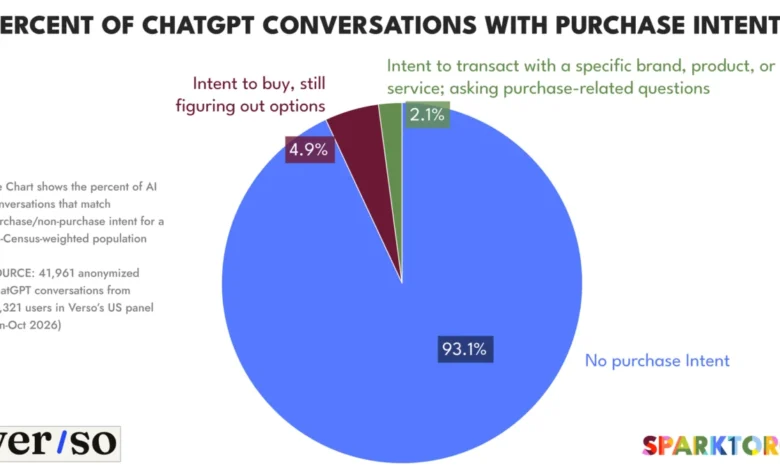
The SparkToro purchase-intent graph, developed from the weighted demographic group, divides user conversations into three distinct behavioral categories based on their primary purpose:
- Active Product Research: 4.9% of total conversations involved a user who planned to make a purchase and was actively exploring, evaluating, or comparing various available options.
- Brand-Specific Inquiries: 2.1% of conversations featured direct questions regarding a specific commercial brand, product, or service.
- Non-Commercial Interactions: A commanding 93.1% of conversations exhibited zero discernible intention to purchase anything.
When aggregating these metrics, conversations involving explicit buyer-journey behavior account for roughly 7% of total ChatGPT usage. This low baseline stands in stark contrast to traditional web search engines. Fishkin cross-referenced these findings with a comprehensive December 2024 SparkToro analysis of approximately 332 million Google searches collected over a 21-month period. In that traditional search dataset, commercial and transactional intents claimed a substantially higher profile, though direct categorization structures differed between the two studies.

The report also evaluated how frequently brands actually appeared within the conversational flow. In the weighted demographic sample, 86.7% of all user prompts did not request information about any brand, product, or company. Conversely, 6.6% of prompts asked about multiple brands, and 6.7% focused on a single brand. On the output side, ChatGPT’s responses mirrored this distribution: 87.9% of all responses failed to name a single brand, product, or business. Only 7.0% of responses mentioned multiple brands, and 5.1% mentioned just one, bringing the total proportion of responses mentioning at least one brand to 12.1%.
Primary Use Cases: What Americans Actually Do with ChatGPT
Beyond commerce, the research provides a comprehensive snapshot of how Americans integrate conversational AI into their daily routines. Each conversation in the dataset was assigned a single category representing its primary goal, prioritizing output type when overlapping requests occurred (for example, asking an AI to draft a formal refund request email to a merchant was classified under writing and communication rather than shopping).
The breakdown of primary use cases across the weighted panel highlights the following distribution:
- Images and Visual Design: Ranking as the most popular category, visual creation requests accounted for 17.6% of all recorded conversations.
- Information and Entertainment: General inquiries, trivia, and entertainment purposes captured second place with 14.4% of total conversations.
- Writing and Communication: Drafting emails, essays, code, and professional correspondence made up 12.7% of the total.
- Shopping, Brands, and Local Services: Commercial inquiries, product searches, and local business lookups constituted 5.3% of the conversations.
When comparing these findings to OpenAI’s official self-reported "Signals" dataset released for September, minor variances emerged. OpenAI’s global message data leaned heavier toward writing tasks and technical support, whereas the U.S. panel data showed a stronger preference for image generation requests and instructional "how-to" queries. Industry analysts note that these differences are entirely reasonable, given that OpenAI’s metrics encompass global usage across free and paid consumer tiers while excluding enterprise and API traffic.
Strategic Implications for Marketers, PPC Teams, and SEO Professionals
The publication of this data carries profound strategic implications for digital marketing departments, search engine optimization (SEO) specialists, and pay-per-click (PPC) advertising managers. For years, businesses have scrambled to optimize their digital assets for "AI visibility," often operating under the assumption that generative chatbots represent the immediate future of consumer product discovery.
However, Fishkin’s analysis challenges this narrative, suggesting that brands may be misallocating their attention and budgets. Based on the finding that nearly 94% of ChatGPT conversations lack purchase intent and that the vast majority of responses omit brand names entirely, Fishkin offered a stark assessment regarding the commercial viability of chat platforms for advertising. "I suspect this is bad news for ChatGPT’s advertising opportunities," he wrote, noting that chat-based interfaces may not offer the high-intent commercial environment that advertisers traditionally seek on platforms like Google or Amazon.
Consequently, Fishkin concluded that the primary driver for investing in AI visibility is not ChatGPT itself, but rather Google’s aggressive implementation of AI Overviews and AI Mode within traditional search engine results pages. Because Google captures a vastly higher volume of commercial and transactional search queries—where users are actively looking to buy goods and services—optimizing digital content to appear within Google’s AI-generated search summaries remains paramount. Conversely, tracking and optimizing brand visibility specifically within ChatGPT may yield a minimal return on investment unless brands simultaneously monitor their performance across traditional search engines and AI-enhanced search integrations like Microsoft Bing.
Looking Ahead: The Future of AI Measurement and Budget Allocation
As the artificial intelligence market continues to mature through 2026 and beyond, research partnerships between data providers like Verso and analytics firms like SparkToro will become increasingly vital for demystifying consumer habits.
For marketing executives and media planners currently evaluating their fiscal budgets, the data serves as both a caution and a roadmap. Experts advise that until panel methodologies evolve to seamlessly capture desktop computing, corporate environments, and API-driven enterprise transactions, businesses should exercise prudence. Rather than relying solely on generalized assumptions about conversational AI usage, digital teams are encouraged to cross-reference broader panel insights with their own proprietary first-party analytics, including internal referral traffic, conversion metrics, and direct AI-driven attribution data.
Ultimately, while generative AI has fundamentally changed how people write, create images, and seek out information, its immediate role in the consumer purchase journey remains more specialized than many industry evangelists originally anticipated. By grounding digital strategy in empirical data rather than speculative hype, organizations can better position themselves to capture high-intent customers wherever they choose to search.
Related posts: