Navigating the Landscape of Social Media Management: The Best Sprout Social Alternatives for Every Budget and Team Size in 2026


The market for social media management tools has reached a critical juncture, characterized by a widening gap between premium enterprise platforms and accessible alternatives. For years, Sprout Social has maintained its position as a powerhouse for large marketing departments, enterprise corporations, and agencies equipped with substantial operational budgets. Offering sophisticated social listening infrastructure, deep multi-channel analytics, and robust customer relationship management (CRM) integrations, Sprout Social has long been the gold standard for corporate social media governance. However, with solo user plans starting at $99 per month—and team tiers scaling rapidly to $249 per user per month—the platform remains financially prohibitive for freelance creators, startups, and lean marketing teams.
This economic reality has triggered a broader migration across the digital marketing landscape. As organizations face tighter macroeconomic conditions and a heightened focus on return on investment (ROI), social media managers are increasingly auditing their software stacks. They are searching for alternatives that deliver equivalent or specialized functionality—such as automated publishing, unified inboxes, and campaign analytics—without the heavy enterprise price tag.

To help organizations navigate this transition, industry analysts and former enterprise consultants have evaluated the top-tier alternatives currently dominating the market. These platforms cater to distinct operational niches, ranging from ultra-flexible creator tools to heavy-duty customer support hubs and specialized video management systems.
The Evolution and Economic Pressures of Social Media Tooling
The demand for diversified social media management software is rooted in the explosive growth of digital marketing channels over the past decade. What began as simple broadcast scheduling utilities for Facebook and Twitter has evolved into complex, multi-functional operational hubs. Modern social media teams must now manage short-form video pipelines on TikTok and Instagram Reels, monitor professional networks like LinkedIn, engage community members on emerging platforms like Bluesky and Threads, and track paid advertising spend across multiple meta-ecosystems.
As the scope of social media marketing has expanded, software vendors have responded by stratifying their pricing models. Enterprise-grade solutions prioritize security, compliance, complex multi-tier approval workflows, and massive data ingestion capabilities. While these features are indispensable for Fortune 500 companies managing thousands of customer service requests daily, they represent unnecessary overhead for smaller enterprises.

Consequently, the alternative software market has matured rapidly. Competitors have engineered targeted feature sets that challenge traditional enterprise strongholds. Whether an organization requires advanced influencer marketing workflows, multi-brand agency management, or seamless content calendar unification, the current market offers tailored solutions designed to maximize efficiency while preserving capital.
Comprehensive Comparison of Leading Sprout Social Alternatives
| Tool | Best Suited For | Starting Price (USD) | Free Tier Available |
|---|---|---|---|
| Buffer | Creators, small-to-medium businesses, and flexible agencies | Free ($6/channel/month paid tiers) | Yes |
| Hootsuite | Large customer support and social listening teams | $149/user/month | No |
| Agorapulse | Marketing teams focused on proving revenue ROI | $99/user/month | No |
| Sendible | Multi-brand agencies requiring collaborative workspaces | $35/month | No |
| CoSchedule | Content teams managing holistic marketing calendars | $39/month | Yes |
| Later | Instagram-centric brands and influencer marketing campaigns | $25/month | Yes |
| Metricool | Teams managing organic content alongside paid ad campaigns | $25/month | Yes |
| RecurPost | Video-heavy creators and evergreen content automation | $9/month | No |
Detailed Breakdown of Top Alternatives
1. Buffer: The Gold Standard for Flexibility and Affordability
Long favored by individual creators, lean startups, and growing boutique agencies, Buffer has built its reputation on a philosophy of simplicity, reliability, and transparent pricing. Unlike enterprise tools that lock essential features behind expensive paywalls, Buffer offers a genuinely robust free tier that permits users to connect up to three social channels and schedule up to 30 posts simultaneously.
For users requiring expanded capacity, Buffer’s Essentials plan begins at a modest $6 per channel per month, while team-oriented tiers start at $12 per channel per month. The platform excels in streamlining the ideation and publishing process through its intuitive "Create" space, which features Kanban-style idea boards, automated content recycling, and AI-assisted copywriting tools. Furthermore, Buffer provides comprehensive multi-channel analytics and report exports in multiple formats, making it a highly adaptable substitute for organizations transitioning away from Sprout Social.

2. Hootsuite: The Powerhouse for High-Volume Engagement and Support
For enterprises where social media functions primarily as an extension of the customer service department, Hootsuite remains a formidable competitor to Sprout Social. Starting at $149 per user per month, Hootsuite is engineered for large teams that process thousands of incoming direct messages, public mentions, and support inquiries daily.
Hootsuite’s core strength lies in its unified social inbox and its extensive integration ecosystem, which supports over 100 enterprise apps—including Zendesk, HubSpot CRM, Canva, and Monday.com. The platform features advanced social listening capabilities, custom multi-tier approval workflows, and granular message assignment features that allow support agents to convert social conversations directly into service tickets. While its price point is similarly positioned to enterprise competitors, it provides the heavy infrastructure required by large-scale communications operations.
3. Agorapulse: Proving Social Media ROI to Corporate Leadership
Demonstrating the direct financial impact of social media campaigns to executive leadership is one of the most persistent challenges facing modern marketing managers. Agorapulse addresses this challenge directly, positioning itself as a data-driven alternative for mid-to-large marketing teams.

Priced at $99 per user per month for up to 10 social channels, Agorapulse bridges the gap between community management and revenue attribution. The platform integrates seamlessly with major social networks, offering deep analytics suites that track how specific content assets drive leads, conversions, and sales. Alongside its robust reporting capabilities, Agorapulse features comprehensive social listening tools, an all-in-one engagement inbox, and collaborative approval workflows designed to keep multi-departmental marketing strategies aligned.
4. Sendible: The Ideal Ecosystem for Multi-Brand Agencies
Managing social media portfolios for multiple external clients introduces unique logistical hurdles, including client review bottlenecks, white-label reporting requirements, and fragmented brand guidelines. Sendible is purpose-built to solve these agency-specific challenges.
Starting at $35 per month for a single workspace supporting up to six social channels, Sendible offers an economical yet powerful environment for growing agencies. The platform features a streamlined dashboard, dedicated client portals (Client Connect) for external approvals, and automated reporting features. Because Sendible includes unlimited users across its pricing tiers, agencies can scale their internal teams without incurring incremental software licensing costs.

5. CoSchedule: Unifying Holistic Content Marketing Strategies
While most social media management platforms focus exclusively on social channels, CoSchedule takes a macro-level approach by functioning as a centralized marketing calendar. It is ideally suited for creators, publishers, and marketing teams that juggle blogs, email newsletters, webinars, and social campaigns simultaneously.
Priced from $39 per month, CoSchedule integrates social scheduling with content management systems like WordPress and email marketing platforms such as Mailchimp and ActiveCampaign. Its calendar-centric interface provides complete visibility across all marketing initiatives. While it lacks the deep social listening suites found in Sprout Social, its unmatched ability to synchronize cross-channel content strategies makes it an indispensable tool for holistic content teams.
6. Later: The Premier Hub for Visual Planning and Influencer Marketing
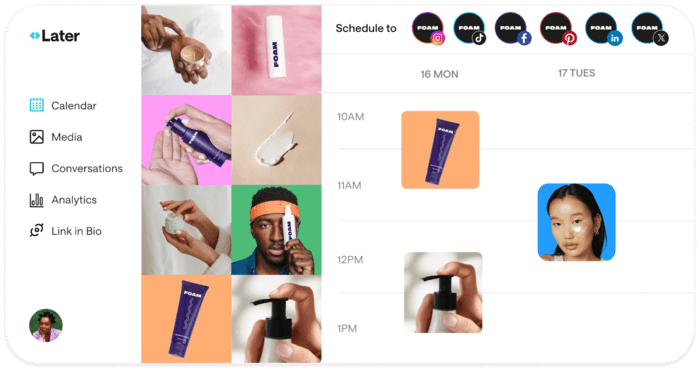
Originally launched as a dedicated Instagram scheduling utility, Later has evolved into a comprehensive visual marketing platform. It remains the premier choice for brands that rely heavily on aesthetics-driven platforms like Instagram, Pinterest, and TikTok.

Starting at $25 per month, Later offers advanced visual content planning grids, optimal posting time recommendations, and automated hashtag suggestions. In recent years, the platform has expanded its capabilities to encompass enterprise-grade influencer marketing campaigns. By providing end-to-end management tools for brand-creator partnerships, Later bridges the gap between organic social publishing and influencer commerce.
7. Metricool: Bridging Organic Content and Paid Advertising
For modern marketing teams that operate across both organic social media and paid acquisition channels, managing campaigns across disparate dashboards can create significant operational friction. Metricool resolves this challenge by unifying organic content management with paid ad administration.
Starting at $25 per month for up to five brands, Metricool enables users to schedule content across all major networks while simultaneously overseeing campaigns on Meta, Google, and TikTok ad platforms. The software also features unique analytical tools, including heatmap-based timing recommendations, detailed competitor benchmarking suites, and comprehensive hashtag tracking.

8. RecurPost: Advanced Control for Video-Centric Creators
As short-form and long-form video content dominates consumer attention across TikTok, YouTube, and Instagram, creators require publishing tools with deep video-native capabilities. RecurPost is engineered specifically to meet this demand.
Starting at $9 per month for two social accounts, RecurPost centers its architecture around evergreen content libraries and automated workflows. However, its standout attribute is its advanced video publishing suite. For Instagram, RecurPost allows users to post trial reels, add licensed audio, tag collaborators, and trigger automated direct messages upon publication. For YouTube and TikTok, it offers granular control over video uploads, privacy settings, comment moderation, and duet/stitch configurations, making it the most technically capable tool for video-first creators.
Strategic Implications and Decision Frameworks for Migration
Transitioning away from an enterprise platform like Sprout Social requires careful logistical planning to ensure operational continuity. Industry consultants emphasize that organizations should maintain their legacy subscriptions temporarily while onboarding alternative platforms. This overlap allows social media managers to safely export historical analytics data and re-queue scheduled posts without risking content gaps.
Ultimately, the selection of a social media management platform is a deeply personalized operational decision. Organizations must weigh several core variables before committing to a new software stack:
- Budgetary Constraints: Evaluating whether the tool offers a scalable pricing model or a functional free tier.
- Channel Demographics: Ensuring the platform natively supports the specific networks where the brand’s audience is most active.
- Team Structure: Determining whether the tool accommodates solo creators, collaborative internal marketing departments, or external agency clients.
- Core Objectives: Aligning software capabilities—such as customer support ticketing, revenue attribution analytics, or video publishing control—with overarching business goals.
By carefully assessing these operational requirements and leveraging the extensive free trials offered by most alternative providers, organizations can successfully transition to a cost-effective, high-performing social media management ecosystem tailored precisely to their strategic vision.