Five Essential Python Scripts to Automate CSV Processing and Eliminate Workflow Bottlenecks

Comma-separated values, universally known as CSV files, remain the foundational currency of data exchange across modern enterprises. Despite the proliferation of sophisticated data lakes, cloud warehouses, and complex streaming architectures, the ubiquitous .csv file persists as the primary output format for database exports, application logs, financial ledgers, and ad-hoc batch reporting jobs. However, the operational reality of managing CSV data is rarely frictionless. Data engineers, analysts, and software developers routinely encounter a predictable array of infrastructural friction points: inconsistent delimiters, unexpected encoding errors, stealthy schema drift, and duplicate or corrupted rows.
Conventionally, data practitioners address these persistent anomalies through one of two inefficient methods: manual inspection inside spreadsheet applications, or the hasty development of ad-hoc, custom scripts written under strict time constraints. Manual spreadsheet reviews scale poorly, introducing severe risks of human error when processing files containing hundreds of thousands of rows. Conversely, writing custom, single-use parsing scripts for every routine data ingestion task introduces unnecessary technical debt, maintenance overhead, and vulnerability to edge cases. Furthermore, many enterprise environments impose strict restrictions on third-party software installations, complicating the deployment of heavy external data manipulation libraries for minor text-wrangling tasks.
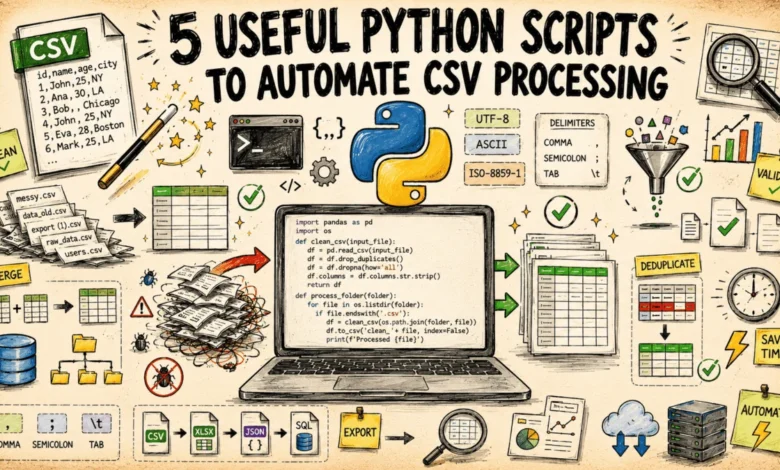
To bridge this operational gap, developer and technical writer Bala Priya C. has released a curated suite of five self-contained Python scripts designed to automate repetitive CSV processing chores. Significantly, each script relies exclusively on Python’s robust standard library, eliminating the need to install external packages such as Pandas or NumPy, or to manage complex dependency trees. This architecture ensures that the scripts can be executed instantly within minimal containerized environments, legacy servers, or secure cloud functions where dependency management is strictly controlled.
Anatomy of Modern CSV Ingestion Challenges
The fragility of CSV workflows stems largely from the format’s lack of a formal, enforced specification. While RFC 4180 attempts to standardize the format, applications generate files with varying assumptions regarding quoting rules, escape characters, line terminators, and character sets. When a downstream analytics pipeline or machine learning model attempts to ingest a malformed or improperly encoded file, the resulting failures are frequently opaque, tracing the error back to its source requires exhaustive forensic analysis across multiple system boundaries.
Industry analysts estimate that data professionals spend up to 80 percent of their time on data preparation tasks, with basic formatting, cleansing, and validation consuming a disproportionate share of engineering bandwidth. Automating these preliminary validation and transformation steps not only accelerates time-to-insight but also prevents upstream data quality issues from corrupting enterprise data warehouses. By deploying standardized, lightweight validation gates and transformation utilities directly at the perimeter of data ingestion pipelines, organizations can significantly enhance data reliability.
1. Automated Schema Validation for Pipeline Integrity
The first major operational vulnerability in data ingestion is schema drift. A CSV file that visually appears correct during a localized spreadsheet preview can harbor latent structural defects: a mandatory identifier column missing from a nightly export, a date field corrupted by mixed string formats, or a numeric metric populated with empty strings instead of null values or zeros. Traditionally, these discrepancies are only discovered downstream when database insertion queries fail or analytical dashboards return anomalous results, forcing costly reactive debugging.
The Schema Validator script addresses this challenge by evaluating incoming CSV files against a predefined configuration schema. Defined via a lightweight JSON file, the schema maps expected column headers to explicit data types—including integers, floating-point numbers, dates, strings, and validated email formats—alongside optional regular expression patterns and nullability constraints.
# Conceptual overview of schema validation logic utilizing standard library csv.DictReader
import csv
import json
import re

def validate_csv(file_path, schema_path):
    with open(schema_path, 'r') as schema_file:
        schema = json.load(schema_file)

    errors = []
    with open(file_path, mode='r', encoding='utf-8') as csv_file:
        reader = csv.DictReader(csv_file)
        for row_idx, row in enumerate(reader, start=1):
            for col, rules in schema.items():
                val = row.get(col, '')
                if rules.get('required', False) and not val:
                    errors.append((row_idx, col, "Missing required value"))
                # Additional type and regex validations performed here
    return errors
Rather than executing a blunt binary pass-or-fail check, the script generates a granular, row-by-row and column-specific error report. Operating via Python’s memory-efficient csv.DictReader, the utility streams data row by row, ensuring scalability for files exceeding available RAM. Upon completing the validation pass, the script exits with a non-zero status code if anomalies are detected. This behavior allows DevOps and data engineering teams to seamlessly integrate the validator as a gatekeeper within automated continuous integration or ETL pipelines, halting malformed data before it pollutes production data stores.
2. Row-Level Differential Auditing
Auditing changes between successive iterations of a dataset is a foundational requirement in compliance, financial reporting, and stateful data synchronization. Comparing historical exports—such as yesterday’s enterprise inventory snapshot against today’s ledger—typically requires side-by-side spreadsheet comparisons. As datasets scale past millions of records, visual inspection becomes entirely unfeasible, creating blind spots where critical record modifications, insertions, or deletions can go unnoticed.
The Row-Level Diff Tool automates this comparative analysis. By ingesting two distinct CSV snapshots and aligning them via a user-specified primary key column or composite key, the script computes set-theoretic differences to categorize records into three distinct buckets: added keys, removed keys, and modified records.
Crucially, the tool filters out entirely unchanged rows, focusing reviewer attention exclusively on modified fields. For altered rows, the script performs a granular field-by-field comparison, recording the specific column name alongside its legacy and current values. The resulting output is structured as a standardized audit report detailing the change_type, record identifier, column name, old value, and new value. This structured output format enables automated downstream filtering, compliance logging, and rapid executive review.
3. Encoding and Delimiter Normalization
Global data exchanges frequently introduce severe friction regarding text encodings and delimiter conventions. While comma-separated values imply a comma delimiter and UTF-8 encoding, legacy enterprise applications, international software exports, and localized spreadsheet software frequently generate files utilizing semicolons, tab characters, or pipe separators. Furthermore, files encoded in ISO-8859-1, Windows-1252, or featuring unexpected byte-order marks (BOM) routinely break standard parsing engines.
The Encoding and Delimiter Normalizer script provides an automated remediation workflow for heterogeneous file inputs. The utility operates in two phases:
- Introspection: The script samples the input file in binary mode, evaluating byte sequences against a shortlist of common character encodings and falling back to probabilistic heuristics if necessary. Simultaneously, Python’s built-in
csv.Snifferutility inspects a sample of the decoded text to accurately deduce the primary delimiter among commas, semicolons, tabs, and pipes. - Normalization: Once the source characteristics are identified, the file is re-read under the detected parameters and systematically re-written into a pristine, standardized format utilizing UTF-8 encoding, comma delimiters, and Unix-style
nline endings, while stripping problematic BOM headers.
A concise execution summary is printed to the system console, logging the original file encoding and delimiter parameters to ensure complete auditability across data processing pipelines.
4. Configurable Column Transformation and Reshaping
Data engineering pipelines frequently require structural reshaping of incoming tabular data: renaming legacy column headers, dropping redundant audit fields, reordering attributes to match database schemas, and deriving new metrics from existing attributes (such as concatenating first and last names, parsing currency strings into numeric floats, or calculating derived financial ratios). While trivial in interactive spreadsheet applications for single files, executing these transformations consistently across hundreds of batch files demands automation.
The Configurable Column Transformer executes complex tabular reshaping based entirely on an external JSON configuration file. Operations are defined as a sequential list of transformation steps encompassing renaming, dropping, reordering, and derivation.
To maintain system security and prevent arbitrary code execution vulnerabilities, derived columns are generated using a restricted, safe expression syntax and registered conversion functions (such as to_float, to_int, and strip_currency) rather than evaluated string execution. Operating via csv.DictReader and csv.DictWriter, the transformer maintains a flat memory footprint regardless of input file scale, ensuring reliable execution on resource-constrained computing infrastructure.
5. Reservoir Sampling and Field Anonymization
Data democratization initiatives and collaborative development workflows frequently necessitate sharing production-grade datasets with external engineering teams, third-party contractors, or automated testing environments. However, strict data privacy regulations, including the European Union’s General Data Protection Regulation (GDPR) and the California Consumer Privacy Act (CCPA), prohibit the unmasked transmission of personally identifiable information (PII) or sensitive commercial data. Manually redacting spreadsheet columns is laborious, error-prone, and unsustainable at scale.
The Sampler and Field Anonymizer script addresses this dual challenge by combining statistical data reduction with robust cryptographic pseudonymization:
- Reservoir Sampling: For exceptionally large datasets, the script utilizes reservoir sampling algorithms to extract a uniform random sample of rows without necessitating the pre-loading of the entire file into memory.
- Deterministic Pseudonymization: For columns flagged as sensitive in the configuration profile, the script applies a keyed cryptographic hash to the original value, truncating the result into a consistent, readable token.
Crucially, the hashing mechanism is deterministic within a given execution run: identical input values consistently map to the identical pseudonymous output token. This mathematical property ensures that referential integrity and relational mappings between rows (such as foreign key relationships linking customers to transaction logs) are fully preserved, allowing engineering teams to perform realistic integration testing and statistical modeling without exposing sensitive underlying data entities.
Broader Implications for Data Operations
The introduction of these standardized, dependency-free Python utilities highlights an ongoing evolution in modern data engineering: the growing emphasis on lightweight, composable micro-utilities over monolithic software frameworks. While enterprise data lakes and cloud-native ETL orchestrators handle massive, petabyte-scale transformations, the operational friction of daily data ingestion frequently occurs at the micro-level—malformed headers, unexpected character encodings, and ad-hoc data sharing requests.
By leveraging Python’s robust standard library, developers can deploy these self-contained scripts across diverse architectural environments without introducing dependency bloat or security vulnerabilities associated with unvetted third-party packages. As data governance mandates tighten and the velocity of multi-source data ingestion accelerates, adopting standardized, automated validation and transformation patterns will remain a critical differentiator for resilient enterprise data operations.
All five fully implemented scripts, accompanied by comprehensive documentation and test schemas, are publicly accessible via the author’s open-source GitHub repository for integration into enterprise data workflows.