AWS Unveils Enhanced Custom Event Bus in Amazon EventBridge to Eliminate Multi-Account Serverless Complexity and Streamline Enterprise Architecture

As organizations increasingly embrace serverless paradigms to build scalable, event-driven applications, architectural complexity often migrates from infrastructure management to inter-service communication. Historically, teams initiating development on Amazon EventBridge typically began with a singular custom event bus localized within a single AWS account. While this localized approach is seamless for small-scale projects owned by individual engineering squads, it rapidly degrades in efficacy as enterprise adoption scales. AWS best practices advocate for multi-account governance structures, which inadvertently necessitate complex webs of cross-account rules, multiple event buses, and intricate bus-to-bus configurations. This workaround has long reintroduced the precise operational overhead that serverless architectures were engineered to eliminate.
To resolve these longstanding structural friction points, Amazon Web Services has officially announced the launch of an enhanced custom event bus within Amazon EventBridge. Purpose-built for modern enterprises scaling event-driven applications across disparate teams and accounts, this new iteration introduces a unified, centralized event bus shared globally across an organization’s AWS accounts. Supported by native ordering guarantees, a simplified unified Subscriber resource, and an innovative cost-allocation pricing model, the rollout promises to reshape how large-scale cloud environments manage event-driven topologies.
The Evolution of Enterprise Event Routing
The historical limitations of multi-account event architectures have presented persistent challenges for platform engineering and operations teams. In traditional setups, establishing communication channels between disparate team accounts required configuring cross-account permissions, resource policies, and intricate routing rules. Consequently, platform teams frequently lost critical visibility into subscription lifecycles, unable to easily track which downstream consumers were listening to specific event streams.
Furthermore, the economic implications of multi-bus architectures compounded quickly. Every hop between event buses incurred distinct routing charges, inflating cloud expenditure unnecessarily. Perhaps most critically, teams requiring strict event ordering—such as those operating logistics, financial transaction pipelines, or real-time IoT networks—were historically forced to deploy secondary architectural workarounds, such as intercalating Amazon Simple Queue Service (Amazon SQS) queues between event sources and compute targets, or migrating entirely to alternative messaging technologies.
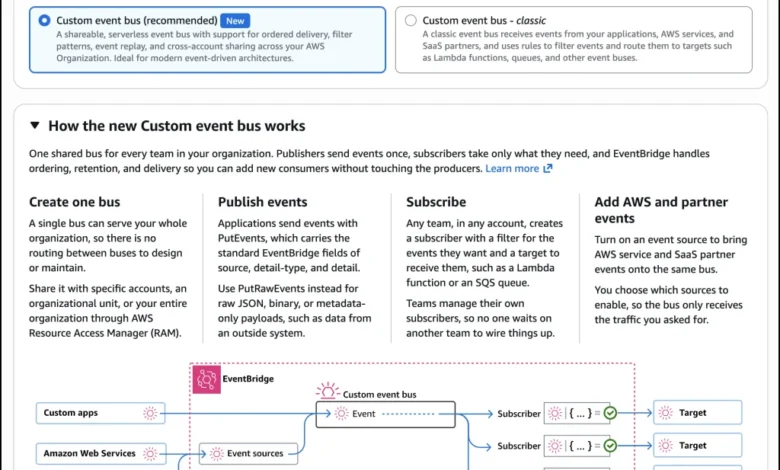
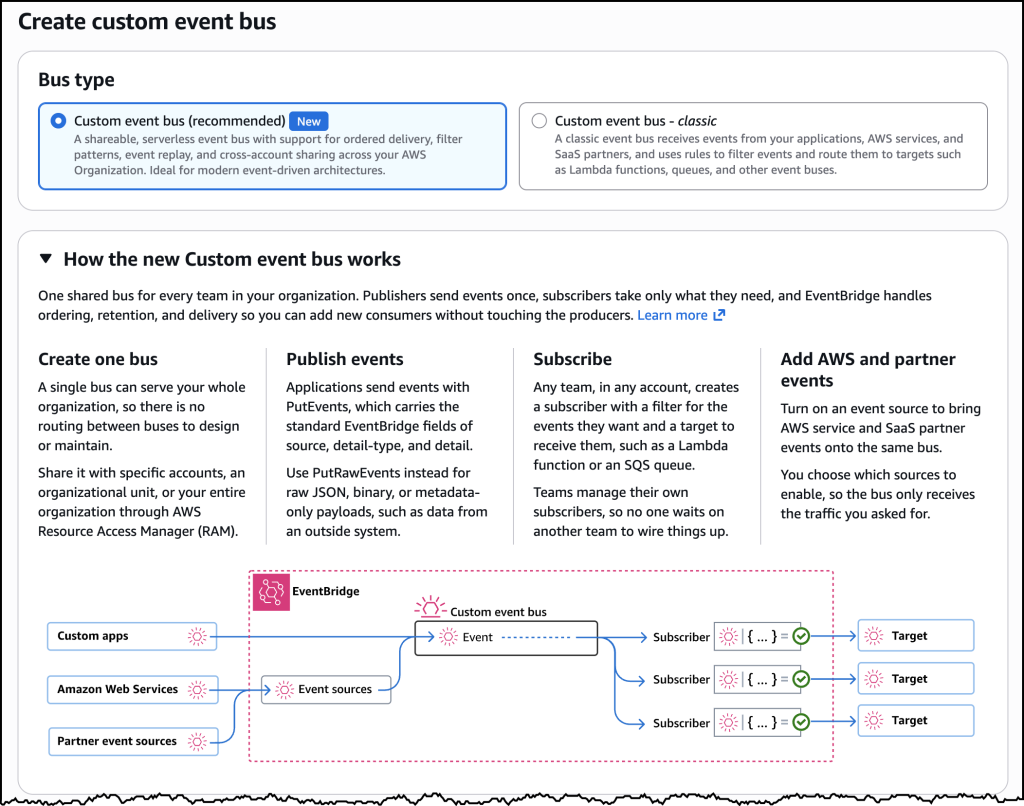
The newly introduced enhanced custom event bus directly addresses these pain points by offering a single, organization-wide event backbone. According to AWS deployment guidelines, platform teams can now provision one centralized bus and distribute access via AWS Resource Access Manager (AWS RAM). This capability allows application teams to publish and consume events natively without waiting for dedicated infrastructure provisioning or manually managing cross-account permissions.

Core Technological Advancements
The enhanced custom event bus introduces several fundamental capabilities designed to optimize performance, reliability, and governance at enterprise scale.
Native Event Ordering and Synchronous Processing
While event-driven architectures fundamentally thrive on asynchronous, decoupled patterns where message sequence is immaterial, certain enterprise workflows—such as tracking vehicular location updates in supply chain applications—demand strict chronological integrity. Out-of-sequence payloads in these contexts routinely cause downstream routing algorithms to execute decisions based on stale or contradictory data.
The enhanced custom event bus natively supports both asynchronous and ordered event processing on a single infrastructural resource. Publishers can attach an EventGroupId parameter to outbound payloads. EventBridge subsequently guarantees sequential delivery of events sharing the same EventGroupId to subscribers that have opted into ordered processing, while concurrently permitting other consumers on the same bus to process events fully asynchronously.
To facilitate this reliably, the new bus introduces synchronous invocation support for targets such as AWS Lambda. This synchronous execution model confirms successful downstream computation before acknowledging receipt of the event upstream, effectively eliminating the architectural necessity of maintaining intermediary message queues solely for sequence preservation.
The Unified Subscriber Resource
Configuration management under legacy EventBridge paradigms required administrators to independently provision and stitch together distinct rules, targets, retry policies, and dead-letter queues. The enhanced custom event bus consolidates these disparate components into a single, cohesive entity designated as the Subscriber resource.
Each Subscriber resource acts as an autonomous administrative unit defining granular event filtering parameters, target destinations, failure handling protocols, and retry mechanics. Additionally, Subscribers feature variable start-time configurations, simplifying the onboarding of newly deployed consumer applications and facilitating rapid event replay workflows during disaster recovery scenarios or application debugging exercises.

Advanced Payload Evaluation and Transformation
Data hygiene and transformation capabilities have also been significantly augmented. Publishers can now activate content-based deduplication directly on the event bus. When enabled, EventBridge generates cryptographic hashes of meaningful payload attributes to identify and automatically drop duplicate retries arriving within a five-minute window, effectively delivering exactly-once semantics for untrusted or flaky event sources that lack native idempotency tokens.
Downstream consumers can leverage integrated JSONata expressions to reshape incoming payloads dynamically before they reach target endpoints. This enables subscribers to extract specific fields, normalize schema discrepancies, or compute derived values directly within the routing layer. Moreover, native deserialization support for Apache Avro and Protocol Buffers allows EventBridge to parse complex binary formats into JSON natively, empowering subscribers to execute fine-grained filtering across the entire event payload without requiring custom ingestion and parsing codebases.
Chronology and Availability
The development and deployment of the enhanced custom event bus represent a multi-year engineering response to feedback collected from enterprise serverless practitioners. Following internal testing and iterative feature scoping, AWS initiated the global rollout to production environments.
The feature is generally available in a wide array of global AWS Regions, including US East (N. Virginia, Ohio), US West (Oregon), Europe (Ireland, Frankfurt, Stockholm, Spain), and Asia Pacific (Hong Kong, Malaysia, Mumbai, Singapore, Sydney, Thailand, Tokyo). Organizations can provision the new resource immediately via the AWS Management Console, the AWS Command Line Interface (AWS CLI), or programmatic calls to the EventBridge APIs.
Crucially, AWS has confirmed that existing custom event buses will remain fully supported, experiencing zero service interruption. These legacy instances are automatically designated as "Custom event bus — classic" within the management console, ensuring that organizations can adopt the new enhanced architecture incrementally and at their own operational pace.
Economic Implications and Pricing Model
To align with the architectural shift toward centralized, multi-tenant event buses, AWS has introduced a modernized throughput-based pricing structure for the enhanced custom event bus. Replacing the traditional per-event pricing model that penalized multi-bus architectures with compounding cross-account routing fees, the new structure separates costs into ingress (ingested events) and egress (delivered events) throughput metrics.
This transparent cost-allocation model provides clearer financial visibility for platform administrators, enabling precise chargebacks across different business units, publishers, and subscribers. By removing the economic penalties associated with cross-account event sharing, enterprises are incentivized to consolidate fragmented event topologies into cohesive, organization-wide backbones, ultimately driving down total cost of ownership for serverless infrastructure.
Industry Reception and Strategic Outlook
Enterprise cloud architects and DevOps leaders have expressed cautious optimism regarding the release. Industry analysts note that as serverless adoption matures, the primary bottleneck in cloud computing has shifted from raw infrastructure scalability to organizational governance and data interoperability.
By abstracting away the operational overhead of cross-account routing policies and introducing native ordering mechanisms, AWS has effectively bridged the functional gap between traditional enterprise service buses and modern cloud-native event streaming platforms. Platform engineering teams are expected to leverage the default quota of 10,000 Subscribers per bus to dismantle departmental silos, fostering a more collaborative, event-driven culture across large engineering organizations.
As enterprises continue to migrate mission-critical transactional workloads to serverless architectures, the success of tools like the enhanced custom event bus will be measured by their ability to maintain low latency and high availability under massive enterprise throughput. For now, the rollout provides a compelling architectural blueprint for organizations seeking to scale event-driven systems without sacrificing operational visibility or financial control.