The advent of artificial intelligence has fundamentally reshaped the landscape of possibility, erasing many long-held excuses for personal and professional stagnation. What remains, in this transformative era, is not a lack of tools but a profound need for permission – the permission to step beyond familiar confines and embrace the vast, uncharted territory that AI has unveiled. This shift is not merely technological; it is a deeply human call to re-evaluate our motivations, our skills, and our very definition of authority in a world where the barriers to entry have dramatically lowered.
The author’s personal narrative of leaving home at seventeen to pursue higher education serves as a powerful metaphor for the journey of transformation. This act, fraught with both terror and excitement, represents the first deliberate step through a door into the unknown. This experience, repeated throughout life, underscores a crucial lesson: while the familiar room offers safety, the door to new opportunities, though frightening, invariably leads to a larger world. Today, AI has collectively flung open such a door for humanity, yet the discourse often overlooks what truly awaits on the other side.

AI is not a phantom threat or an elaborate deception; its gifts are tangible and measurable, ushering in an era of unprecedented potential. However, these gifts are inextricably linked to the vast unknown, compelling individuals to navigate a new frontier.
The Four Gifts of Artificial Intelligence
Artificial intelligence bestows upon individuals a quartet of transformative advantages, each with profound implications for skill acquisition, productivity, and personal endeavor.
1. Unearned Expertise: Bridging the Skill Gap
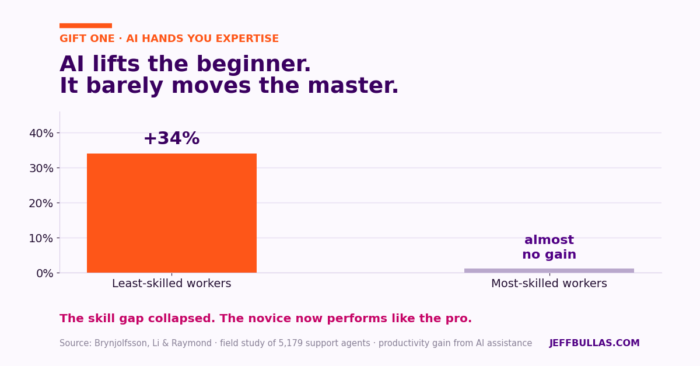
One of the most striking benefits of AI is its ability to democratize expertise. Research from institutions like Stanford and MIT has provided empirical evidence of this phenomenon. A study involving over 5,000 customer support professionals who utilized an AI assistant revealed an average productivity increase of 14%. Crucially, the least skilled workers experienced the most significant gains, with a 34% improvement, while those already highly experienced saw minimal enhancement. This disparity highlights AI’s power as an accelerant for novices, effectively leveling the playing field by providing them with the patterns and insights that seasoned professionals have spent years cultivating. The implication is clear: AI acts as a powerful mentor, imbuing beginners with a level of proficiency that would have previously required extensive training and experience. This collapse of the skill gap has the potential to redefine entry-level roles and accelerate career progression for a broad spectrum of the workforce.
2. The Demise of Friction: Accelerating Creation
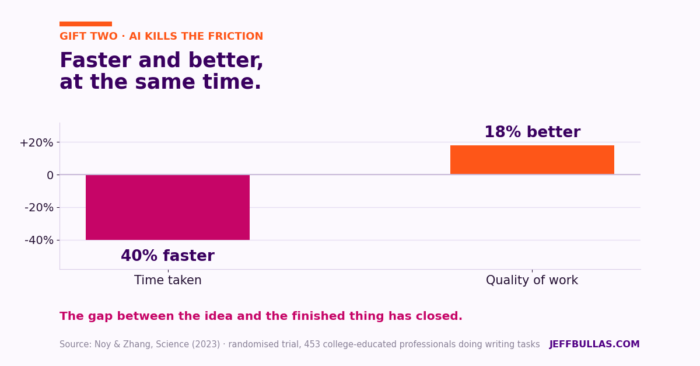
The friction that once existed between conception and completion has been drastically reduced by AI. A controlled trial published in the journal Science, involving 453 professionals engaged in writing tasks, demonstrated that those using ChatGPT completed their assignments 40% faster, with an 18% improvement in quality. This dual enhancement of speed and quality signifies a paradigm shift. The distance between having an idea and bringing it to fruition has been dramatically compressed, empowering individuals and organizations to iterate and produce at an unprecedented pace. This streamlining of the creative and productive process has far-reaching implications for industries that rely on rapid content generation, research, and development.
3. Complexity Simplified: Democratizing Sophistication
Tasks that historically demanded extensive teams, significant budgets, and years of specialized training can now be accomplished with relative ease. AI has the capacity to transform complex challenges into manageable endeavors, often requiring little more than a well-articulated query and a short period of focused effort. This simplification of complexity has the potential to unlock innovation across various sectors, enabling smaller entities or individuals to tackle projects previously deemed insurmountable due to resource constraints or technical barriers. The democratization of sophisticated problem-solving can lead to a more diverse and dynamic innovation ecosystem.
4. The Gift of Unfettered Opportunity: Permission to Venture
Perhaps the most profound, yet least discussed, gift of AI is the liberation it offers for individuals to embark on their own ventures. Traditional obstacles such as lack of capital, insufficient skills, limited team resources, or time constraints have been significantly diminished. AI tools effectively dismantle these barriers, shifting the focus from a lack of resources to a question of will. The absence of these external impediments leaves individuals facing a fundamental internal challenge: the need for self-permission. This permission is not granted by technology, but by an individual’s willingness to overcome self-doubt and take the leap.
The Internal Gatekeeper: Permission and Action
The realization that "everything standing in your way is behind your own eyes" is a critical juncture in this new era. The path forward is not paved with technical hurdles but with psychological ones. The gate to opportunity has two steps: granting oneself permission and then acting upon it. The author emphasizes that inaction, even with a brilliant idea, dooms it to obscurity. This fundamental truth remains immutable: a machine cannot provide the internal impetus, the "why," behind one’s actions.
The Unspoken Consequence: A Crowded Frontier
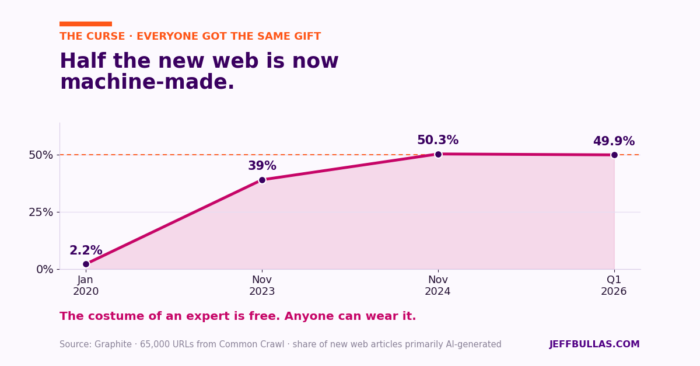
The widespread availability of these AI-driven gifts, bestowed simultaneously and at minimal cost, has led to an unforeseen consequence: a crowded landscape. The ease of entry has naturally attracted a larger cohort of participants. Data from Graphite’s analysis of web articles indicates a dramatic surge in machine-generated content. In January 2020, approximately 2% of new web articles were machine-written; by late 2024, this figure had surpassed 50%. This arithmetic reality means that while the tools are abundant, the space to stand out is increasingly competitive. The "cost" of walking through this open door is not financial, but the challenge of navigating a significantly more populated environment.
The True Adversary: Difficulty Replaced by Competition
For years, the inherent difficulty of certain tasks served as a natural barrier, protecting specialized knowledge and skills. The author recalls the initial struggles of starting a blog in 2009, a seemingly simple endeavor that presented significant technical challenges. This difficulty acted as a moat, deterring casual participation. AI has effectively drained this moat, making previously inaccessible tasks achievable for a wider audience. This democratization, while empowering, has also introduced a new form of competition, as the once-exclusive domain is now open to millions. The trade-off, often unacknowledged, is the acquisition of powerful tools coupled with an influx of new players.
The Price of Transformation: Personal Cost and Profound Reward
The journey of embracing new opportunities, as exemplified by the author’s personal milestones – leaving home at seventeen, departing from a deeply ingrained religious upbringing at twenty-seven, and transitioning to self-employment at fifty-two – reveals a consistent pattern: the price of walking through a new door is real. This price often involves fear, anxiety, and a significant investment of time and resources with no guaranteed outcome. However, the rewards are equally profound. These include the freedom to grow, the resilience gained from overcoming setbacks, and an intrinsic motivation that transcends mere discipline. This deep-seated drive, born from the act of pursuing one’s path, is an intangible yet invaluable outcome that AI, while providing tools, cannot replicate.
AI’s Limits: Collapsing the Doing, Not the Deciding
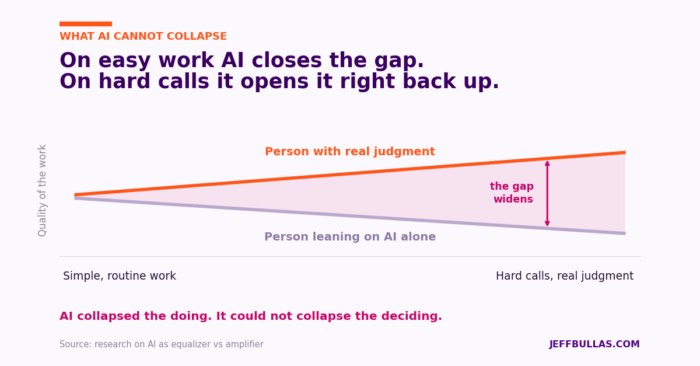
While AI excels at streamlining and democratizing the execution of tasks, its capabilities have distinct limitations. Studies consistently show AI closing the gap between beginners and experts in routine or formulaic work. However, in areas requiring nuanced judgment, contextual understanding, and sophisticated decision-making, AI acts as an amplifier rather than an equalizer. It magnifies the capabilities of those who already possess these higher-level skills, rather than granting them to novices. Therefore, AI has collapsed the doing, but it has not collapsed the deciding.
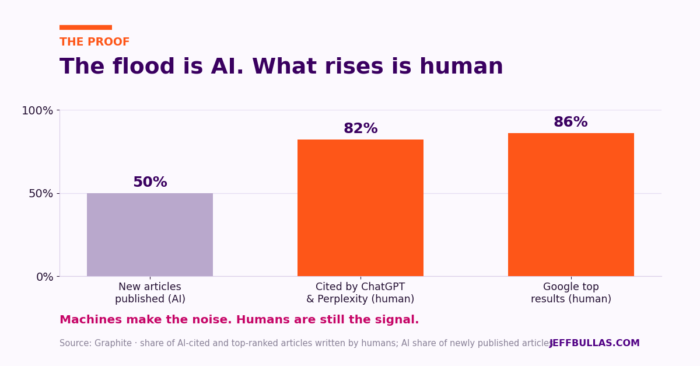
This distinction is evident in the market’s response. Despite the proliferation of AI-generated content, human-authored articles continue to dominate search engine rankings and are more frequently cited by advanced AI models. Graphite’s research indicates that while approximately half of new web articles are machine-generated, a substantial majority of high-ranking content in Google Search and citations by AI models originate from human creators. This suggests that while AI can generate volume, human insight, critical thinking, and established authority remain the signal amidst the noise.
Building What Matters: The Authority of Trust
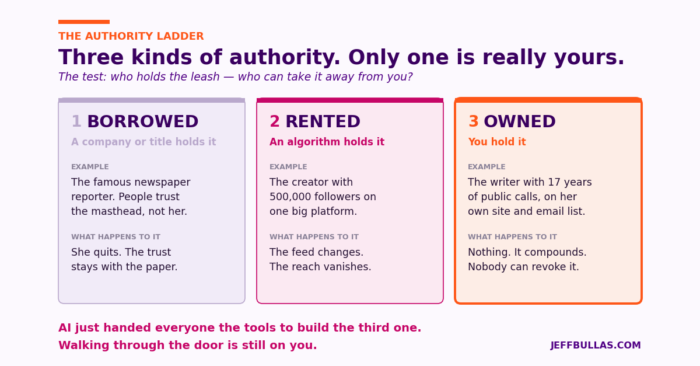
In an era where production is increasingly commoditized by AI, the true prize shifts to what cannot be easily replicated: a verifiable record of judgment that fosters trust. Authority can be categorized into three types, distinguished by who holds the ultimate control: borrowed, rented, and owned. Borrowed authority is transient and dependent on external validation. Rented authority is subject to the whims of algorithms or platforms. Owned authority, however, is built through consistent effort and intrinsic value, a form of trust that cannot be revoked.
Current societal trends, as indicated by the Edelman Trust Barometer, reveal a growing skepticism towards established institutions. A significant percentage of the global population expresses concern about deliberate misinformation from officials, business leaders, and journalists, and a perception that institutions serve narrow interests. This erosion of trust in titles and institutions necessitates a shift towards person-to-person earned authority.
The Pillars of Owned Authority
Building owned authority is a deliberate and sustained process, grounded in five fundamental pillars:
- Authenticity: Presenting a genuine self and perspective, unvarnished by pretense.
- Consistency: Regularly producing valuable content and demonstrating a reliable presence.
- Credibility: Backing assertions with evidence, expertise, and verifiable facts.
- Vulnerability: Willingness to share struggles, learn from mistakes, and admit uncertainty.
- Generosity: Providing value freely and contributing to the community without immediate expectation of return.
These pillars are not quick fixes but are cultivated through a continuous loop of engagement, learning, and sharing. The critical, often overlooked, element is the sustained commitment to this loop, which creates an authentic and defensible position of trust.
The Enduring Human Element
The author’s writing philosophy – to understand rather than to sound certain – resonates deeply in this context. Readers connect with the process of thinking, the journey of discovery, not merely a polished performance. While AI can deliver answers instantaneously, it cannot replicate a lifetime of earned judgment, developed through experience, reflection, and consistent engagement with the world.
The current landscape is characterized by accessible tools, diminished barriers, and a crowded marketplace of information. The enduring differentiator, the asset that cannot be copied, faked, or revoked, is the demonstrable trajectory of an individual who has consistently learned, taken risks, and communicated truthfully in the public sphere, thereby building irrefutable trust.
AI has opened the door for everyone, but the act of walking through it, of embracing the challenges and opportunities it presents, remains a distinctly human endeavor. The question for each individual is not what room they are currently in, but which door they are willing to step through, and what journey they are prepared to undertake on the other side.