Microsoft Unveils Dual-Front Cyber Offensive Featuring AI-Driven Financial Fraud and Sophisticated Cloud-Based Identity Hijacking

In a comprehensive security briefing released this month, Microsoft’s threat intelligence division has exposed a sophisticated dual-pronged offensive conducted by malicious actors targeting enterprise organizations. The findings detail two distinct but equally dangerous campaigns: a massive, AI-assisted financial fraud scheme designed to siphon corporate funds, and a high-stakes social engineering operation targeting cloud authentication protocols. These activities highlight an evolving threat landscape where attackers are leveraging generative artificial intelligence and psychological manipulation to bypass traditional security perimeters.
The Rise of AI-Enhanced Executive Impersonation
The first campaign, which reached a fever pitch between August 3 and August 5, 2026, saw threat actors launch a massive blast of over one million fraudulent emails. This operation was not a typical "spray-and-pray" phishing attempt; rather, it was a highly targeted, multi-layered deception campaign. By utilizing generative AI tools, the attackers successfully crafted personalized email templates and forged internal communication threads that mimicked the tone and style of high-ranking corporate executives.
The attackers systematically targeted accounts payable departments across a diverse range of sectors, including IT services, consumer goods, real estate, and manufacturing, primarily within the United States. The objective was to deceive finance personnel into authorizing Automated Clearing House (ACH) transfers under the pretense of paying for annual ServiceNow subscriptions.

To achieve this, the actors registered sophisticated impersonation domains and populated email signatures with the actual names and credentials of CEOs, CFOs, and other C-suite executives. By layering vendor branding, fabricated invoices, and simulated email correspondence, the threat actors effectively minimized suspicion among financial staff. According to Microsoft’s security researchers, the integration of these elements into a single, cohesive narrative marked a significant shift from traditional invoice scams, which often rely on a single, flimsy pretext.
Anatomy of the Cloud Identity Compromise
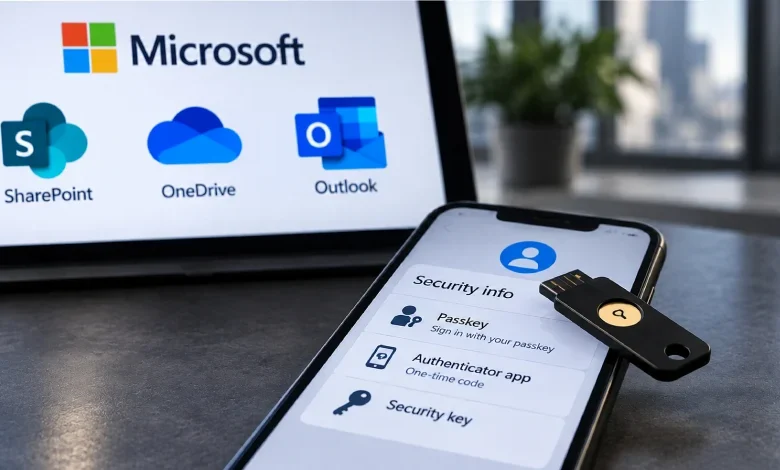
While the financial fraud campaign targeted the pocketbook, the second operation exposed by Microsoft focused on long-term persistence within cloud environments. This campaign, observed since May 2026, targets the very foundation of modern identity management: the passkey, multi-factor authentication (MFA), and single sign-on (SSO) configurations.
The attack methodology begins with identity-focused social engineering. Victims receive phone calls or text messages from individuals posing as members of their organization’s IT help desk. The attackers create an artificial sense of urgency, insisting that the user must immediately update their authentication methods to avoid a loss of system access.
Once the victim is hooked, they are directed to a counterfeit website that perfectly replicates the official Microsoft login experience. Through Adversary-in-the-Middle (AitM) techniques or the abuse of device-code authentication flows, the attackers capture sensitive tokens or trick the user into granting them access to their account. This allows the threat actors to bypass traditional security layers without necessarily needing to steal static passwords.

The Actors Behind the Intrusion: Tracking the Collective
Microsoft’s investigation suggests that the cloud-focused campaign is linked to a loose-knit cybercrime collective known by various monikers in the cybersecurity community, including Cordial Spider, O-UNC-045, PREY-0058, and most notably, UNC6671. This group has gained notoriety for operating multiple extortion brands and sharing a centralized, commoditized phishing infrastructure.
The connection between these groups is characterized by a shared playbook. By utilizing common credential-harvesting panels and pre-attack reconnaissance—often scraped from professional networking sites—the actors can tailor their attacks to specific corporate hierarchies. Microsoft has further attributed this activity to specific groups under its internal tracking system, such as Storm-3121 and Storm-3032 (the latter being the designation for the group operating under the Helix extortion brand).
The sophistication of these groups is evidenced by their post-exploitation behavior. In several instances, once initial access is gained, the threat actors prioritize "MFA persistence." They register their own phone numbers or authenticator applications as a second-factor method. This gives them a "backdoor" to the corporate account, allowing them to maintain access even if the original user resets their password.
Data Exfiltration and API Abuse
Once inside a compromised environment, the attackers do not merely sit idle. Microsoft has documented high-volume activity involving the Microsoft Graph API. By leveraging the initial access, attackers can programmatically crawl through a victim’s SharePoint and OneDrive folders, exfiltrate sensitive data, and gain visibility into internal organizational services.

The challenge, Microsoft notes, lies in the stealthy nature of these API calls. When viewed in isolation, a single request to access a file or read a mailbox may appear benign. However, when aggregated and analyzed through the lens of behavioral progression, the malicious intent becomes clear. This underscores a critical shift in defense requirements: security operations centers (SOCs) must move away from evaluating individual events and toward holistic, cross-event correlation.
Broader Implications and Defensive Strategies
The emergence of these campaigns signals a dangerous evolution in the cyber threat landscape. By combining AI-generated content with psychological manipulation, attackers are finding success even against organizations with mature security postures. The shift toward targeting "identity" rather than "credentials" represents a significant hurdle for traditional security tools.
For enterprise organizations, the implications are clear: the human element remains the most vulnerable vector. While technical controls like hardware-backed FIDO2 security keys are more resilient than traditional SMS or app-based OTPs, the social engineering tactics observed in these campaigns—specifically the "help desk" ruse—can still lead employees to authorize malicious access requests.
Industry Response and Future Outlook
Microsoft’s disclosure serves as a stark warning to the global business community. The tech giant has already taken steps to disrupt the infrastructure used by these threat actors, including the takedown of malicious domains and the blocking of known compromised accounts. However, the modular nature of these criminal groups—where affiliates can easily trade or switch between different phishing playbooks—suggests that these threats will continue to mutate.

In response to these findings, cybersecurity experts recommend a multi-tiered defensive strategy:
- Behavioral Analytics: Organizations must prioritize the monitoring of API usage, particularly with Microsoft Graph and similar cloud-based services, to detect anomalous data access patterns.
- Hardened Identity Verification: Moving toward phishing-resistant authentication, such as physical security keys, is no longer optional for high-value accounts.
- Internal Awareness: Training staff to recognize the signs of "help desk" impersonation is vital. Employees should be instructed that legitimate IT departments will rarely request a direct, off-the-cuff configuration change via a personal phone number.
- Zero-Trust Architecture: Implementing a strict zero-trust model ensures that even if an account is compromised, the attacker’s ability to move laterally across the network is severely limited.
The dual campaigns documented by Microsoft are a testament to the resourcefulness of modern cybercrime syndicates. As AI lowers the barrier to entry for crafting high-quality lures and as cloud environments become more complex to secure, the responsibility for defense falls equally on technological implementation and organizational culture. As the threat actors continue to innovate, the defensive community must likewise evolve, moving toward automated, proactive, and cross-platform threat hunting to stay ahead of the curve. The incident serves as a definitive reminder that in the age of generative AI and cloud-native attacks, the standard security perimeter is effectively a thing of the past.