AWS Announces Major Architectural Evolution for Amazon EventBridge with Enhanced Custom Event Buses Designed for Multi-Account Enterprises

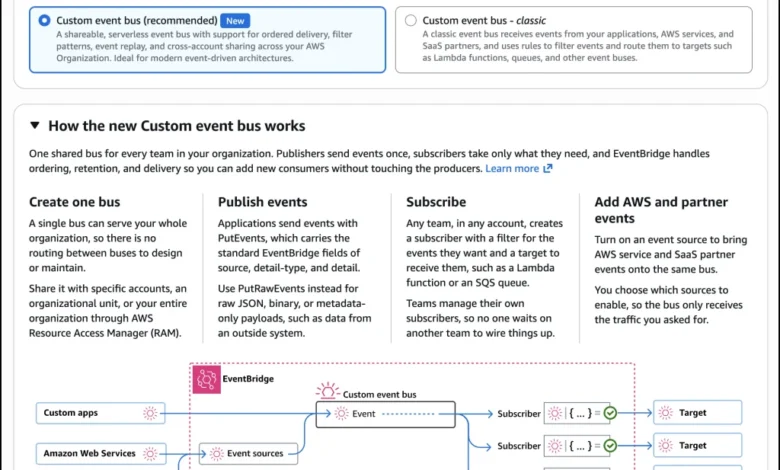
Amazon Web Services (AWS) has officially announced a significant architectural upgrade to its serverless event routing service with the introduction of the enhanced custom event bus for Amazon EventBridge. This new capability has been engineered specifically to address the complex operational challenges faced by large, multi-team enterprises scaling their event-driven architectures across numerous AWS accounts. By replacing fragmented, multi-bus topologies with a single, highly scalable, and centralized event backbone, AWS aims to eliminate the administrative overhead and compounding routing costs that have historically accompanied hyper-growth cloud deployments.
The announcement comes at a time when event-driven architectures (EDAs) have become the gold standard for building decoupled, highly responsive, and resilient microservices. However, as enterprise adoption matures, the initial simplicity of managing a single custom event bus within a solitary AWS account quickly dissipates. To comply with rigorous organizational security postures and structural best practices, companies routinely transition to multi-account frameworks where individual business units operate within isolated environments.
The Structural Challenges of Scaling Legacy Event-Driven Architectures
In the traditional operational paradigm of Amazon EventBridge, bridging the communication gap between disparate team accounts required the provisioning of multiple auxiliary event buses. These individual endpoints had to be meticulously connected using intricate webs of cross-account resource policies, IAM permissions, and bus-to-bus routing rules.
While functional, this workaround inadvertently reintroduced the exact operational friction that serverless computing was designed to eradicate. Platform engineering teams frequently found themselves grappling with diminished visibility into event governance, struggling to track precisely which downstream microservices were subscribing to specific upstream publishing patterns. Furthermore, the financial mechanics of the legacy model meant that cross-account and bus-to-bus routing charges escalated rapidly, creating budgeting hurdles for finance departments.

Compounding these economic and administrative concerns was the inherent architecture of the legacy event bus, which treated all event streams as strictly asynchronous. For specialized domains—such as financial transaction processing, supply chain logistics, and IoT fleet tracking—where the sequential delivery of payloads is paramount, engineering teams were forced to implement bespoke, brittle workarounds or resort to entirely separate messaging technologies like Amazon SQS and Apache Kafka.
Core Architectural Innovations of the Enhanced Event Bus
To resolve these longstanding friction points, the newly released enhanced custom event bus introduces several foundational capabilities designed to streamline governance, enforce sequence integrity, and optimize cloud expenditure.
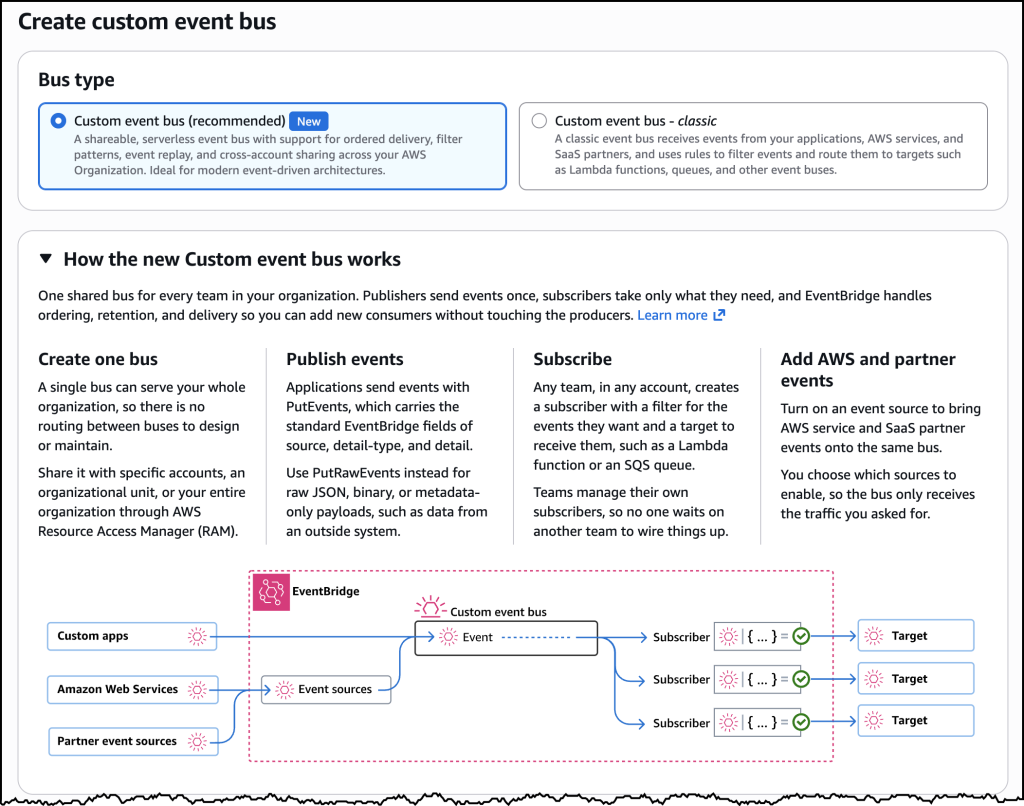
At the center of this release is organization-wide sharing, facilitated natively through AWS Resource Access Manager (AWS RAM). Rather than provisioning redundant event buses across different business units, platform operators can now deploy a single, centralized event backbone that spans the entire AWS organization. Infrastructure teams can configure resource-sharing permissions restricted specifically to designated organizational units (OUs), specific AWS accounts, or granular IAM roles and users. This integration allows application teams to publish and subscribe to a unified event stream instantly without waiting for lengthy infrastructure provisioning cycles.
Visibility and governance are vastly improved under this centralized model. Publishers can dispatch events to the shared bus without needing to maintain awareness of downstream consumer topology, while subscribers independently manage their own ingestion parameters. To accommodate large enterprises, the enhanced bus scales to support a default quota of 10,000 active subscribers per bus—a significant threshold increase designed to prevent the architectural fragmentation previously caused by strict subscriber limitations.
Solving the Event Ordering Dilemma
One of the most technically demanding requirements in distributed systems is maintaining event sequence integrity without sacrificing the horizontal scalability inherent to asynchronous architectures. While standard EDA patterns thrive on out-of-order processing, real-world applications frequently demand strict causality. For instance, in an enterprise logistics or ride-sharing ecosystem, real-time driver telemetry coordinates must be processed sequentially; an out-of-order arrival can cause spatial algorithms to calculate trajectories based on obsolete data points.

The enhanced custom event bus addresses this dual requirement by supporting both strict sequential processing and standard asynchronous delivery concurrently on the same physical bus. Publishers can attach an optional EventGroupId metadata tag to outgoing payloads. EventBridge intelligently routes all events sharing an identical EventGroupId in strict chronological sequence to subscribers configured for ordered delivery, while concurrently dispatching other asynchronous streams to remaining consumers without sequence constraints.
To ensure reliable, deterministic processing for these ordered workflows, AWS has introduced native synchronous invocation support for targets such as AWS Lambda. In synchronous mode, EventBridge waits for confirmation of successful target execution before acknowledging the event. This advancement removes the historical architectural pattern of interposing Amazon Simple Queue Service (SQS) queues between an event bus and compute functions solely to guarantee execution reliability.
Streamlined Subscriptions and Advanced Payload Management
Managing event consumption under the legacy EventBridge model required the cumbersome orchestration of multiple decoupled resources, including individual rules, target definitions, customized retry policies, and dead-letter queue (DLQ) endpoints.
The enhanced custom event bus revolutionizes this administrative workflow by introducing the unified Subscriber resource. This construct consolidates event filtering logic, target configuration, error-handling retry strategies, and DLQ destinations into a single, cohesive, and easily manageable entity. Additionally, the inclusion of variable start time parameters empowers teams to seamlessly onboard new microservices or execute historical event replays for disaster recovery and application re-hydration.
Data transformation and ingestion resilience have similarly been modernized. Publishers can now activate content-based deduplication directly within the event bus configuration. Instead of forcing upstream producers to generate and track complex idempotency tokens, EventBridge hashes the structural payload to automatically identify and discard duplicate transmissions arriving within a five-minute window. This mechanism grants those specific retry pathways true exactly-once delivery semantics, replacing the traditional at-least-once delivery model for unreliable sources.
For downstream consumers requiring specific data schemas, subscribers can leverage native JSONata expressions to reshape event payloads dynamically en route to their targets—extracting required fields, modifying property names, or computing derivative values without writing custom transformation code. Furthermore, for organizations utilizing advanced serialization formats such as Apache Avro or Protocol Buffers, EventBridge can natively deserialize these binary payloads into standard JSON. This enables subscribers to execute fine-grained filtering and routing directly against the rich internal structure of the event without necessitating upfront deserialization logic on the consumer side.
A Scalable New Economic Model
Accompanying these architectural advancements is a completely revised pricing structure tailored for enterprise-scale deployments. The enhanced custom event bus transitions away from legacy per-event pricing models, adopting an ingress and egress throughput pricing paradigm. Under this structure, publishers incur costs based strictly on the volume of events ingested, while subscribers pay for the volume of events successfully delivered.
This separation of financial responsibility improves cost allocation transparency across disparate business units and neutralizes the compounding financial penalties associated with multi-hop, cross-account routing architectures of the past. Detailed financial schedules and regional pricing tiers are publicly accessible via the official AWS EventBridge pricing documentation.
Availability and Enterprise Adoption Roadmap
AWS has confirmed that existing custom event buses will remain fully operational and will continue to receive, route, and process events without requiring any immediate modifications. In the AWS Management Console and API surfaces, these legacy environments have been systematically designated as "Custom event bus – classic," ensuring uninterrupted continuity for mission-critical workloads. Organizations can adopt the new architecture incrementally, creating enhanced custom event buses at their own operational pace.
The enhanced custom event bus is generally available starting today across a broad footprint of global AWS Regions, including US East (N. Virginia, Ohio), US West (Oregon), Europe (Ireland, Frankfurt, Stockholm, Spain), and Asia Pacific (Hong Kong, Malaysia, Mumbai, Singapore, Sydney, Thailand, Tokyo). Engineering and platform teams can provision their first enhanced event bus immediately utilizing the AWS Management Console, the AWS Command Line Interface (AWS CLI), or infrastructure-as-code automation frameworks through the standard EventBridge APIs.