The Rise of Social-First AI: Why General-Purpose Models Are Failing Modern Marketing Teams


The landscape of digital marketing is undergoing a fundamental transformation as artificial intelligence shifts from a peripheral novelty to the backbone of social media strategy. However, a significant divide has emerged between the expectations of corporate leadership and the practical realities faced by social media practitioners. Recent industry data suggests that while organizations are funneling billions into AI, the tools being deployed—often general-purpose large language models—are fundamentally ill-equipped for the hyper-fast, volatile, and context-dependent nature of social media. This gap has given rise to the concept of "social-first AI," a specialized technological approach designed to prioritize real-time data integration and platform-specific workflows over the static, lagging datasets that define traditional generative AI.

The divergence between general-purpose AI and social-first systems represents a critical inflection point for the industry. General-purpose models are typically trained on massive, static crawls of the internet, often hindered by knowledge cutoffs that leave them weeks or months behind current events. In contrast, social-first AI is engineered to operate on live, continuous data streams from social platforms. This distinction is not merely technical; it is operational. In an environment where a brand-defining trend can emerge, peak, and vanish within a 48-hour window, the latency inherent in standard AI tools effectively renders them useless for real-time engagement.
The Growing Disconnect in Marketing Leadership
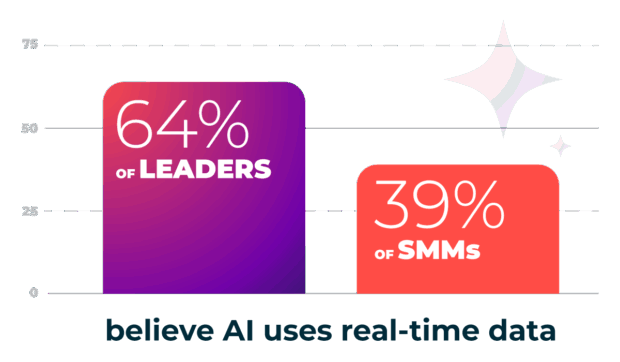
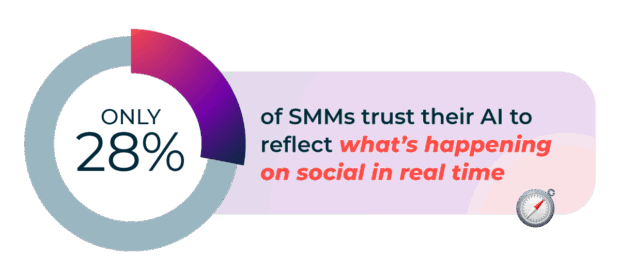
A concerning trend has materialized regarding executive perception versus operational reality. According to recent surveys, 64% of senior marketing leaders believe their current AI toolsets utilize real-time data, yet only 39% of the social media managers tasked with executing those strategies share this confidence. This 25-percentage-point gap highlights a dangerous disconnect. When leadership assumes their teams have access to real-time, actionable intelligence, but those teams are actually struggling with outdated information, the result is a strategic failure.

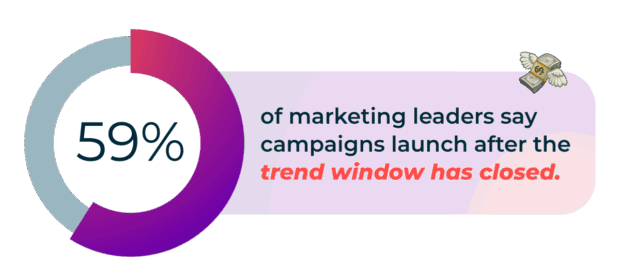
This failure manifests in the "trend window" problem. Nearly 59% of senior marketers report that their campaigns frequently go live after the relevant trend has already passed its peak. Instead of gaining a competitive advantage, teams are left creating content that feels "tone-deaf" or dated, essentially chasing ghosts of conversations that occurred days prior. This inability to move at the speed of social media creates a paradox: businesses are spending more money on AI to achieve agility, yet they are finding themselves slower and less relevant than before the adoption of these tools.
The Cost of Inefficiency and Wasted Budgets
The financial implications of this technological mismatch are profound. Recent industry reporting indicates that 40% of senior marketing executives report wasting at least 10% of their annual AI budget on tools that fail to deliver tangible results. In a fiscal environment where Chief Financial Officers are scrutinizing marketing expenditures with unprecedented rigor, these wasted budgets represent a significant risk to the credibility of social media teams.
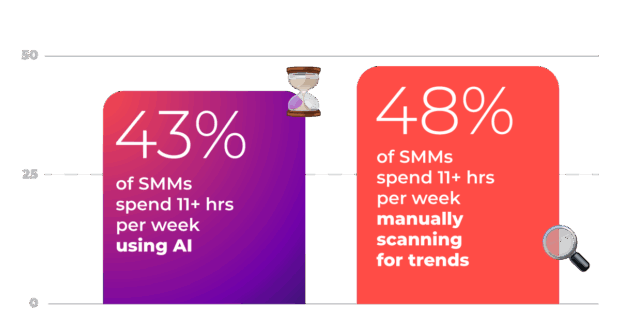
Furthermore, the promised efficiency of AI has, for many, become a time-sink. Approximately 43% of social media managers now spend upwards of 11 hours per week managing or "coaxing" content out of AI tools. This represents more than a full business day dedicated to fixing or refining outputs from systems that were ostensibly designed to eliminate manual labor. Rather than freeing up human talent for high-level creative strategy, the current generation of general-purpose AI has created a new layer of administrative burden.
Defining Social-First AI: Architecture and Capability
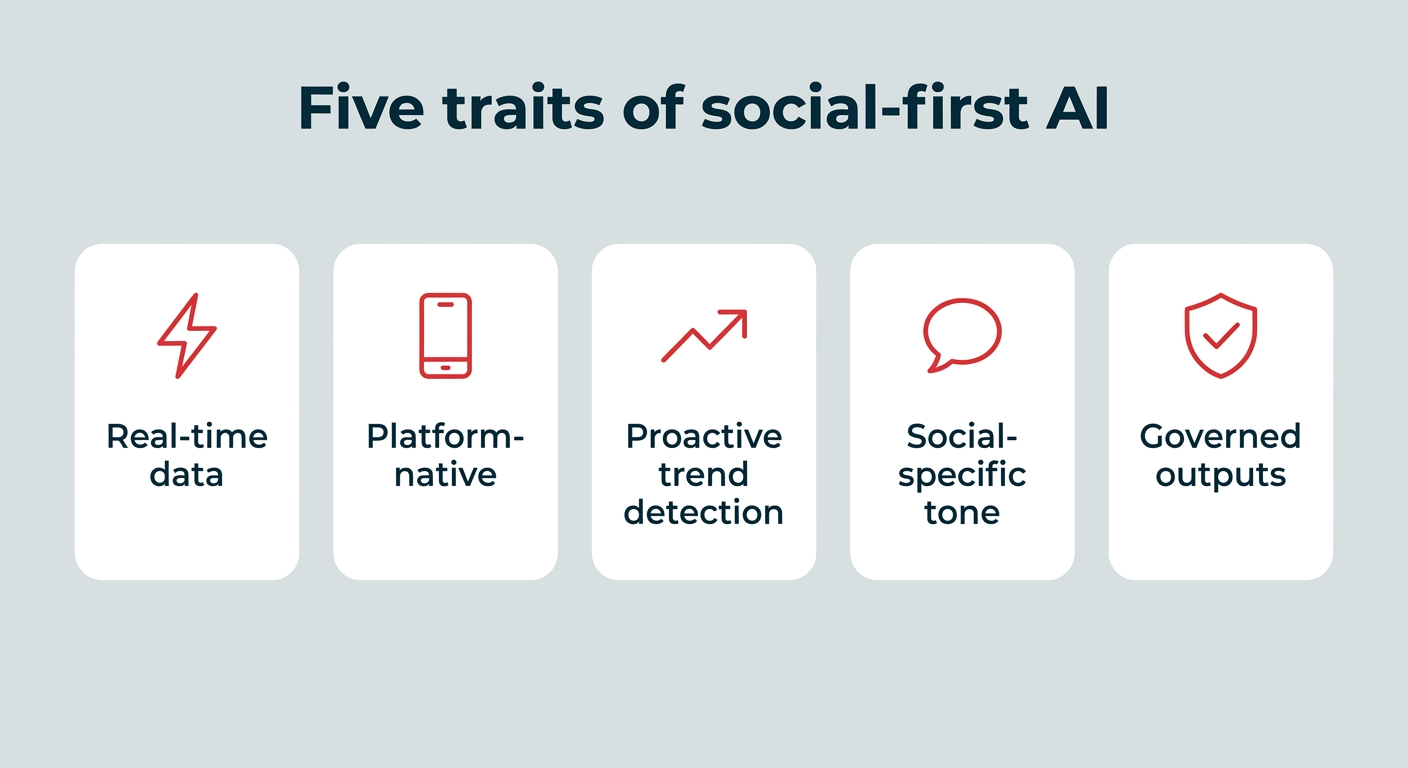
To bridge this gap, industry experts are advocating for a shift toward social-first AI, which is characterized by six core pillars: real-time data access, platform-native tone and formatting, proactive trend detection, seamless workflow integration, robust governance, and verifiable, cited sources.
Unlike general-purpose models, which treat all content as uniform, social-first AI understands the nuanced differences between platforms. It recognizes that a message that resonates on LinkedIn requires a vastly different tone and format than one intended for a TikTok audience. By grounding outputs in current, platform-specific conversations, these systems minimize the need for extensive human editing and rewriting.
Governance remains the final, critical hurdle for enterprise-level adoption. Because social-first AI operates with higher velocity, it requires embedded compliance and approval workflows. Tools such as those integrated into the Hootsuite Social OS—specifically components like "Vigil"—are designed to ensure that even at the speed of real-time intelligence, every piece of content remains within brand guidelines and legal compliance.
The Evolution Toward Agentic Workflows
As the industry moves beyond basic content generation, the focus is shifting toward "agentic workflows." In this model, AI does not simply act as a chatbot to answer prompts; it functions as an autonomous or semi-autonomous assistant configured for recurring tasks. For instance, an AI agent might be tasked with continuous competitive monitoring, sentiment analysis, or weekly performance synthesis. These agents operate in the background, surfacing insights to human teams only when they reach a threshold of significance.
This evolution is supported by the integration of Managed Component Protocol (MCP) connectors, which allow social intelligence data to flow directly into other enterprise systems. By breaking down the silos between social media dashboards and broader organizational tools, businesses can finally integrate social sentiment into their core business decisions, from product development to crisis management.
Implications for the Future of Social Media Management
The rise of social-first AI does not signal the end of the social media manager; rather, it marks the end of the "manual laborer" era of the role. By offloading the drudgery of data aggregation, trend monitoring, and basic drafting to sophisticated, specialized AI agents, practitioners can reclaim their time for the work that truly requires human judgment: creative strategy, community building, and nuanced brand positioning.
However, the burden of success now rests on the criteria used for procurement. Marketing teams must move away from "all-in-one" generalist tools that prioritize mass appeal over depth. The future of the industry belongs to platforms that can demonstrate, with evidence, that their AI is grounded in the volatile, real-time reality of the social web.
As Gartner and other industry analysts have noted, while the adoption of AI in marketing is expected to double by 2028, only about 30% of Chief Marketing Officers currently possess the organizational readiness to effectively scale these technologies. Closing this gap will require more than just increased spending; it will require a fundamental shift in how organizations define and evaluate "intelligence" in the context of their social media presence.
In summary, the transition to social-first AI is an imperative for any brand looking to remain competitive in an increasingly digital-first economy. Those that successfully pivot to systems that prioritize real-time data, platform-native understanding, and integrated governance will find themselves better positioned to capture fleeting market opportunities. Conversely, those that remain tethered to generic, lagging AI models risk not only the erosion of their marketing budgets but also the long-term dilution of their brand voice in an era where speed and authenticity are the primary currencies of the social web.