Despite pervasive anxiety regarding the health of the U.S. economy, the American consumer has not abandoned the marketplace; rather, they have fundamentally altered how they interact with it. According to Feedvisor’s 2026 Consumer Commerce Report, while 87% of surveyed consumers acknowledge that current macroeconomic conditions have significantly influenced their shopping habits, the volume of transactions remains remarkably resilient. More than half of all consumers (52%) continue to shop online on a weekly basis, and 88% engage in monthly digital commerce. The narrative, therefore, is not one of total austerity, but one of heightened diligence and strategic caution.
The data suggests a transition from impulsive consumption to calculated acquisition. Consumers are investing more time and cognitive effort into the pre-purchase phase, characterized by rigorous price comparisons and a heightened sensitivity to promotional validity. This shift is not merely a temporary reaction to inflation but appears to be a recalibration of household spending habits that marketers must now address with precision.

The Rise of the Calculated Consumer
The most significant shift in retail behavior is the increased "work" performed by consumers before finalizing a purchase. The 2026 report indicates that 45% of shoppers are comparing prices more frequently than they were a year ago, while 41% are actively delaying purchases to wait for specific sales events. Furthermore, 31% of respondents have increased their reliance on coupons, cashback programs, and loyalty incentives.
This behavior is rooted in a desire for empirical verification. For those engaging in frequent price comparisons, nearly 50% verify prices across at least three different retailers before completing a transaction. This "verification loop" signifies a loss of brand loyalty in favor of value assurance. If a consumer cannot find immediate, verifiable proof that a purchase is financially sound, they are increasingly likely to abandon the cart or switch to a competitor that provides more transparent pricing.
Resilience of the "Small Treat" Economy
Financial pressure has not resulted in a total abandonment of discretionary spending. On the contrary, the "small treats" phenomenon—a consumer trend where individuals make modest, frequent purchases to improve their mood—remains a pillar of modern retail. Data shows that 56% of consumers purchase non-essential items to boost their spirits at least once a month, with 34% doing so on a weekly or more frequent basis.

These purchases are typically concentrated in sectors such as apparel, grocery, and beauty. Crucially, these are "bounded" expenditures; 44% of these mood-lifting purchases are capped between $10 and $20. This indicates that while consumers are limiting their total financial exposure, they are not willing to sacrifice the psychological benefits of minor retail therapy.
For brands, this represents an opportunity, provided they can align their offerings with these specific price thresholds. The consumer is seeking value through a combination of emotional gratification and convenience, but they are applying a rigid boundary to the total cost. Marketers who can position products as accessible, low-risk rewards are finding more success than those attempting to drive larger, high-ticket sales.
The Erosion of Trust in Promotional Events
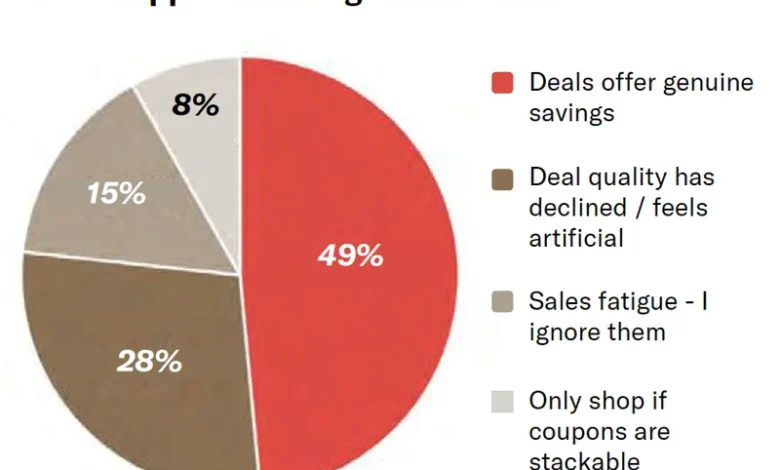
Perhaps the most challenging trend for retailers is the growing skepticism surrounding major sales events. Traditionally, events like Amazon’s Prime Day or the Black Friday season were seen as guaranteed opportunities for savings. However, the 2026 report reveals that only 49% of consumers believe these events offer genuine discounts.

A significant 28% of shoppers expressed the belief that the quality of these deals has declined or feels artificial, while 15% reported feeling "sale fatigue," leading them to ignore promotional messaging entirely. This skepticism is not uniform across demographics. Younger consumers (ages 18–29) are more vocal about the perceived lack of quality, with 38% noting that deals feel manufactured. In contrast, older consumers (ages 65 and older) are less concerned with the "quality" of the deal and more likely to disengage from the sales cycle altogether.
The implication for the retail industry is profound: the "biggest sale of the year" marketing trope has lost its potency through overexposure. Consumers are no longer taking the bait on volume-based promotional noise. They require proof of price history and clear evidence that a discount is legitimate. A "louder" discount is no longer a viable substitute for a transparent one.
AI as the New Analytical Assistant
To manage the complexities of modern price comparison and deal hunting, consumers are increasingly turning to Artificial Intelligence. The 2026 data shows that 55% of consumers have utilized AI tools to research or compare products within the last six months.

The primary use case for AI in this context is the automation of tedious tasks. Specifically, 39% of consumers want AI to identify the lowest possible price, 31% use it to compare product specifications, 27% seek out coupons, and 26% rely on AI to track price fluctuations over time.
However, there is a clear limit to this reliance. While consumers are happy to use AI for the "homework" of shopping, they are overwhelmingly resistant to ceding the final decision to a machine. Approximately 62% of shoppers state they would never trust an autonomous agent to finalize a transaction and process a payment without a manual checkout phase.
This human-in-the-loop behavior is consistent with the broader consumer trend: shoppers want assistance in verifying their work, but they insist on maintaining final agency. AI is acting as a tool for validation rather than a tool for automation. Consequently, brands must ensure that the output of their AI interfaces is backed by the same level of quality in their core retail elements: pricing, review transparency, shipping logistics, and product documentation.

Holiday Shopping: A Fragmented Landscape
The upcoming holiday season presents a complex, fragmented picture. At the national level, spending expectations appear stable, with 31% of consumers planning to spend more than last year, 33% planning to spend less, and 37% intending to maintain their current levels.
However, these averages obscure significant disparities between demographic and income groups. Households earning over $150,000 are notably more bullish, with 43% planning to increase their holiday spending. Conversely, lower-income households (earning less than $25,000) are more polarized, with 26% planning significant cuts while 22% intend to increase spending, reflecting a volatile segment that is sensitive to immediate financial shifts.
Furthermore, the "holiday shopping season" has effectively ceased to be a Q4 event. Sixty percent of consumers now initiate their holiday shopping before the end of October, while only 11% wait until December. This trend toward early shopping suggests that retailers must adjust their inventory management and marketing cadences much earlier in the year. The traditional "Black Friday rush" is becoming an artifact of the past, replaced by a prolonged, multi-month period of incremental shopping.

Strategic Implications for Retailers
The current retail environment is defined by a shift from brand-led demand to value-led verification. Consumers are not just buying products; they are buying the confidence that they have made the best possible financial decision.
For brands and retailers, the path forward requires a three-pronged strategy:
- Radical Transparency: Since consumers are skeptical of promotional events, retailers must provide clear, accessible data on pricing history and the legitimacy of discounts. Misleading "original" prices will likely alienate a significant portion of the base.
- AI Integration as a Support Tool: Retailers should invest in AI tools that assist the consumer’s research process—price tracking, feature comparison, and discount aggregation—rather than attempting to push autonomous purchasing agents that shoppers are not yet ready to trust.
- Targeted Personalization: Because the "national average" of consumer behavior is becoming less relevant, brands must segment their marketing based on income and age. The motivations of an 18-year-old shopper are fundamentally different from those of a retiree, and treating the market as a monolith is a strategic error.
In conclusion, while the macro-economic environment remains a source of concern for many, the American retail sector is not facing a collapse. Instead, it is navigating a period of evolution where the consumer has become more informed, more skeptical, and more technologically equipped than ever before. Success in this environment will belong to the brands that prioritize the consumer’s need for certainty and convenience over the traditional, high-pressure promotional tactics of the past.