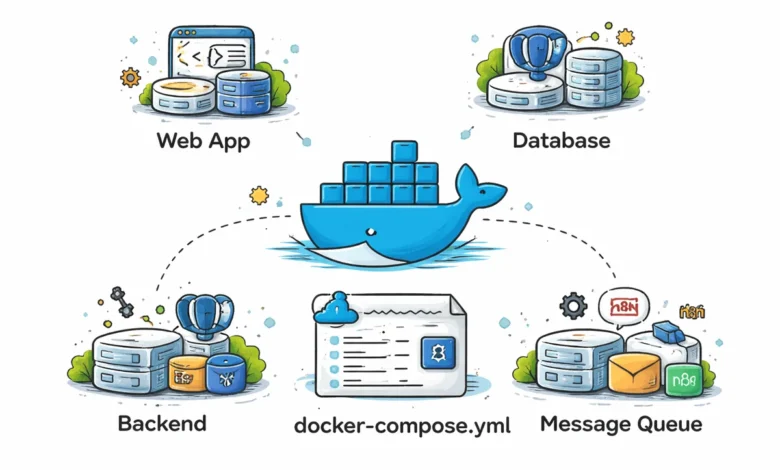
The software development landscape in 2024 is increasingly defined by the transition from monolithic architectures to containerized microservices, a shift that has placed Docker and its orchestration tool, Docker Compose, at the center of the modern DevOps toolkit. As organizations seek to minimize the "it works on my machine" phenomenon, the adoption of standardized configuration templates has become a strategic necessity for engineering teams aiming for rapid deployment and environment parity. Docker Compose, which allows developers to define multi-container applications using a single YAML file, has evolved from a convenience tool into a foundational pillar of the Software Development Lifecycle (SDLC). By encapsulating dependencies, databases, and application logic into portable units, these templates provide a blueprint for consistency across local development, staging, and production environments.
The Evolution of Container Orchestration and Local Development
The history of Docker Compose traces back to "Fig," an independent tool later acquired by Docker and integrated into its core ecosystem. Over the past decade, the project has transitioned from the Python-based V1 to the Go-based V2, which is now integrated directly into the Docker CLI. This evolution reflects a broader industry trend: the democratization of infrastructure as code (IaC). According to recent industry surveys, over 70% of developers now utilize containerization in some capacity, with Docker Compose serving as the primary entry point for managing multi-service stacks without the overhead of Kubernetes.
The primary challenge for contemporary developers is no longer just writing code, but managing the complex web of auxiliary services—databases, message brokers, caching layers, and AI engines—that modern applications require. The following seven templates represent the most critical configurations currently used to streamline this process, offering a mix of legacy stability and cutting-edge innovation.
1. Enterprise CMS Workflows: The WordPress Ecosystem
WordPress remains a dominant force in the digital economy, powering approximately 43% of all websites globally as of early 2024. However, the complexity of modern WordPress development, which often requires specific PHP versions, database configurations, and command-line tools, has historically created friction. The standardized Docker Compose template for WordPress addresses this by bundling the core application with a MySQL or MariaDB database and the WordPress Command Line Interface (WP-CLI).
Industry analysts note that containerizing WordPress allows agencies to manage dozens of client projects with varying requirements on a single machine without dependency conflicts. The inclusion of phpMyAdmin in these templates provides a visual interface for database management, which remains a preference for many full-stack developers. By using this template, developers can mirror production environments locally, ensuring that plugin updates and theme modifications are tested against the exact architecture they will encounter upon deployment.
2. Modern Full-Stack Architectures: Next.js and the Self-Hosting Movement
Next.js has emerged as the premier framework for React-based applications, favored for its Server-Side Rendering (SSR) and Incremental Static Regeneration (ISR) capabilities. While platforms like Vercel offer seamless deployment, there is a growing movement toward self-hosting to maintain data sovereignty and reduce long-term infrastructure costs. The Next.js Docker Compose template is designed for this purpose, integrating the application with a PostgreSQL database and an Nginx reverse proxy.
This template is particularly significant because it addresses the complexities of caching and environment variable management in a containerized environment. As enterprise-grade Next.js applications grow, the need for a robust database like PostgreSQL becomes paramount. The template provides a production-ready structure that includes health checks and volume persistence, ensuring that data survives container restarts—a critical requirement for any stateful application.
3. Data Management and Persistence: PostgreSQL with pgAdmin
Relational databases continue to be the backbone of enterprise data strategy. PostgreSQL, often cited as the world’s most advanced open-source database, has seen a surge in popularity due to its extensibility and support for JSONB data types. The PostgreSQL and pgAdmin Docker Compose template simplifies what was once a tedious installation process into a single command.
For data scientists and backend engineers, this template provides an immediate, isolated environment for schema design and query optimization. The inclusion of pgAdmin, a web-based administration tool, allows for visual data inspection and management. This setup is frequently used in educational settings and rapid prototyping, where the ability to tear down and rebuild a database in seconds is a major competitive advantage. Statistical data from developer forums suggests that PostgreSQL has become the preferred choice for new projects, surpassing MySQL in many developer preference surveys conducted in 2023.
4. Robust Backend Engineering: The Django and Celery Stack
Python’s dominance in both web development and artificial intelligence has kept the Django framework at the forefront of the industry. However, Django’s "batteries-included" philosophy often necessitates additional services for production-grade features, such as Redis for caching and Celery for asynchronous task processing.
The Django Docker Compose template is an essential tool for developers building complex applications that require background processing—such as sending emails, processing images, or running machine learning inference. By orchestrating Django, PostgreSQL, Redis, and Celery workers together, this template provides a comprehensive environment that mimics high-traffic production systems. This approach allows developers to debug race conditions and task queue bottlenecks locally, significantly reducing the time-to-market for enterprise applications.
5. Real-Time Data Streaming: Apache Kafka and the Event-Driven Shift
As businesses move toward real-time analytics, event-driven architecture (EDA) has become a standard. Apache Kafka is the industry standard for distributed event streaming, but its local setup is notoriously difficult due to its dependency on Zookeeper (though the industry is transitioning to KRaft) and various management proxies.
The Kafka Docker Compose template provides a modular stack that includes Kafka, Zookeeper, and management interfaces like Conduktor. This allows developers to simulate complex data pipelines on a laptop. Market trends indicate that skills in Kafka and real-time processing are among the highest-paid in the DevOps and Data Engineering sectors. Providing a standardized template for this stack lowers the barrier to entry for developers looking to master stream processing, enabling them to build and test producers and consumers in a controlled environment.
6. The Low-Code and AI Integration: n8n and Self-Hosted Automation
The rise of AI has led to a surge in demand for workflow automation. n8n, an extendable workflow automation tool, has gained traction as a self-hosted alternative to Zapier. The n8n AI Docker Compose template is a specialized configuration that bundles n8n with vector databases like Qdrant and local AI engines like Ollama.
This template represents a shift toward "local-first" AI development. Privacy-conscious organizations are increasingly hesitant to send proprietary data to third-party LLM providers. By hosting the entire automation and AI stack locally via Docker Compose, developers can build AI agents and retrieval-augmented generation (RAG) pipelines that never leave their infrastructure. This configuration is particularly relevant for the financial and healthcare sectors, where data security regulations are stringent.
7. The Democratization of Large Language Models: Ollama and Open WebUI
The final template in this collection highlights the most significant trend of the past two years: the local execution of Large Language Models (LLMs). The Ollama and Open WebUI Docker Compose setup allows developers to run models like Llama 3, Mistral, and Gemma on their own hardware.
This template integrates Ollama (the model runner) with a sophisticated web interface and LiteLLM for API compatibility. The implications are profound: developers can now build and test AI-powered features without incurring API costs or worrying about internet connectivity. As hardware acceleration for containers (such as NVIDIA Container Toolkit) becomes more stable, the performance of these local AI stacks has reached a level where they can be used for daily development tasks, code generation, and automated testing.
Impact on Developer Productivity and DevOps Standards
The widespread adoption of these templates has several measurable impacts on the technology sector. First, "onboarding time" for new developers has been drastically reduced. In traditional environments, setting up a local development stack could take days; with Docker Compose templates, it takes minutes. Second, these templates promote "Shift Left" security and testing. By running the full stack locally, developers can identify security vulnerabilities and performance bottlenecks earlier in the development cycle.
From a management perspective, standardized templates reduce "architectural drift." When every developer on a team uses the same Docker Compose file, the likelihood of environment-specific bugs reaching production is significantly diminished. This standardization is a key metric in the DORA (DevOps Research and Assessment) reports, which link high-performing engineering cultures to the use of consistent, automated environments.
Conclusion and Future Outlook
The use of Docker Compose templates is more than a technical convenience; it is a reflection of the industry’s move toward modularity, portability, and automation. As we look toward the future, we can expect these templates to become even more integrated with cloud-native technologies. The transition from Docker Compose to Kubernetes (via tools like Kompose) is already a well-trodden path for scaling applications.
The seven templates discussed—ranging from the foundational WordPress and PostgreSQL setups to the cutting-edge local AI and Kafka stacks—provide a comprehensive toolkit for the modern developer. By leveraging these proven configurations, developers can bypass the tedious aspects of infrastructure setup and focus on their core mission: building innovative software that solves real-world problems. In an era where speed and reliability are the primary currencies of the tech industry, the Docker Compose template remains one of the most valuable assets in a programmer’s arsenal.